

Soiling is one of the largest drags on solar output. The IEA Photovoltaic Power Systems Programme estimates that dust and snow on PV systems cost about 3% to 5% of annual energy production worldwide. For Ventura and Santa Barbara homeowners, cleaning pays off when the value of the recovered energy exceeds the cost of the cleaning, not merely because the glass looks dirty.
That distinction matters along the coast. Salt air can leave a thin film on the glass, while inland Santa Ana winds carry dry dust, pollen, and grit onto exposed arrays. The right solar panel cleaning system responds to the type of residue, the roof access, the water quality, and the output data from your inverter, rather than a generic calendar.
Table of Contents
- What a Solar Panel Cleaning System Actually Does
- The Four Main Cleaning Methods Compared
- How Soiling Quietly Drains Your Panel Output
- Setting a Cleaning Schedule That Fits Your Location
- Common Myths About Cleaning Solar Panels
- When a Professional Service Pays for Itself
- Safety, Warranty, and Final Decision Checklist
- Frequently Asked Questions
What a Solar Panel Cleaning System Actually Does
A solar panel cleaning system combines hardware, water, and technique to remove buildup from the glass without scratching it or damaging its coating. The objective isn’t a polished-looking roof. It’s to restore the light reaching the photovoltaic cells and recover the energy that soiling has blocked.
The stakes are real. The IEA PVPS report on soiling losses ranks soiling as the single most influential factor in PV system yield after sunlight itself, at an estimated 3% to 5% of annual production. Dusty regions fare much worse. Research from the National Renewable Energy Laboratory (NREL, now the National Laboratory of the Rockies) puts annual soiling losses at as much as 7% in parts of the United States and as high as 50% in the Middle East.
Match the method to the residue
Salt aerosol behaves differently from loose inland dust. Coastal residue can dry into a haze, especially when mixed with moisture, sprinkler overspray, or organic matter. Pollen can cling to that film, while bird droppings create concentrated spots that need soaking rather than aggressive scrubbing.
A useful system therefore has three working parts:
- Hardware: Soft brushes, telescoping poles, hose controls, or robotics reach the array without anyone standing on it.
- Water source: Tap water can rinse loose dirt, but the minerals it leaves as it dries can spot the glass. First Solar’s module cleaning guidelines say reverse-osmosis water gives the best results and that hard water must be squeegeed off to prevent scale buildup.
- Technique: Gentle agitation, controlled rinsing, and a sensible schedule remove both loose and bonded grime.
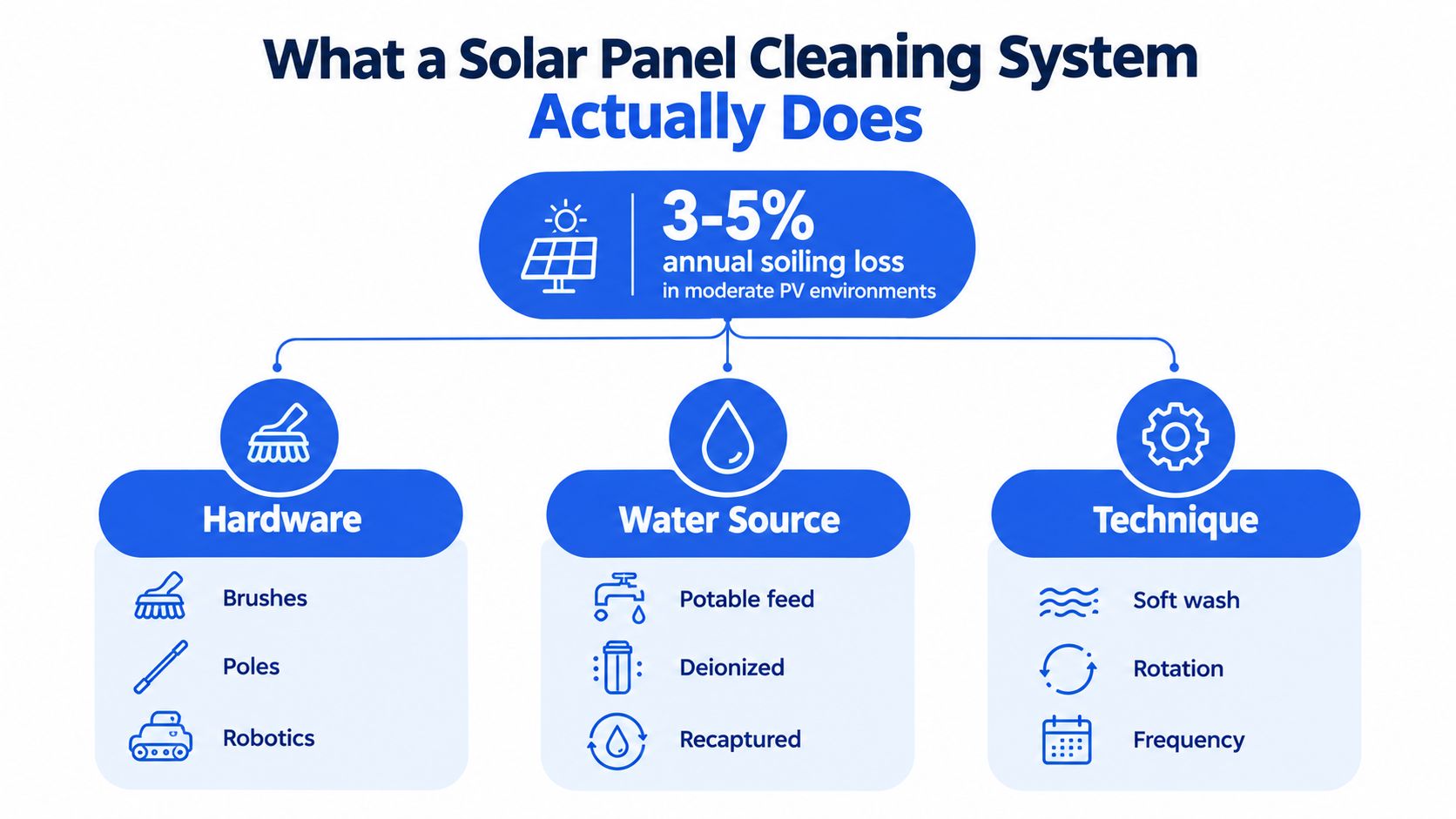
The four practical method families are manual brush and hose cleaning, purified water-fed poles, automated robotic units, and professional purified-water service. For most residential rooftops in this region, purified water delivered through a soft water-fed pole is the sensible starting point. It works from the ground, keeps weight off the array, and dries without the mineral film that tap water can leave behind.
The Four Main Cleaning Methods Compared
A cleaning method earns its place when the recovered energy and reduced risk justify its cost. Choose for the residue on your roof, not for the lowest equipment price.
| Method | Typical Cost | Best For | Coastal Suitability |
|---|---|---|---|
| Manual brush and garden hose | Lowest equipment cost | Ground-mounted arrays, loose pollen, light dust | Acceptable for rinsing, weak against bonded salt and mineral spotting |
| Purified water-fed pole with soft brush | Moderate service or equipment cost | One- and two-story homes, routine residential cleaning | Strong choice for salt haze and routine coastal maintenance |
| Automated robotic cleaner | Higher upfront equipment cost | Large, hard-to-reach, or very frequently cleaned arrays | Useful where repeated roof access is difficult, but unnecessary for many small homes |
| Professional purified-water service | Per-visit service fee | Heavy salt film, hard-water spotting, steep or tall roofs | Appropriate for stubborn deposits when the crew uses low-pressure, solar-safe methods |
Manual brush and hose
A soft brush and a gentle hose handle loose pollen and dry dust, especially on ground-mounted panels. They are a weaker match for bonded coastal residue, and hard tap water can leave mineral spots that form a fresh film after the dirt is gone.
Keep the force low. First Solar’s guidelines tell owners not to use abrasive cleaners or degreasers and not to spray pressurized water directly at the junction box, edge seals, or connectors.
Purified water-fed poles
For most one- and two-story homes, this is the method we recommend first. A telescoping pole keeps the technician on the ground, a soft brush loosens residue, and purified water rinses it away without the mineral marks common with untreated tap water. It also keeps weight off the glass: REC’s solar panel installation manual tells owners not to stand or walk on panels, and not to lean on them or rest buckets on them while cleaning.
Our explainer on how a water-fed pole system works covers the purification and rinse in detail, and our guide to choosing a solar panel cleaning brush and pole compares equipment types and pole reach.
Robotic units
Robotic cleaners travel across the array using battery power, water, or both. They suit large installations, difficult roof geometry, and sites that need very frequent cleaning. NREL notes that brush robots used in the Middle East keep panels clean and prevent cemented dust, but only when they run every day or every other day.
For a typical home system, the price and setup can outweigh the benefit. Check the warranty before buying: First Solar, for example, requires its own review and approval of automated or motorized cleaning tools to keep warranty coverage. Also confirm panel compatibility, edge coverage, and performance against bird droppings and bonded salt.
Professional purified-water service
A professional crew fits heavy contamination, hard-water spotting, and arrays that are tall, steep, or spread over several roof planes. First Solar’s guidelines say only trained personnel who understand the risks of applying water to electrical components should clean modules, and they point owners to professional cleaning services for hire.
In Ventura and Santa Barbara, start with purified water and soft agitation for routine salt haze. Escalate to professional service when deposits have bonded, spotting has built up, or the roof itself is the hazard.
How Soiling Quietly Drains Your Panel Output
The loss begins at the glass, not the inverter. A film of salt and dust reduces the light entering the cells, the inverter reports less power, and your bill credits or export value shrink.
A useful way to frame the problem is recovered energy per cleaning dollar. Cleaning isn’t valuable because someone spent time on the roof. It’s valuable when removing the film produces enough additional generation to justify the visit.
The same NREL research shows the trade-off at utility scale. A one-time cleaning of a 10-megawatt solar farm can cost an estimated $5,000, so operators weigh the energy they lose against what it costs to clean. NREL senior scientist Lin Simpson notes that in places such as California’s Central Valley, where soiling rates are high and rain is low, it makes economic sense to clean more than once a year. Those figures don’t set a Ventura rooftop schedule, but they show why local dust and rainfall control the economics.
Use a simple break-even test
Track three things:
- Expected production: Use the inverter app and compare similar weather periods.
- Cleaning result: Record output before and after service, allowing for cloud cover and normal daily variation.
- Energy value: Apply your current avoided-purchase or export value to the recovered kilowatt-hours.
The important variable is local soiling. A coastal array with persistent salt haze may justify service sooner than an inland array whose loose dust clears in the rain. Compare the cleaning cost with the value of recovered generation, not with a cosmetic standard.
Setting a Cleaning Schedule That Fits Your Location
An unexplained drop in production, compared with a similar stretch of weather, can justify an inspection, but it does not prove dirt is the cause. Check shading, equipment, and the glass before paying for service.
Location decides when cleaning reaches break-even. Near the Ventura or Santa Barbara coast, salt aerosol, marine moisture, and bird residue can bond to the glass. Inland valleys and foothills collect dry dust, pollen, and windblown grit, especially after Santa Ana conditions. Tilt matters too: REC’s manual notes that normal rainfall cleans panels installed at a sufficient angle, and that the lower the angle, the more cleaning is required.
| Location Profile | Primary Soiling | When to Inspect |
|---|---|---|
| Near the Ventura or Santa Barbara coastline | Salt aerosol, marine film, bird residue | After strong wind or coastal storms, and whenever the glass shows an even haze |
| Inland valleys and foothills | Dry dust, pollen, windblown grit | After Santa Ana winds, and more often near construction or agricultural activity |
| Areas exposed to repeated dust events | Fine dust and ash-like particulate | After Santa Ana winds, wildfire smoke, or heavy pollen |
| Homes with nearby trees or nesting activity | Organic debris and droppings | After seasonal debris or nesting activity |
For starting intervals, our guide to how often solar panels should be cleaned breaks the schedule down by coastal, inland, and foothill exposure. Treat those intervals as a starting calendar, then adjust them for your microclimate and monitoring results.
Use monitoring to test the schedule
Your inverter app should trigger an inspection, not dictate a cleaning appointment by itself. Compare output before and after service while allowing for cloud cover and normal daily variation. Then apply your current avoided-purchase or export value to the recovered kilowatt-hours. If the value of that recovered generation does not exceed the cleaning cost, the service has not reached break-even.
Practical rule: Check the glass first, then check the inverter, shade, and weather before paying for a cleaning.
Where you can, schedule service ahead of the long days of late spring and summer. The right interval is the one that removes measurable residue before its energy cost outweighs the price of a cleaning.
Common Myths About Cleaning Solar Panels
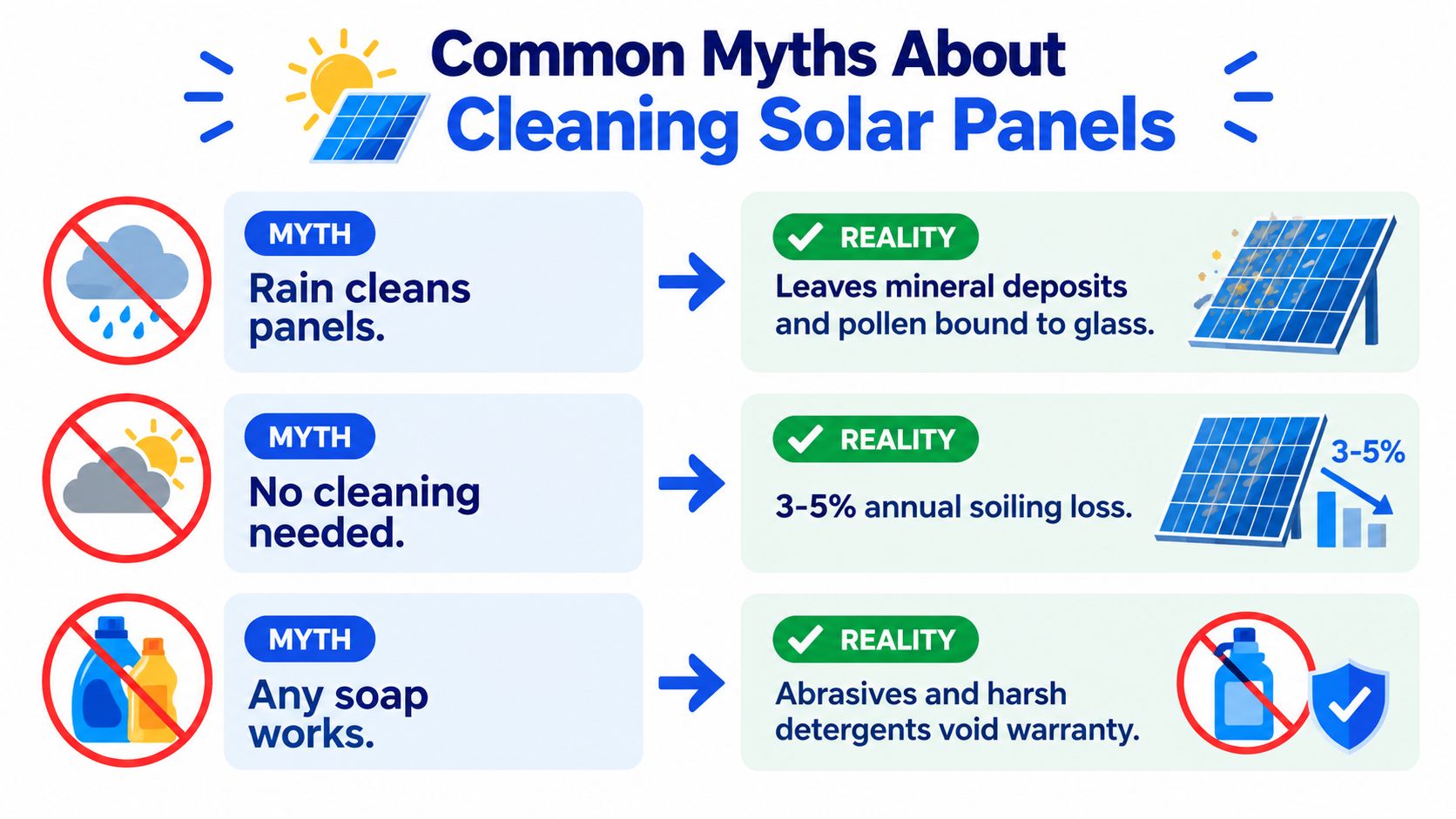
Myth one, rain cleans the array
Rain rinses loose dust, but it does not reliably clean an array. NREL researchers found that because panels cool at night and attract morning dew, dust can go through cementation, bonding to the glass until even a strong rain won’t remove it. An NREL study in Denver also found that rain washed away most coarse particles but not the fine ones, which tended to stick to the surface.
Rain’s limits show up in the numbers. A 2025 study of soiling losses across Europe in the journal Renewable Energy put the average annual loss at 0.9% if rain were a perfect cleaner, rising to 5.3% if rain removed only 10% of the dirt.
Inspect the surface after a storm. A dull film means the rain changed the appearance, not the underlying soiling.
Myth two, new panels do not need maintenance
Coatings help, but they don’t make cleaning unnecessary. NREL explains that a hydrophobic, water-repelling coating lets dew or rain run off and carry dust with it when a panel is steep enough, but that the approach does not work on panels that sit nearly horizontal. New or old, every array collects dust, pollen, salt, and droppings, which is why the IEA’s 3% to 5% estimate applies to PV systems in general.
Myth three, more pressure means a better clean
Pressure washers are the wrong tool for residential arrays. REC’s manual does not permit high-pressure hoses or cleaners because they may damage the panels, laminate, or cells. First Solar caps water pressure at 500 psi at the nozzle and warns against spraying pressurized water directly at junction boxes, edge seals, and connectors. Gentle water flow and a soft brush remove contamination without that risk.
Myth four, soap is always helpful
Soap is optional, not the main event. REC calls for deionized water with a sponge, microfiber cloth, or soft brush, allows a mild, biodegradable washing-up liquid only for further cleaning, and does not allow acidic or alkaline detergents. First Solar similarly allows only a mild, non-abrasive, non-caustic detergent and rules out degreasers and solutions containing ammonia, hydrochloric acid, D-limonene, or sodium hydroxide. Whatever you use, REC’s instruction is to rinse the panel with plenty of water.
The rule is simple. Use enough agitation to lift the residue, but not enough force to damage the surface. A panel covered in mineral spots is not clean, even if it looks bright from the driveway. Judge the result by the glass condition and whether cleaning restores measurable output, not by suds or shine.
When a Professional Service Pays for Itself
A professional cleaning pays for itself when the recovered generation, avoided roof risk, or better water quality outweighs the fee. Light dust on a panel you can reach safely rarely justifies a service call. Salt film on a hard-to-reach array can.
The access decision is usually straightforward. A one- or two-story home may be serviceable from the ground with an extendable pole and purified water. Clay tile, standing-seam metal, steep composition roofs, raised sections, and awkward edges raise the risk and favor a trained crew. A professional can also check whether residue, bird droppings, or ash is limiting output rather than merely dulling the glass.
Three situations favor professional cleaning
- Unsafe access: If you cannot keep stable footing and controlled reach from the ground, hire the work instead of improvising on the roof.
- Persistent spotting: If tap water leaves mineral film, purified water and soft tools can remove it without abrasive scrubbing.
- A large or complicated array: Multiple roof planes, difficult edges, optimizers, and microinverters make controlled access and output verification more valuable.
Request a quote that names the water treatment, brush type, access method, and whether the crew records inverter readings before and after service. Ask how the operator protects tile, gutters, flashing, wiring, and junction areas. A low fee is false economy if poor technique causes damage or a warranty dispute.
Our solar panel cleaning service uses purified water and soft tools, with no pressure washing and no chemicals, and ends with a final check that every panel is clear.
Ask before booking: Will the crew use purified water, avoid pressure washing, stay off the modules, and explain what they found?
If the array is safely reachable from the ground and only lightly dusty, occasional DIY cleaning is the better choice. Judge the decision by local residue and recovered output, not cosmetic shine.
Safety, Warranty, and Final Decision Checklist
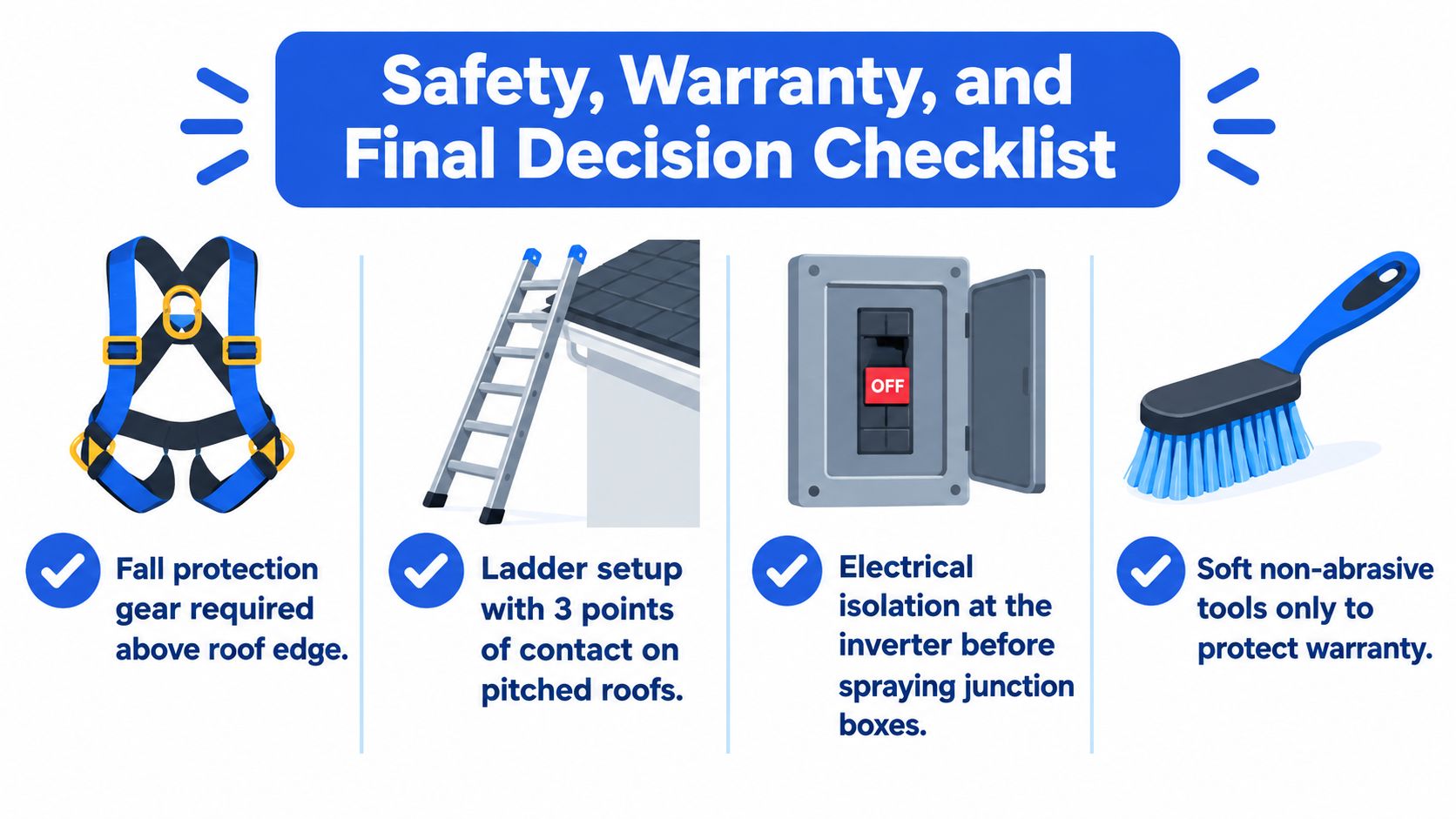
Treat the array as energized electrical equipment on a roof. First Solar’s guidelines warn that the voltage and current in an array during daylight hours are enough to cause a lethal shock, and that cracked modules become a greater shock hazard when wet, so inspect for cracks, damage, and loose connections before any water goes on. Follow your inverter and panel maker’s shutdown instructions, and keep water away from junction boxes, cable connectors, and the inverter.
Use this decision checklist:
- Fall protection: Do not climb a pitched roof without suitable protection, stable access, and the skill to use it.
- Ladder setup: OSHA’s portable ladder safety guidance calls for three points of contact while climbing, and says an extension ladder used to reach an elevated surface must extend at least 3 feet above the point of support. If the ladder position is awkward, hire the work.
- Timing: Clean when the panels are cool, such as early morning. REC warns that cleaning hot panels risks breakage through thermal shock.
- Surface protection: Use soft, non-abrasive brushes and purified water. Skip pressure washers, rough pads, and harsh detergents.
- Warranty terms: Check the module maker’s cleaning and pressure requirements before service.
- Access hardware: Take extra care around optimizers, microinverters, wiring, flashing, and gutters.
- Water quality: Mineral film left by hard tap water can undo the cleaning. Use purified water for the final rinse.
- Output check: Compare inverter or monitoring readings before and after service when possible.
Choose DIY when the array is safely reachable from the ground or a secure access point, residue is light, and your water will not leave mineral spots. Choose occasional professional cleaning when coastal salt or hard-water film appears and access remains straightforward. Choose routine service for steep, tall, fragile, or difficult arrays, especially when monitoring shows unexplained output decline.
If you go the DIY route, our step-by-step guide to cleaning rooftop solar panels, from tool and safety checks to the final rinse, walks through the full process.
Frequently Asked Questions
Is Dawn soap safe for solar panels?
Some panel makers allow a small amount of mild soap, but neither of the manufacturer guides cited here names a brand. REC permits a mild, biodegradable washing-up liquid for further cleaning after deionized water, and First Solar allows a mild, non-abrasive, non-caustic detergent. Both rule out harsher chemistry, and REC says to rinse with plenty of water. Check your own panel manual first, because cleaning rules vary by manufacturer and can affect the warranty.
What should you not clean solar panels with?
Skip pressure washers, abrasive pads, and harsh chemicals. REC does not permit high-pressure hoses or cleaners and does not allow acidic or alkaline detergents. First Solar rules out abrasive cleaners, degreasers, and solutions containing ammonia, hydrochloric acid, D-limonene, or sodium hydroxide, and caps water pressure at 500 psi at the nozzle. Hard tap water is also a poor final rinse, because the minerals it leaves behind can spot the glass as it dries.
Do robotic solar panel cleaners work on home roofs?
They can, but they are built mainly for large arrays that need very frequent cleaning. NREL notes that brush robots used in the Middle East keep panels clean and prevent cemented dust when they run every day or every other day. On a home roof, check the warranty first: First Solar requires its own approval of automated or motorized cleaning tools for warranty coverage. For most small arrays, a soft brush on a water-fed pole is simpler.
How often should solar panels be cleaned in coastal California?
There is no single interval. Soiling depends on salt air, dust, pollen, rainfall, and panel tilt, and REC notes that the lower the installation angle, the more cleaning panels need. NREL points out that in low-rain, high-soiling parts of California such as the Central Valley, cleaning more than once a year makes economic sense. Inspect after wind, storms, and smoke, and use your inverter data to confirm whether a cleaning actually recovers output.
Can I use tap water to clean solar panels?
You can, but it is not the best choice. First Solar's guidelines say reverse-osmosis water gives the best results, with low-mineral tap water or deionized water as alternatives, and that hard water must be squeegeed off to prevent scale buildup. REC names deionized water first and lists tap water only as a secondary option. In hard-water areas, a purified final rinse keeps minerals from drying into spots on the glass.
Aloha Window Bros cleans solar panels across Ventura County and Santa Barbara County with purified water and soft tools, never pressure washing or chemicals. Visit Aloha Window Bros to request a free on-site quote based on roof access, local soiling, and panel condition.