

You’re standing in the patio looking up at second-story windows dulled by pollen, salt haze, and dust. The panes sit above flower beds, a roofline, or a narrow side passage where setting an extension ladder feels awkward at best. Then a cleaner arrives with a long pole, a brush, and water, but no bucket of soap. The natural question is, how does a water fed pole system work, and why can a window be left wet without drying into spots?
The short answer is that the pole provides reach, while purified water, brush agitation, and a continuous rinse do the cleaning. The method isn’t pure-water magic, and it isn’t a pressure washer. It’s a carefully matched system that scrubs contamination loose, carries it away, and leaves little mineral residue behind as the glass air-dries.
Table of Contents
- What a Water Fed Pole System Actually Does
- The Four Parts Working Together
- Why Purified Water Dries Spot Free
- How the Cleaning Process Unfolds Step by Step
- Ladders vs Poles for High Windows
- Why Local Pros Like Aloha Window Bros Rely on Pure Water
- Honest Limits Every Homeowner Should Know
What a Water Fed Pole System Actually Does
Consider a two-story home with tall panes above a planted patio. Yellow pollen has collected on the screens, airborne dust has settled on the glass, and the homeowner doesn’t want ladder feet placed beside a rose bed or across soft soil. A water-fed pole changes the working position. The technician stays on the ground and extends a brush to the glass instead of climbing up to it.
The equipment pumps purified water through a telescoping pole to a brush head. Small jets release the water at the brush, while soft bristles agitate dirt on the pane and surrounding frame. The loosened material runs downward with the rinse water, and the glass is left to air-dry rather than being wiped with a squeegee.

What the pole does, and what it doesn’t
A water-fed pole lets the cleaner wash second- and third-story glass while standing on the ground, which takes the ladder out of most residential jobs. That reach makes the system useful for multi-story homes, storefronts, skylights, and glass above conservatories. Where a ladder is still used, OSHA 1910.23 sets the requirements it has to meet, which is part of why professionals prefer to keep their feet on the ground.
The pole itself doesn’t dissolve grime. It also isn’t a steam cleaner, a chemical sprayer, or a pressure washer. The brush makes physical contact with the surface, and the water provides lubrication and flushing. The important work happens when those actions continue together.
Practical rule: The brush loosens the dirt. The rinse carries it away. The purified water keeps the drying surface from receiving a fresh layer of minerals.
For a homeowner, the practical result is straightforward. A cleaner can work around landscaping with feet on stable ground, avoid repeated ladder repositioning, and reach upper-story exterior panes in a continuous pass. But the final finish depends on more than height. Water quality, flow, brush contact, and the condition of the glass all matter.
The Four Parts Working Together
A water-fed setup works as a connected chain. Purified water must reach the brush, the brush must loosen the soil, and the rinse must carry that soil off the glass. A weak link leaves a visible clue.
Purification removes the spotting material
Tap water carries dissolved minerals. A purification train uses reverse osmosis, deionization, or both to remove substances such as calcium and magnesium before the water reaches the pole. The practical target is roughly 0 to 10 parts per million, or ppm, of total dissolved solids, with many cleaners preferring 0 to 5 ppm, so the rinse can dry without depositing hard-water residue. Unger’s guide to pure-water cleaning mistakes explains why readings above about 10 ppm start to leave spots.
The system may draw from a customer’s outdoor spigot or from a storage tank. Either way, purification comes first. Water with too many dissolved solids can leave spots even when the technician uses sound scrubbing technique.
The pump keeps delivery moving
The pump draws purified water from the source and pushes it through the hose. It needs enough flow to keep the brush wet and flush loosened soil downward. Weak delivery can leave the brush scrubbing without properly washing contamination from the pane.
Purification, pumping, hose delivery, and brush action operate as one system. The pump handles movement and pressure. It does not improve water quality.
The hose carries water up the pole
A flexible hose runs inside or alongside the telescoping pole. It connects the purified water source to the brush head while the technician extends, angles, and lowers the pole. Controlled routing and secure connections help prevent kinks that interrupt flow.
The pole provides access. The hose provides delivery. A lightweight shaft may be easier to guide around rooflines and upper panes, but it cannot overcome a blocked or poorly connected hose.
The brush makes contact
At the tip, the brush head combines bristles with rinse jets. Bristles agitate pollen, dust, bird residue, and salt film. The jets keep water moving across the glass, carrying loosened material away rather than leaving it on the pane.
That distinction matters near the coast, where salt aerosol can cling to exterior glass, and in homes with hard-water scale, where mineral deposits may already be bonded to the surface. Brush movement and continuous rinsing handle loose film, but purified water alone does not dissolve every stubborn deposit.
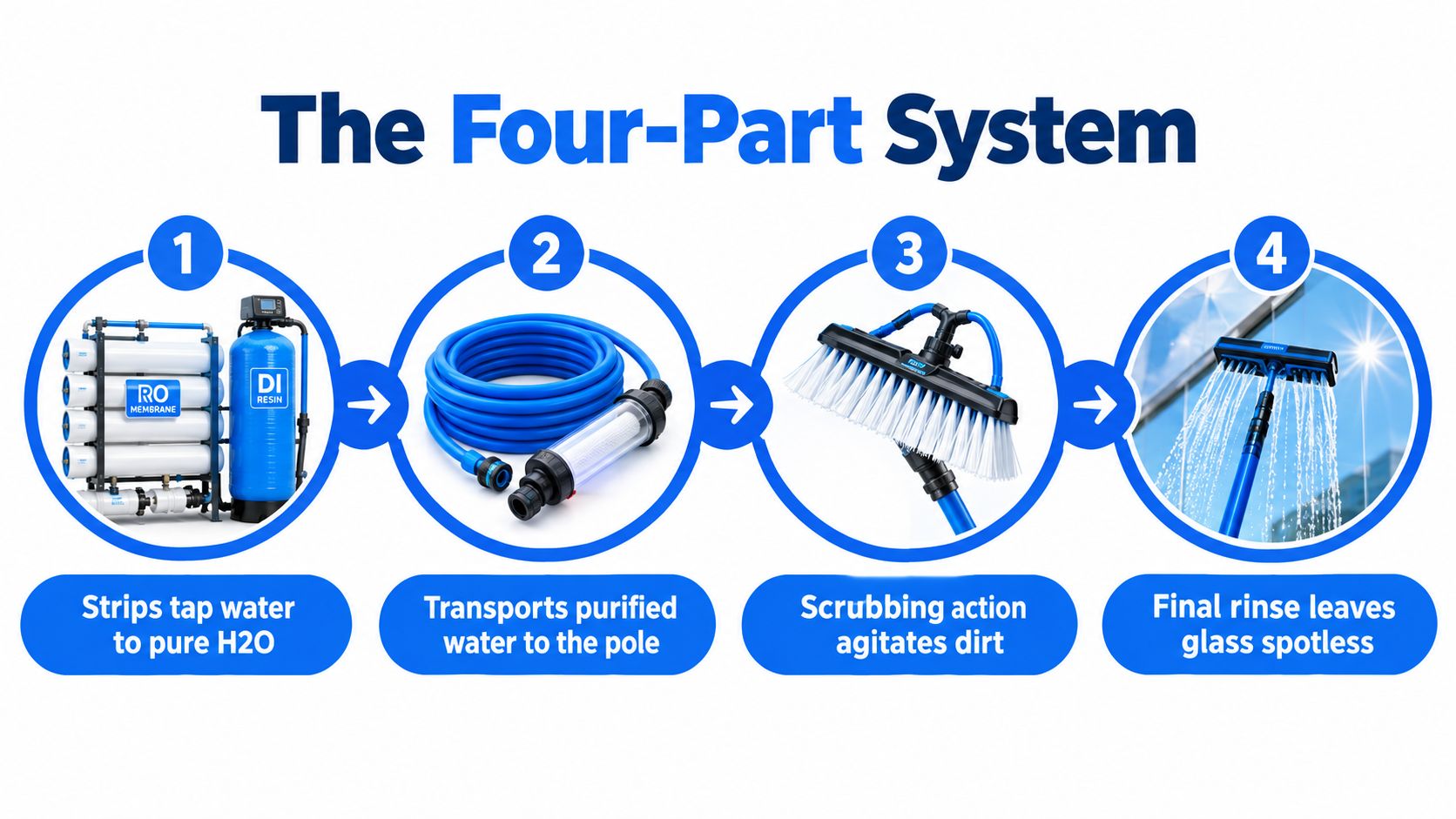
Troubleshooting follows the same chain. Soil left behind may indicate weak brush contact or insufficient rinse flow. Spots after drying may point to water quality or bonded residue. Checking each component separately makes the result easier to understand.
Why Purified Water Dries Spot Free
A pane can look clean while drying into spots. The reason is often dissolved material in the water, not dirt left by the brush. TDS means total dissolved solids, including minerals and other substances carried by water. Tap water evaporates from the glass, while those solids remain as spots, a film, or scale.
Purification removes much of that residue before the rinse reaches the window. Reverse osmosis sends water through a membrane that rejects many dissolved substances. Deionization resin then removes remaining charged particles. The finished water has very low mineral content, ideally under 10 ppm TDS and closer to 0 to 5 ppm, according to Unger’s guidance on common pure-water cleaning mistakes. See our guide to purified water window cleaning for how RO and DI stages are maintained in the field.
The rinse matters as much as the water
Purified water does not pull every contaminant from glass by itself. The brush bristles provide the scrubbing action, breaking the bond between the pane and pollen, dust, bird residue, or salt film. Continuous rinse flow then carries that loosened material down the glass.
Both parts have to work together. Too little agitation leaves stubborn soil attached. Too little flow leaves loosened grit on the pane or allows it to settle again. This is why brush movement, water volume, and contact pressure matter as much as the water’s purity.
That process handles ordinary exterior film and pollen well, but it has limits. Coastal salt aerosol can cling to Ventura and Santa Barbara windows, while hard-water scale may already be bonded to the glass. Purified water helps prevent new mineral spots during drying, yet it does not dissolve every baked-on deposit or greasy residue. Those surfaces may need separate treatment.
| Property | Tap Water | Purified RO + DI |
|---|---|---|
| Dissolved minerals | Carries minerals that can remain after drying | Minerals are removed before application |
| Main drying concern | Spots, films, or hard-water residue | Little mineral residue when the process is done correctly |
| Cleaning action | Can rinse, but may add dissolved solids | Works with brush agitation and continuous rinsing |
| Quality check | Source water quality varies | Pros can verify output with a TDS meter |
Technicians check the system with a TDS meter. Measuring at the brush head is more useful than assuming the filters still work, because it shows the quality of water reaching the glass.
The window dries spot-free because brush agitation and continuous rinsing remove the soil, while purified water leaves little mineral material behind.
How the Cleaning Process Unfolds Step by Step
A professional job starts before the brush touches the first pane. The technician positions the vehicle, identifies the water source, connects the hose, and allows the system to flush. The output is checked at the working end, since water quality can change between the purification equipment and the brush.
The first look at the property also matters. A cleaner checks the glass, frames, screens, roof access, landscaping, and likely runoff paths. A pane beside an active sprinkler, a frame with oxidation, or glass carrying old mineral deposits may need a different treatment from a dusty upper window.
The working sequence
-
Set up the source: The system connects to a spigot, storage tank, or purification vessel, then water moves through the filters and pump.
-
Inspect the surface: The technician identifies pollen, bird residue, salt film, hard-water deposits, cobwebs, and frame contamination before choosing brush pressure.
-
Scrub with controlled contact: The brush works across the glass in overlapping strokes. The operator uses enough contact to agitate soil without forcing the pole into the pane or seals.
-
Rinse continuously: Purified water flows through the jets while loosened material travels down the glass. Flow has to be high enough to flush, but not so poorly matched to the system that purification performance suffers.
-
Watch the sheet: During the final rinse, the technician checks whether water is flowing evenly over the surface. A spot that refuses to sheet may indicate residue, scale, greasy contamination, or a frame that is releasing dirt.
-
Inspect after drying begins: The cleaner checks edges, lower corners, sills, and frames, then returns to any area that needs hand detailing or another pass.
Flow rate is one of the variables behind that rinse. An industry guide lists common residential setups at about 0.25 to 0.4 gallons per minute for a two-jet brush, with 0.5 to 0.8 gallons per minute through 1/4-inch pole hose. Higher-output systems can reach 2 to 3 gallons per minute when the pump and purification capacity are sized for it. See the window-cleaning flow-rate guide for the relationship between flow, flushing, and purification contact time.
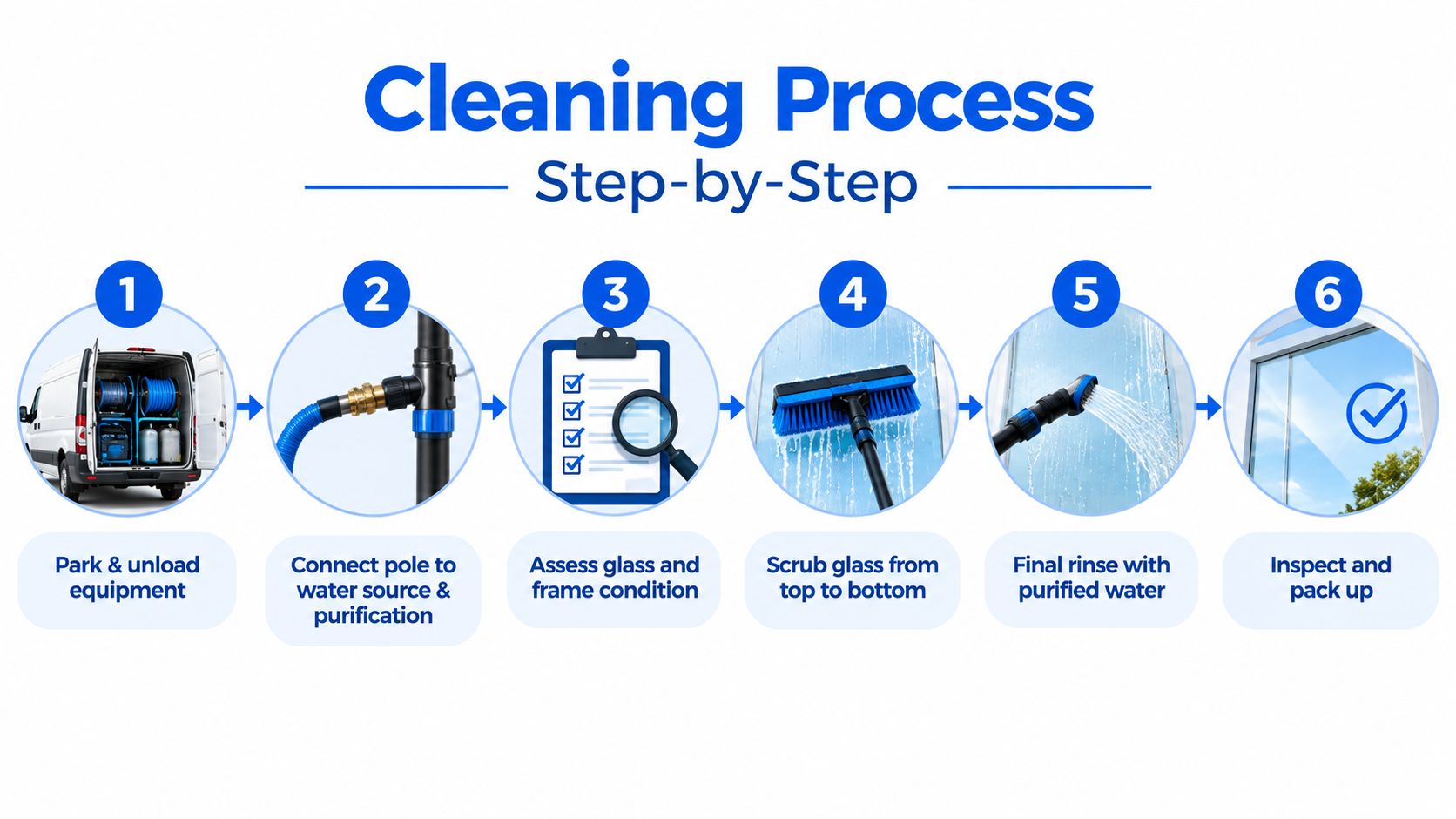
The homeowner may see water running down the pane and assume the cleaner has stopped too early. In this method, the wet finish is intentional. The relevant check is whether the glass has been properly agitated, thoroughly rinsed, and left with water that can dry without mineral residue.
Ladders vs Poles for High Windows
A second-story window above a planted patio may be easy to see but awkward to reach. A ladder places the cleaner beside the pane, while a water-fed pole lets the operator remain on the ground and guide the brush from below. The better choice depends on access, surface conditions, and whether the brush can make consistent contact.
Reach and access
A ladder needs a stable landing point and must be moved as the route changes. That becomes difficult beside a sloped driveway, over delicate planting, or near a roof edge. The reach limits covered earlier still apply, and they are only useful when the pole has enough room and a workable angle.
Poles suit upper windows, storefronts, skylights, and glass above roof projections. They also avoid placing ladder feet on soft soil or against an unsuitable surface. Their limitation is geometry. A tight courtyard, deep overhang, or obstructed sightline can prevent the brush from meeting the glass squarely.
Safety and working time
The operator keeps both feet on the ground and avoids climbing for every pane. That reduces ladder movement, but it does not remove all hazards. Long poles can contact overhead wires or branches, wind can affect control, and runoff or equipment can still affect people, plants, and property.
Ladders remain useful for interior glass, restricted courtyards, architectural peaks, and small areas that need close manual work. They can also make sense when a specialist must treat bonded scale that brush agitation alone cannot remove.
| Factor | Ladder | Water Fed Pole |
|---|---|---|
| Working position | Cleaner climbs to the glass | Cleaner works from the ground |
| Repositioning | Required as the route changes | Often possible from a continuous ground path |
| Landscaping | Feet may occupy soil or planting areas | Equipment stays primarily at ground level |
| High exterior panes | Useful where access is direct | Useful where the pole has a clear angle |
| Heavy bonded residue | Close hand work is possible | May need pre-treatment or supplemental tools |
Finish quality depends on the surface
Purified water can provide a spot-free rinse, but it does not dissolve every deposit. Calcium drip lines from sprinkler overspray, oxidized insect marks, and baked-on residue may need slower brushing, treatment, or hand detailing. Coastal homes may carry salt aerosol, while foothill properties can collect windblown dust and grit. Brush agitation and continuous rinsing remove ordinary surface soil, but mineral scale can remain bonded to the pane.
Skylights show why access must match the glass and structure. This guide to skylight cleaning with a pole explains the access concerns around angle, surrounding surfaces, and tool control. The choice is not a fixed ladder-versus-pole rule. It is the method that allows safe positioning, proper brush contact, thorough rinsing, and a finish the cleaner can inspect.
Why Local Pros Like Aloha Window Bros Rely on Pure Water
A Ventura or Santa Barbara job can change from one property to the next. Coastal air may leave salt aerosol on glass and frames, citrus or avocado trees can add plant debris, and dry foothill winds carry dust toward screens and sills. A local technician has to identify the soil first, then decide whether brushing and rinsing are enough or whether a surface needs separate hand work.
The practical reason pros prefer pure water is control. A van-mounted system can produce purified water at the property, while the technician checks the water quality at the brush head before cleaning. That check matters when a crew moves between different areas, such as a coastal Oxnard home and an inland Thousand Oaks property on the same day. The technician can re-check the output rather than assume the equipment is producing the same rinse everywhere.
Pure water also fits exterior maintenance because the brush agitates ordinary dirt while the water continuously carries loosened material away. It leaves no detergent film behind, but it does not dissolve every deposit. Salt that has dried into a heavy film, sprinkler scale, greasy residue, or stucco dust may need treatment or supplemental hand work.
One visit involves more than the glass
The pole reaches exterior panes, while the surrounding components still need separate attention. A careful service may include:
-
Screens: Screens are removed, brushed or washed as appropriate, dried, and returned to position.
-
Frames and sills: Dirt around the perimeter is addressed instead of treating the pane as an isolated rectangle.
-
Tracks: Accessible tracks receive detailing because trapped soil can move back onto clean glass.
-
Ground-level checks: The crew reviews runoff, landscaping, and areas where loosened contamination could collect.
Aloha Window Bros describes service for windows, screens, frames, and sills, along with purified-water pole work for high glass, across Ventura County and Santa Barbara County. The pole is one part of that service, not a substitute for every cleaning method.
Local knowledge helps with the judgment calls. Salt film may rinse away readily when it is fresh, while hard-water spotting, pollen buildup, and irrigation residue can remain attached. A technician can select the right combination of brush agitation, rinse flow, treatment, and hand detailing for each surface.
Coastal exposure, tree cover, irrigation patterns, and seasonal wind also affect maintenance needs. A local crew can assess those conditions during the visit and explain which surfaces the pole can handle directly, along with the areas that require additional work.
Honest Limits Every Homeowner Should Know
A water-fed pole can leave glass spotless after loose soil is brushed away and rinsed continuously. It cannot dissolve every residue. The working mechanism is physical agitation plus enough rinse flow, so the result depends on what is on the glass and how firmly it is attached.
A useful diagnosis starts with the residue. Loose dust, pollen, and a light film usually move under the brush and rinse. Bonded mineral scale behaves differently. Sprinkler overspray or hard water that has dried repeatedly can leave a crust that remains visible after ordinary pole cleaning. If repeated brushing changes the deposit very little, the technician may need a compatible pre-treatment, controlled hand work, or a separate restoration method.
Failure modes that need diagnosis
-
Greasy residue: Kitchen-adjacent glass, storefront film, and oily marks may resist purified water because water does not provide degreasing chemistry. A cleaning solution and manual agitation may be required.
-
Hard-water scale: Mineral deposits can remain after loose dirt is removed. Their outline, rough feel, and limited response to rinsing help distinguish scale from a temporary film.
-
Oxidized frames: Aging frames may release chalky material when brushed. If that runoff reaches freshly cleaned glass, the pane can soil again.
-
Post-construction dust: Fine construction residue may require repeated removal and protection of nearby surfaces. A single rinse is not a reliable test of whether the area is clean.
-
Screens and tracks: A brush can remove some exterior screen soil, while heavily loaded screens, tracks, and seals may need hands-on cleaning.
The technician also checks which side is dirty. Interior haze from household residue can look similar to exterior contamination from dust or other deposits. Cleaning the wrong side first wastes time and can make the result seem worse than the system’s actual performance.
Height and access still have limits
Pole reach does not guarantee access to every pane. Roof geometry, enclosed courtyards, overhead lines, wind, and the angle needed to keep the brush flat can restrict practical reach. A high window may still require a ladder, another access method, or a return visit with suitable equipment.
The guide to window cleaning for high windows explains why height is only one part of planning. A professional should identify which glass the pole can reach, which surfaces it can clean effectively, and where manual detailing or specialized access is more appropriate.
When the method struggles, a good cleaner changes the diagnosis rather than repeating the same rinse. They identify the residue, adjust the process, add an appropriate tool when needed, and tell the homeowner what may remain. Purified water supports the cleaning process, but brush contact and correct treatment determine whether the residue leaves.
If your Ventura County or Santa Barbara home has high glass, stubborn sprinkler spotting, or residue that does not respond to ordinary rinsing, Aloha Window Bros can assess which panes suit water-fed pole cleaning and which need hand detailing. Visit the company’s website to request an estimate and arrange care for windows, screens, frames, and sills.