

You walk outside after a windy week in Ventura or Santa Barbara, look up at your roof, and notice your solar panels don’t look glossy anymore. They have that dull, chalky haze. Maybe it came after Santa Ana winds pushed inland dust toward the coast. Maybe it’s salt spray if you’re closer to the water. Maybe spring pollen settled in and the last light rain only turned it into streaks.
That’s usually when the same question pops up: Will the next rain clean this off, or do I need to schedule a cleaning?
The honest answer is that there isn’t one fixed rule for every home. A big operations and maintenance guide for photovoltaic systems says the right cleaning interval is site-specific and should be based on local rainfall, dust, and a cost-benefit analysis instead of a fixed national schedule, with annual soiling losses reported in the 4.3% to 7.5% range and many studies clustering around about 6% per year in that guide’s review of the field (ScienceDirect guide summary). That lines up with what local homeowners see in real life. A panel in Goleta near marine air doesn’t collect grime the same way a panel in Thousand Oaks near dry winds does.
If you’ve looked at maintenance advice from other regions, you’ve probably noticed the same pattern. Even resources focused on places far from California, like this practical guide on Brisbane solar panel maintenance 2026, point back to the same basic truth: climate and local grime matter more than a generic calendar reminder.
Table of Contents
- Introduction Why Cleaning Frequency Matters for Your Home
- How Soiling Builds Up and Blocks Sunlight
- How Much Energy You Lose When Panels Stay Dirty
- Recommended Cleaning Intervals by Environment and Location
- Seasonal Schedules and When Rain Helps or Not
- Signs Your Solar Panels Need Cleaning Now
- Choosing Your Cleaning Plan and Next Steps
Introduction Why Cleaning Frequency Matters for Your Home
You look up after a light rain in Ventura and expect your panels to be clean. Instead, the glass still has a dull film. That surprises a lot of homeowners, but it explains why cleaning frequency matters. The schedule that works best for your home depends less on a generic calendar rule and more on how much natural rinsing your roof gets.
For homeowners, that matters for three simple reasons. Power, appearance, and effort later. Dirt and residue can cut production, make an otherwise tidy home look worn, and become harder to remove if it sits through sun, fog, and dry spells.
Two Ventura area homes can need different schedules
A house near the Ventura or Santa Barbara coast often picks up salt haze from marine air. A home in Camarillo, Ojai, or Newbury Park may collect more dust after windy periods. In the foothills, pollen and ash can join the mix.
Those differences change how much self-cleaning your system gets from normal weather. Rain works like a quick rinse on a car. It can wash away loose dust, but it may leave behind sticky residue or streaks if the buildup has already bonded to the surface.
Practical rule: The more useful question is not only how often should solar panels be cleaned. It is how often your panels get a meaningful rinse from rain, and what kind of grime that rain cannot remove.
That is why a fixed six month rule only gets you part of the way. It is easy to remember, but it overlooks the main variable. A panel in Montecito that sees coastal moisture and salt film may need a different rhythm than one in inland Ventura County that mostly deals with dry dust.
Even guides from other climates land on the same idea. This practical resource on Brisbane solar panel maintenance 2026 also points back to local conditions, not a one-size-fits-all schedule.
For California homeowners, the better approach is simple and reassuring. Start with your location, notice what tends to land on the glass, and build a cleaning plan around the amount of help rain provides. In Ventura and Santa Barbara, that usually leads to a more accurate schedule than any blanket rule.
How Soiling Builds Up and Blocks Sunlight
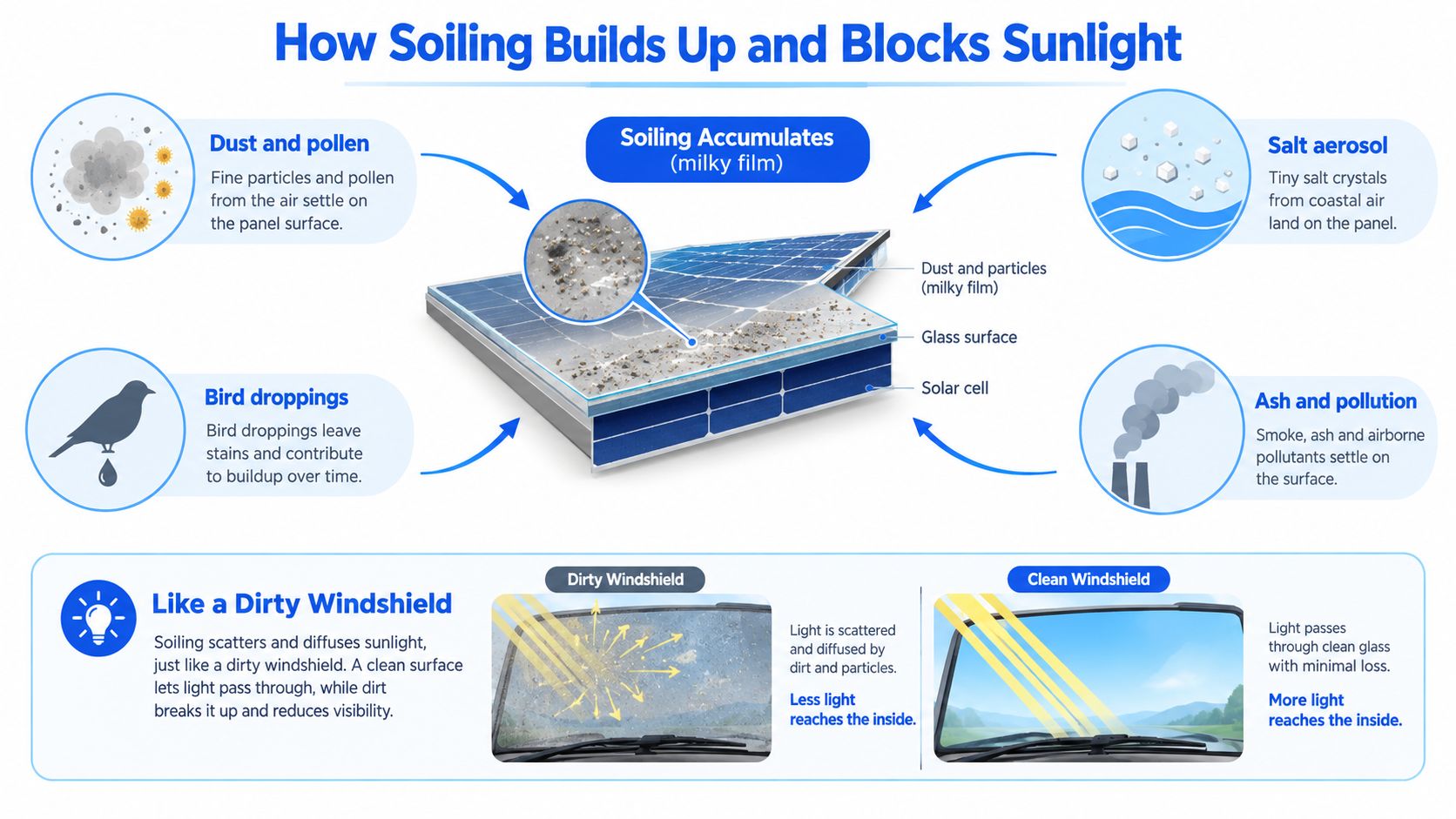
Solar panels don’t have to look filthy to lose performance. Often the problem is a thin layer of residue that spreads evenly across the glass and cuts the amount of sunlight getting through. Driving into the sun with a dusty windshield lets you see through it, but not as clearly.
What actually lands on the glass
The main types of soiling are easy to recognize once you know what you’re looking for.
- Dry dust and road grit settle after windy periods, especially in inland and foothill areas.
- Pollen can coat panels in a fine yellow or green film during spring.
- Salt aerosol comes in from coastal air and can leave a hazy residue that doesn’t always rinse clean.
- Bird droppings block small areas heavily and often bake onto the surface.
- Ash and urban fallout can arrive after fire events or drift in from nearby traffic corridors.
Some of that material is loose. Some turns sticky when dew, fog, or light moisture mixes with it.
Why some grime washes off and some doesn’t
Many homeowners get confused. They assume rain is rain. But the effect depends on the type of residue and how the panel is positioned.
A panel with decent tilt and loose dust may get a fair rinse during a stronger storm. But a panel with dried droppings, coastal film, or mineral spotting may still look smeared afterward. Light rain can even leave streaks if it softens the surface grime without fully carrying it away.
NREL notes that cleaning frequency should come from a local cost-benefit analysis because the optimal interval changes with soiling rate, rainfall, dust characteristics, and cleaning costs, and that the best schedule is often seasonal rather than fixed year-round (NREL photovoltaic soiling guidance).
Why location changes everything
Two roofs can sit only a few miles apart and collect grime differently.
- A lower-tilt roof can hold residue longer.
- A home near the beach may collect salt film even when inland areas stay clearer.
- A house near open land, construction, or a busy road may gather dust faster.
- Morning marine layer moisture can help grime bond to glass instead of blowing off.
A panel doesn’t need a thick crust of dirt to underperform. A light, even film across the surface can matter because it affects every row of cells a little bit all day.
That’s why cleaning isn’t really about “dirty or clean.” It’s about whether your site gets enough natural help from weather to keep buildup from turning into a persistent light-blocking layer.
How Much Energy You Lose When Panels Stay Dirty
A dirty panel does not have to look terrible to lose production. Solar glass works a lot like a windshield at sunset. Even a light film can cut the light coming through, and because that film sits across the whole surface, the loss adds up hour after hour.
Research reviewed in a major U.S. solar best-practices guide reported annual soiling losses in the 4.3% to 7.5% range, with many studies clustering around about 6% per year (ScienceDirect best-practices review).
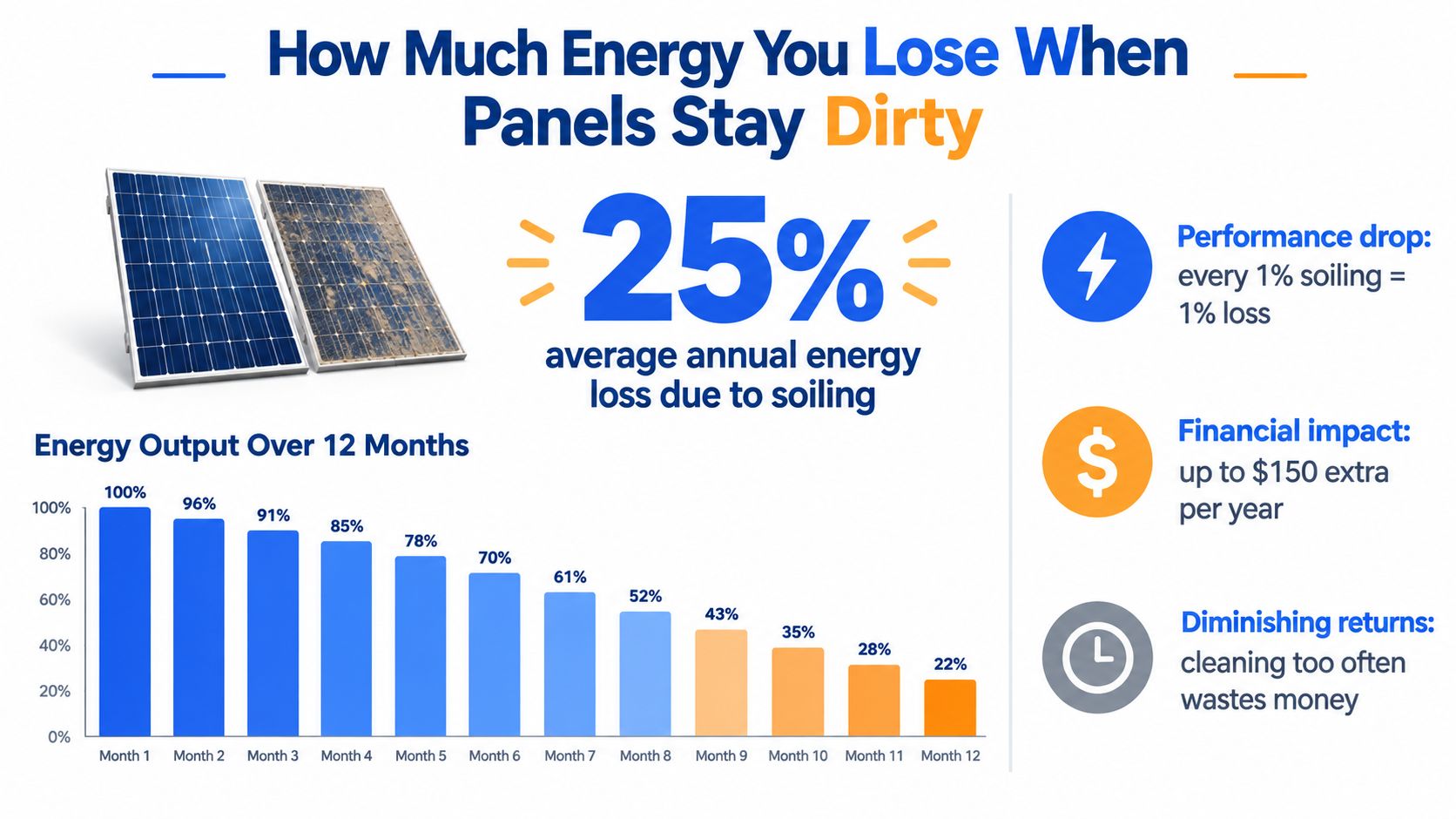
For a California homeowner, the practical takeaway is simple. The question is not whether dirt matters. The question is how much natural washing your roof gets before that thin layer turns into a steady drag on output.
That is why the first cleaning after months of buildup often delivers the biggest improvement. Once you remove the layer that has been muting sunlight every day, production usually rebounds more than it would from squeezing in extra cleanings too close together. After that, the benefit of each additional visit often gets smaller unless your roof keeps collecting grime fast.
If you want help weighing cost against likely production gain, this local guide on whether solar panel cleaning is worth it walks through the decision in plain language.
In high-soiling climates, shorter cleaning intervals can make financial sense. A review in Sustainability found that the optimal timing can be much shorter in dusty regions, and that soiling losses can rise quickly over months when dust, humidity, tilt, and wind help residue stick to the glass (Sustainability review on PV cleaning frequency).
Ventura and Santa Barbara homes usually need a different lens. Coastal panels may not collect desert-style dust, but sticky salt film, pollen, ash, and bird mess can hang on long after a light rain. Inland homes with better rinsing rain and less marine residue may hold output longer between cleanings.
Use this simple framework:
- Panels that get real self-cleaning from rain usually lose energy more slowly and can often wait longer between visits.
- Panels that collect sticky residue such as coastal salt haze, pollen paste, or ash mixed with dew usually give up more production because rain does not fully clear the film.
- Extra-frequent cleaning only pays off when your roof keeps rebuilding that light-blocking layer faster than weather removes it.
That is why a generic six-month rule misses the point. Two homes can have the same equipment and very different losses based on how much free cleaning nature is doing at that address.
Here’s a quick visual if you want to see the logic in action before deciding on a schedule.
Recommended Cleaning Intervals by Environment and Location
A better way to set a cleaning schedule is to ask one practical question first. How much free cleaning does your roof get?
Two homes can sit 20 miles apart, use the same panels, and need very different care. One roof gets solid winter rain that rinses dust away like a garden hose. Another gets light moisture, salt haze, pollen, or ash that dries into a film, more like a dirty windshield after ocean mist. That difference matters more in Ventura and Santa Barbara than any generic six-month rule.
Research on soiling intervals shows how wide the range can be across climates. A global modeling study and desert field data found that the best interval changes sharply by local conditions, from much more frequent cleaning in high-soiling areas to far longer gaps where buildup is lighter and easier to remove (global and desert interval study).
For homeowners here, the easiest way to use that idea is to group your home by what lands on the glass and whether rain rinses it off.
Cleaning Interval Guide by Environment
| Environment | Primary Soiling Driver | Suggested Cleaning Interval |
|---|---|---|
| Coastal Ventura, Santa Barbara, Montecito, Hope Ranch | Salt aerosol, marine film, bird activity | Every 3 to 4 months |
| Near-beach homes with visible haze or frequent seabird activity | Salt residue and droppings that rain may not remove well | Every 2 to 3 months |
| Inland Ventura County such as Thousand Oaks, Camarillo, Newbury Park | Dry dust, windblown grit, pollen | Every 4 to 6 months |
| Foothill and canyon areas exposed to Sundowner or Santa Ana winds | Wind-driven dust plus seasonal pollen | Every 3 to 4 months, with extra checks after major wind events |
| Low-soiling homes with good seasonal rain and little visible buildup | Light dust only | Every 6 to 12 months, based on observation |
| After nearby wildfire ash fall | Ash and residue that can cling to glass | Prompt inspection, then clean if residue is visible |
| Homes with sprinkler overspray or mineral spotting | Hard-water deposits | Clean when spotting appears, because rain usually won’t solve it |
These are planning ranges, not a rigid calendar. Your actual interval depends on whether your roof gets a true washdown or just enough moisture to make grime stick.
Ventura and Santa Barbara examples
Ventura and Oxnard coastal homes often land in the shorter range. Marine air can leave a light film that is hard to notice day by day, but easy to see once the glass loses that crisp, dark look. If your panels face the ocean, sit under regular bird traffic, or stay damp in the morning, every 2 to 4 months is often more realistic than waiting half a year.
Santa Barbara, Goleta, Montecito, and Hope Ranch properties can behave the same way. Salt haze plus pollen is a sticky mix. Rain may knock off loose dirt while leaving behind a thin residue, like rinsing a car without soap. In those areas, many homeowners do well with a 3 to 4 month rhythm and shorter intervals for homes very close to the beach.
Thousand Oaks, Camarillo, Newbury Park, Westlake Village, and Simi Valley usually shift the question from salt to dust. If your roof gets decent winter rain and your lot is not especially windy, every 4 to 6 months is often enough. Homes near open land, hillsides, orchards, horse property, or busy dusty roads may need checks sooner because buildup can return faster.
A canyon or foothill location deserves its own category. Wind can reload the panels quickly, especially after dry spells. In those spots, use the standard 3 to 4 month interval as a starting point, then shorten it if you keep seeing fresh dust after wind events.
Why rain changes the schedule less than homeowners expect
Rain only helps if it acts like a rinse, not a light mist. Analysts cited earlier found that annual soiling losses change sharply depending on how much residue rain removes. That is the key idea for local homeowners.
So the right question is simple. Does your roof get storms that wash the glass clean, or does it mostly collect dew, drizzle, salt, pollen, and ash that dry into a film?
If your site gets real washdown, you can usually stretch the interval. If it keeps collecting sticky residue, shorter cleanings protect production more reliably.
Seasonal Schedules and When Rain Helps or Not
You look up after a winter storm and your panels seem clean from the driveway. Then spring pollen hits, summer brings long dry weeks, and the glass starts to lose that clear shine again. Around Ventura and Santa Barbara, that pattern is common because the schedule depends less on the calendar and more on how much real self-cleaning your roof gets from weather.
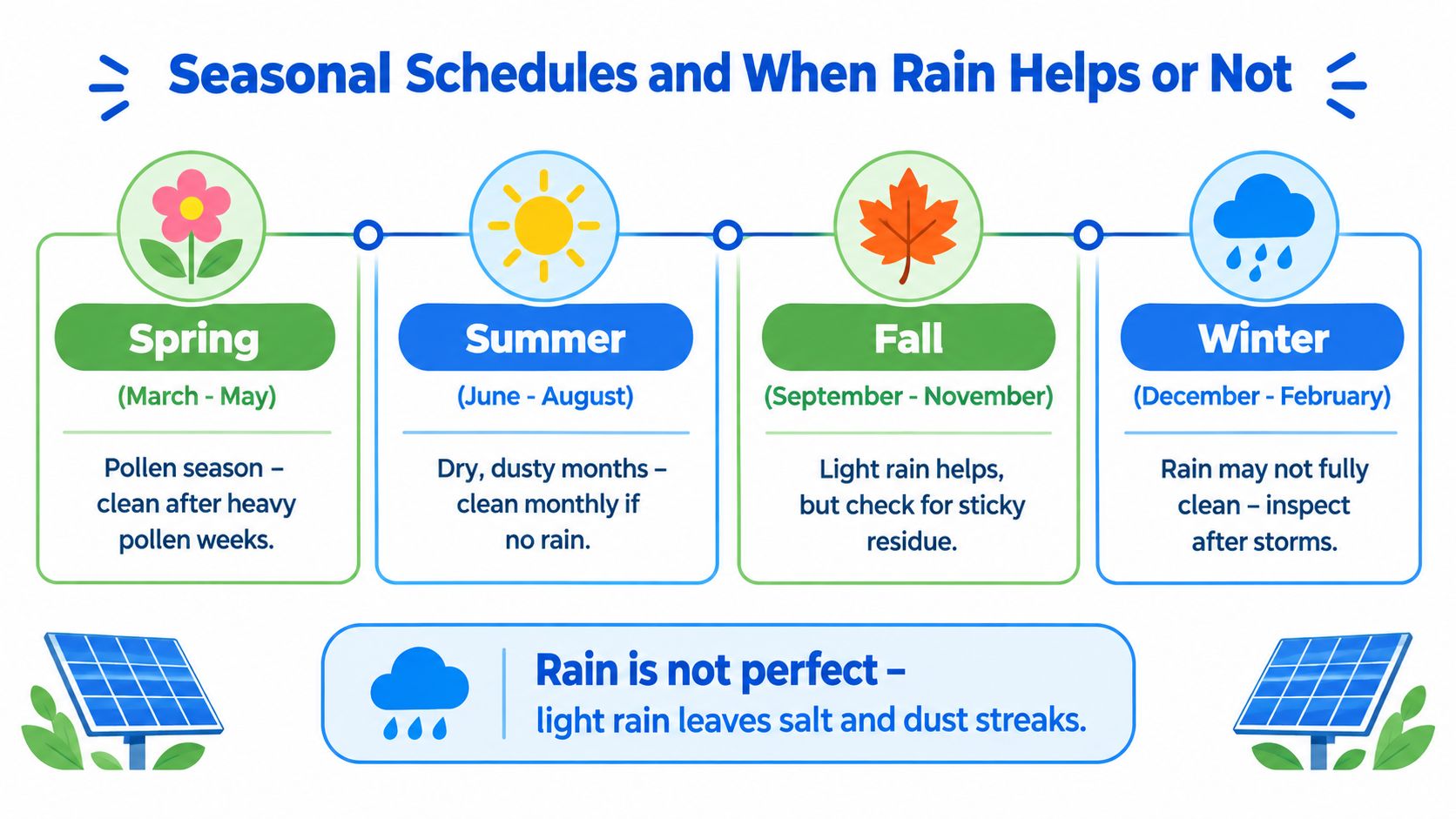
A simple way to judge your timing is to treat rain like a garden hose without a brush. A solid rinse can remove loose dust. It usually does less against salty film, sticky pollen, ash, bird droppings, or mineral spots. That is why two homes a few miles apart can need very different cleaning schedules even if they get the same forecast.
A practical seasonal rhythm for coastal homes
For homes in Ventura, Santa Barbara, Montecito, Goleta, and other beach-close neighborhoods, winter rain helps most when storms are strong enough to wash residue off instead of drying into a film.
- Late winter or early spring: Check the panels after the rainy stretch ends. If the glass still looks dull or slightly milky, the rain rinsed but did not fully clean.
- Late spring: Pollen season often leaves a thin coating right before the strongest production months.
- Mid to late summer: Coastal moisture, salt in the air, and bird activity can leave grime that sticks harder than plain dust.
- After a long dry period: Plan another check if your roof has gone weeks without a meaningful washdown.
For many coastal homes, this lines up with a 3 to 4 month rhythm. Homes very close to the beach may need shorter intervals because salt and marine residue return faster.
A practical seasonal rhythm for inland and foothill homes
Inland areas usually get less sticky salt and more dry buildup. That sounds easier, but it changes fast after wind.
- Check in spring once heavy pollen starts settling down.
- Clean in early summer if visible dust is sitting on the glass before peak sun months.
- Inspect after strong wind events such as Santa Ana or Sundowner conditions, especially near open land or foothills.
- Inspect after wildfire ash even if the layer looks light from the ground.
Inland homes with decent winter rain can sometimes stretch longer than coastal homes. Foothill and canyon properties often cannot. Wind reloads the panels the way a freshly swept patio gets dusty again by the next afternoon.
Rain helps, but only under the right conditions
Rain is helpful when it arrives hard enough and long enough to carry grime off the panel. Light showers, mist, dew, and marine moisture often loosen dirt without removing it. Once that residue dries, it can leave streaks or a thin film.
That is the part many homeowners miss.
A roof does not ask, “Did it rain?” It responds more like a windshield. A real wash clears it. A light sprinkle can leave spots. If your home deals with coastal salt, tree pollen, sprinkler overspray, or ash, rain may reduce the mess without fully resetting the panels.
So the best seasonal plan is simple. Use winter storms as a possible reset, then check what your site collected in spring and summer. In Ventura and Santa Barbara, cleaning frequency works best when it follows local buildup patterns, not a generic twice-a-year rule.
Signs Your Solar Panels Need Cleaning Now
A lot of homeowners expect dirty panels to look obviously filthy. Often, they do not. A panel can lose its clear, glossy look and still seem “mostly fine” from the driveway.
That is why the best trigger is not a fixed date. It is the combination of what your panels look like and what your home has been exposed to. Near the Ventura or Santa Barbara coast, sticky salt film can hold onto dust. Inland, pollen, ash, and windblown grit are more common troublemakers. The question is simple: did your last stretch of weather wash the panels, or just leave a new layer behind?
What to look for from the ground
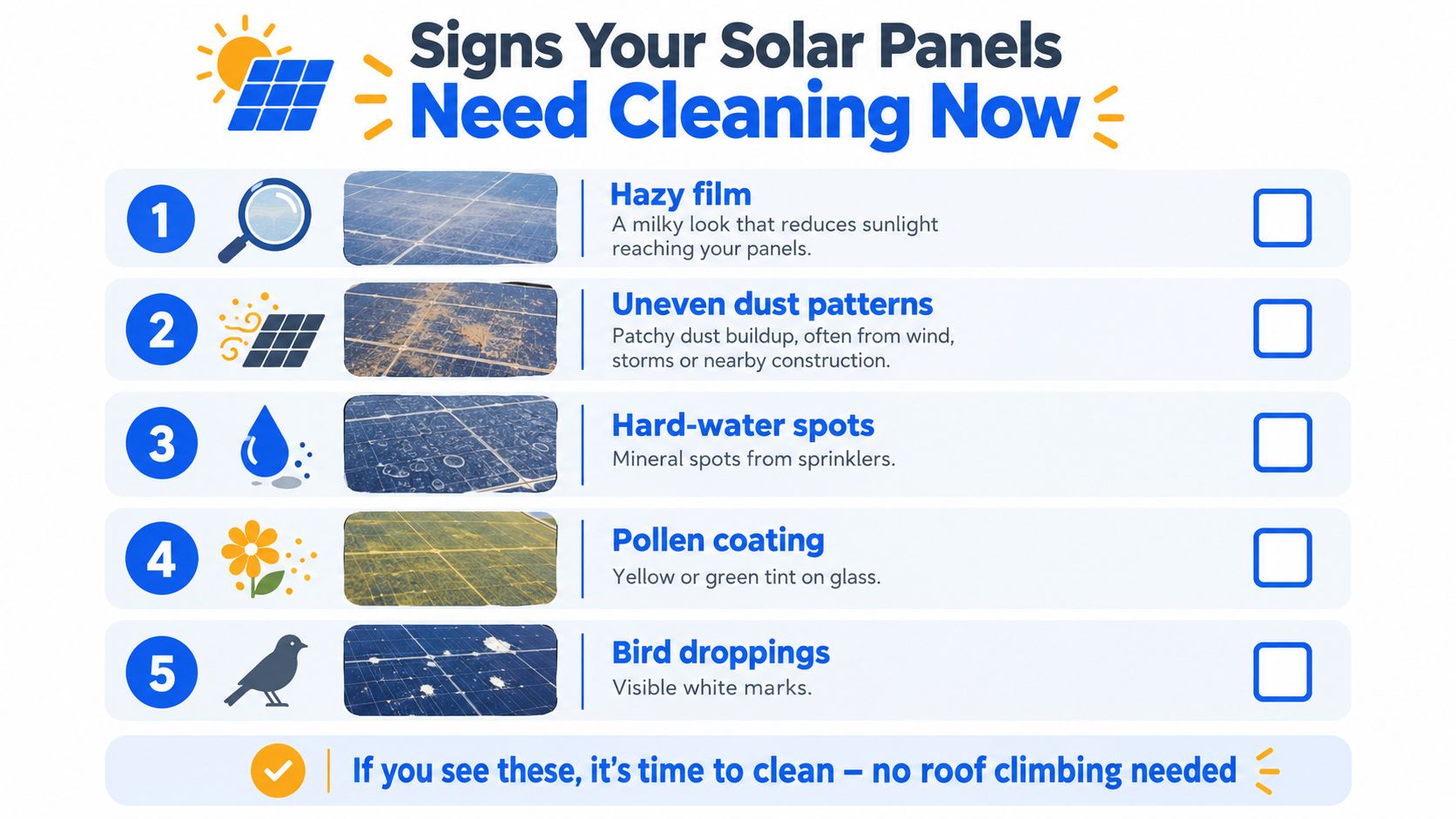
You can catch many cleaning needs without going on the roof. Morning light or late-afternoon light usually makes residue easier to spot because the glass shows film the same way a windshield does when the sun hits it at an angle.
A cleaning check is worth acting on if you notice:
- A dull, milky film across several panels. This usually points to fine dust, coastal salt, or pollen that light rain did not remove.
- Uneven dirty patches or streaks. That often means runoff shifted grime around instead of clearing it off.
- White mineral spots or crusty marks. Sprinkler overspray and hard-water runoff tend to leave residue that stays put.
- Yellow-green dusting during pollen season. That coating can build faster than many homeowners expect, especially near trees.
- Bird droppings or sticky splatter. These dry hard in the sun and are better handled sooner.
If you want to understand the safe limits before trying anything yourself, this guide on how to clean solar panels on a roof explains what homeowners can usually handle and what is better left alone.
Clues from performance
Your monitoring app can confirm what your eyes only partly catch.
If production looks softer than usual on clear, bright days, surface buildup may be part of the problem. If the panels still look flat and hazy after a decent rain, that is another strong clue. A sudden drop can also point to equipment trouble, so it helps to compare the visual condition with what the app is showing instead of blaming dirt automatically.
A simple monthly check
Keep this routine easy enough that you will do it.
- Stand at ground level or look from an upstairs window.
- Use the same viewing angle each time, and snap a phone photo for comparison.
- Check after the kinds of weather that leave residue behind, such as marine haze, pollen bursts, ash fall, or windy dry spells.
- Glance at your monitoring app the same day so you can match appearance with output.
If you can clearly see film, spotting, or baked-on residue from the ground, you already have a practical reason to schedule cleaning or ask for an evaluation.
Choosing Your Cleaning Plan and Next Steps
By this point, the answer to how often should solar panels be cleaned is probably clearer. It depends less on a generic six-month rule and more on how much real self-cleaning your site gets.
If your home is close to the coast, and salt haze keeps returning, shorter intervals usually make sense. If you’re inland with modest dust and decent winter rain, a lighter schedule may be enough. If pollen, ash, bird droppings, or sprinkler minerals are part of your situation, visual triggers matter more than a fixed date.
DIY or professional help
A gentle ground-level rinse may help in some situations, but many homeowners run into limits fast. Roof access is the obvious one. Streaking and mineral residue are another. Sticky buildup also tends to need the right water quality and soft tools, not just more scrubbing.
For homeowners comparing options, this overview of solar panel cleaning cost helps frame what you’re paying for when a professional handles access, water quality, and visible residue safely.
One local option is Aloha Window Bros, which provides solar panel cleaning in Ventura County and Santa Barbara County using purified water systems and soft tools suited to residential exterior cleaning. That’s often a practical fit when you’re dealing with coastal film, high rooflines, or mineral spotting that doesn’t come off with a basic rinse.
A simple plan you can use
Try this approach:
- Classify your home as coastal, inland dusty, foothill wind-exposed, or low-soiling.
- Start with the interval table above instead of a national average.
- Adjust by season based on pollen, wind, ash, and how your panels look after rain.
- Use ground-level checks to decide whether the next cleaning should happen sooner.
- Bring in a pro when access is unsafe or residue is clearly sticking.
A good plan should feel calm and manageable. Your panels don’t need constant attention. They just need the right attention for the roof they’re on.
If your panels are starting to look hazy after wind, salt air, pollen, or ash, Aloha Window Bros offers professional solar panel cleaning for Ventura County and Santa Barbara County homeowners using purified water and safe exterior methods. If you want help choosing the right interval for your location, or you’d like a seasonal assessment for your roof, visit Aloha Window Bros.