

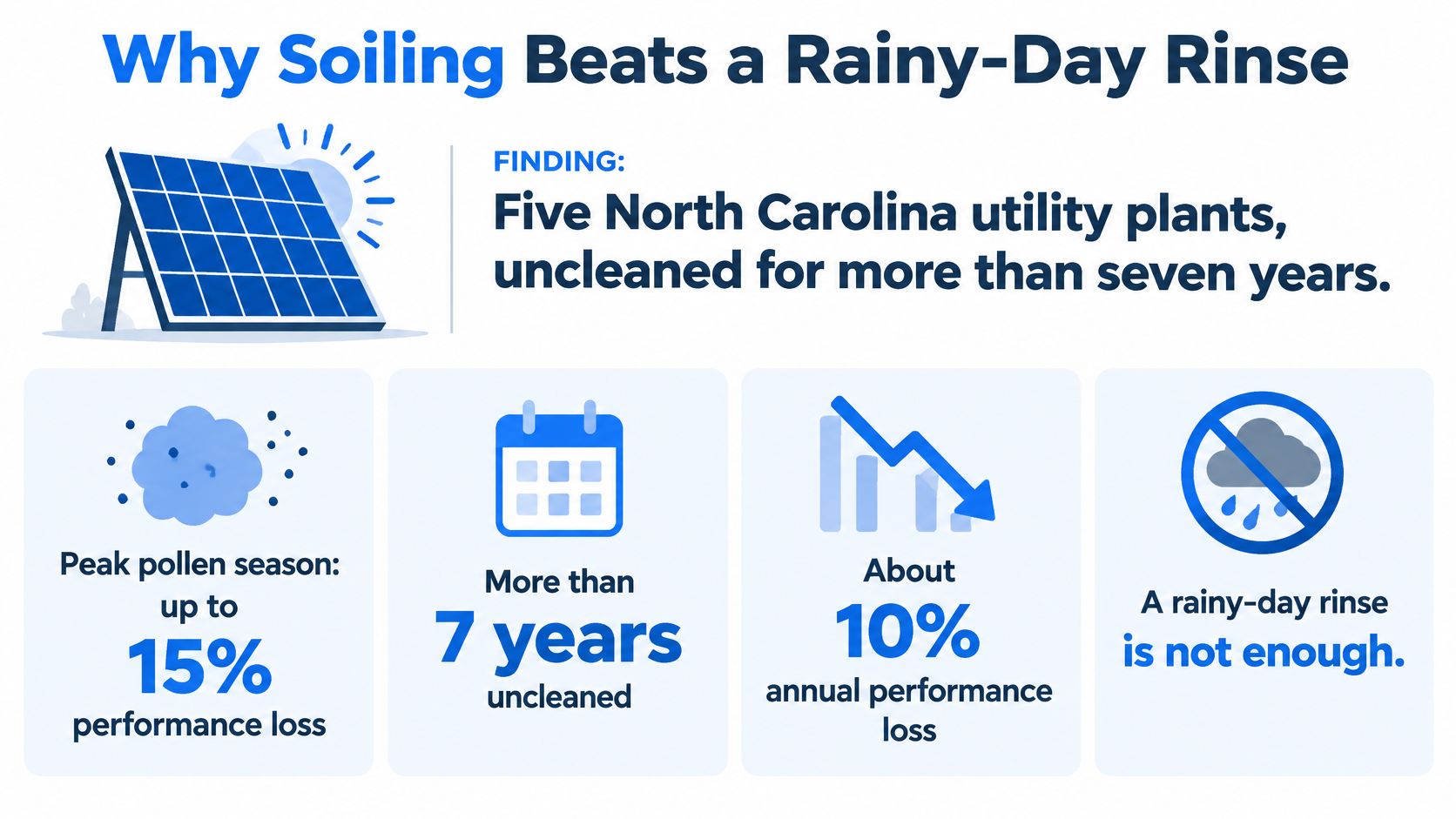
Solar panels at five North Carolina utility plants left without manual cleaning for more than seven years lost as much as 15% of performance during peak pollen season, according to NREL’s pollen-soiling study, which also estimated pollen-related losses could reach approximately 10% of annual production without planned cleaning. Rain didn’t fully restore performance afterward, and mechanical wet-brush cleaning increased measured performance by 5% to 11%. The lesson isn’t to buy the strongest brush. It’s to choose solar panel cleaning tools that match the deposit, the glass, and the safest way to reach it.
Table of Contents
- Why Soiling Beats a Rainy-Day Rinse
- Solar Panel Cleaning Tools Compared by Job
- Loose Dust Versus Bonded Film
- When a Clean Pays and When to Wait
- How to Clean From the Ground Safely
- Decide on DIY or a Local Clean
Why Soiling Beats a Rainy-Day Rinse
A roof can look freshly rinsed while its solar panels remain coated. Rain may carry away loose particles, but sticky pollen and other bonded deposits can remain attached to the glass. Think of a dusty kitchen window: splashing water over it isn’t the same as lifting the film with an appropriate cleaning tool.
For coastal California homeowners, the useful distinction is rain exposure versus actual cleaning. Salt aerosol, airborne dust, pollen, and bird droppings don’t all respond to the same treatment. A passing shower tells you that the panels got wet, not that they recovered their clean condition.
Follow the output, not the weather forecast
Say your Ventura home has panels near flowering trees. After the pollen settles, rain makes the roof look cleaner, but the monitoring app still shows lower production during comparable sunny conditions. That combination deserves an inspection rather than an automatic decision to wait for another storm.
Start with a clean baseline, meaning production recorded when the panels were known to be clean. Compare similar conditions rather than a cloudy afternoon with a clear morning. Season, temperature, shade, and equipment status can all complicate a simple before-and-after comparison.
Use these checks together:
- Production pattern: Look for a persistent change under comparable weather, not an isolated dip.
- Visible deposits: Inspect from the ground for hazed rows, pollen patches, droppings, and sprinkler marks.
- System alerts: Check the monitoring app for faults before assuming dirty glass explains reduced output.
- Recent conditions: Note nearby landscaping work, dusty wind, pollen release, or repeated overspray.
The infographic summarizes why wet panels aren’t necessarily clean panels.
Make the cleaning trigger specific
A visibly dirty array with reduced production gives you a stronger reason to act than the calendar alone. Conversely, a faint haze without a meaningful change in output may justify continued observation, especially when cleaning would require difficult access.
Our guide to how often solar panels should be cleaned helps connect inspection habits with maintenance timing. Treat any suggested interval as a reminder to assess the array, not a command to wash clean glass.
Practical rule: Rain is an event. Recovered production and clear glass are the checks that tell you whether cleaning is still needed.
The useful tool families are straightforward: soft brushes, purified-water-fed poles, and controlled wet-cleaning equipment. Each has a job, but none should be chosen before you understand what’s on the panel.
Solar Panel Cleaning Tools Compared by Job
| Tool | Best deposit | Skip it when | Damage risk |
|---|---|---|---|
| Soft nylon brush on a pole | Loose dry dust | Sticky pollen, salt film, or droppings need more than brushing alone | Low if bristles stay clean and soft |
| Purified water-fed pole | Salt, pollen, bird droppings, and light mineral film | Water is scarce and dust is only loose | Low with light contact and low-pressure deionized water |
| Garden hose or tap sprayer | Light soluble dust | Film is bonded or tap water is hard | Medium from spotting and redistributed grit |
| Soft rubber squeegee | Finishing after a wet clean | Dry grit remains on the glass | Medium if particles sit under the blade |
| Clean microfiber pad | Light film on cool, reachable glass | Any grit remains or the module is hot | Medium-high once the cloth loads with dust |
| Home robot with nylon roller | Frequent dust on a regular, low array | The roof is steep, irregular, or coated with scale | Requires verified weight limits, edge protection, and brush pressure |
| Pressure washer | None for routine home-module cleaning | Coated glass, frames, seals, and connections are exposed | High from concentrated force and forced water |
| Professional purified-water clean | Elevated arrays and stubborn film | Ground-level loose dust can be removed safely by the owner | Reduced when tools stay clean and nobody walks on modules |
Brushes and water-fed poles
A soft nylon brush on a pole is a sensible starting tool for loose dust, provided the module manufacturer allows dry brushing. Choose a head intended for photovoltaic glass, with no exposed metal that could strike the surface. Light contact matters more than force: pressing harder can trap particles between the bristles and glass.
The brush must also stay clean. A soft head dragged across the ground can collect grit that makes it unsuitable for the next panel. Store it off the driveway, inspect it before use, and replace damaged or stiffened bristles.
A purified-water-fed pole combines gentle agitation with a controlled rinse. Deionized water avoids adding dissolved minerals during the rinse, helping the glass dry without water spots. It’s useful for soluble salt deposits and softened biological residue, but it isn’t a universal solvent for established mineral scale.
For droppings, allow water to soften the deposit instead of pushing harder. For persistent white sprinkler marks, stop if gentle cleaning doesn’t work. Scraping or experimenting with household descalers can create a larger problem than the original spot.
At Aloha Window Bros, our purified-water system uses no chemicals and leaves no residue or streaks. A professional service applies that same water-fed approach without requiring the homeowner to manage raised cleaning equipment.
Hoses and finishing tools
A garden hose is convenient, but convenience doesn’t make it the right finishing tool. Hard tap water can leave a new layer of spots after evaporation, while a rinse alone may shift dirt rather than remove it. Keep any permitted rinse gentle and directed away from electrical components.
A soft rubber squeegee belongs only on already-clean, wet glass that you can reach safely. It isn’t a scraper, and there’s no reason to drag it across remaining grit. A nicked blade or contaminated edge should be taken out of use.
A microfiber pad has an even narrower role. It can handle a light film on cool, accessible glass, but its clean appearance can be misleading once dust becomes embedded in the fibers. Don’t keep rubbing with the same loaded patch of cloth.
For broader maintenance context beyond washing, The Green Living Guy’s guidance on how to care for your rooftop solar panels is a useful companion to a deposit-specific tool choice.
Robots, pressure washers, and professional equipment
A robot needs more scrutiny than a brush purchase. In a field-tested autonomous cleaning system described by pv magazine, the robot used a 7.6 kg body, a nylon roller brush, and ultrasonic edge sensors. Those specifications illustrate why panel loading, edges, layout, and contact pressure need checking before deployment.
Don’t assume a robot suitable for a regular test array can safely cross your residential roof. Gaps, clamps, uneven rows, cables, and roof transitions all require deliberate assessment. A robot also doesn’t eliminate the risk involved in placing or retrieving it.
A pressure washer isn’t an appropriate substitute for controlled solar cleaning. Concentrated spray introduces unnecessary risk around coatings, frame joints, seals, and electrical connections.
Choose the least aggressive tool that can remove the deposit. If it takes increasing pressure to make progress, reassess the method instead of pushing harder.
Loose Dust Versus Bonded Film
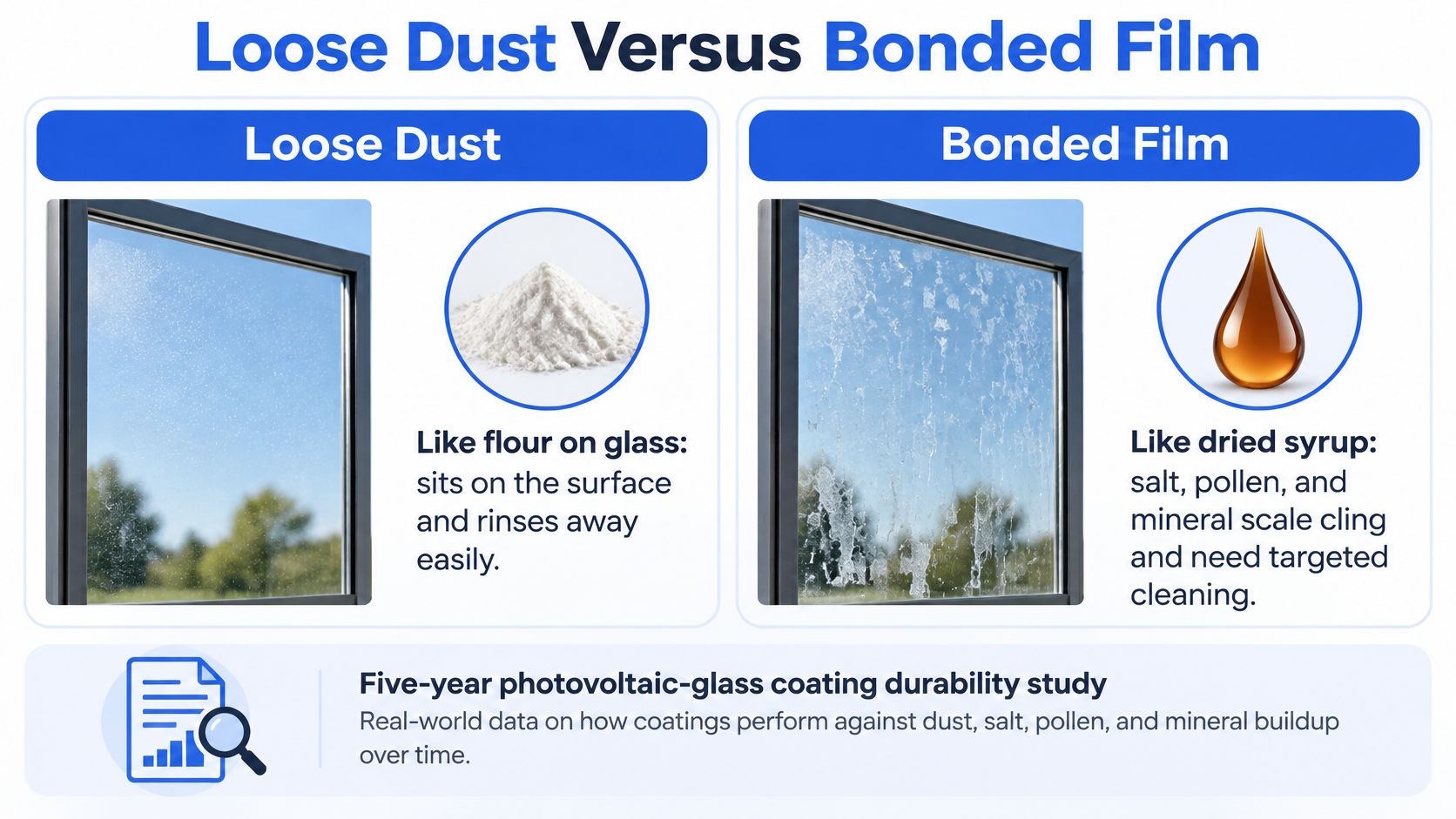
Loose dust is like flour on glass. Bonded film is more like dried syrup. The first sits on the surface; the second clings to it. Coastal aerosol, foothill dust, pollen, and mineral residue can form overlapping layers, so identifying only the top layer can lead to the wrong cleaning method.
A photovoltaic-glass coating durability study conducted over five years found that rinsing removed virtually none of the contamination examined, while water-spray cleaning produced the largest transmittance losses and dry brushing the smallest. That finding doesn’t make dry brushing universally superior. It shows why water alone isn’t a reliable answer to every deposit.
The visual distinction is simple, even when the deposits occur together.
Work from loose material to attached residue
Inspect first, then lift loose particles with a clean, soft nylon brush using controlled contact pressure, where the manufacturer permits it. Use purified water for residue that needs softening or dissolution. Indiscriminate spraying can redistribute contamination rather than carry it away.
- Powdery deposit: Begin with gentle removal of loose material.
- Smearing film: Plan a controlled wet finish rather than repeated dry rubbing.
- Hard, fixed spots: Stop before escalating to abrasive pads, hard bristles, or scraping.
On cool glass that’s safely reachable from the ground, a very light finger swipe can help distinguish powder from a smear. Don’t grind grit across the coating to perform the test, and don’t climb to reach a sample.
The useful rule is brush loose material first, then treat what remains. Purified water may remove soluble film, but established scale needs assessment rather than more force.
When a Clean Pays and When to Wait
| Situation | Starting interval | Lean toward | Wait if |
|---|---|---|---|
| Coastal or near-beach salt and pollen | About every 2 to 4 months | Purified-water rinse after appropriate soft brushing | Output is already at the clean baseline |
| Inland dust and wind grit | About every 4 to 6 months | Soft brush, then water only if film remains | Recent rain cleared loose dust and production recovered |
| Low-soiling roof | About every 6 to 12 months | Inspection first | Glass is clear and production hasn’t slipped |
| After peak pollen | Assess when production remains down | Wet soft brush or water-fed pole | Rain already restored the baseline |
| Bird droppings or sprinkler mineral spots | Assess as soon as they’re seen | Gentle purified-water cleaning, no pad over grit | Inspection shows shade or an equipment issue rather than dirt |
These are our local starting intervals for Ventura and Santa Barbara conditions, not research-measured cleaning requirements. Coastal exposure, nearby trees, roof layout, and individual weather events can justify changing them. The shorter coastal interval shouldn’t become an automatic paid cleaning when the array is already clear and performing normally.
Compare the value recovered with the effort required
Cleaning pays when the value of recoverable electricity justifies the cost and risk of removing the dirt. That’s different from asking whether a dirty panel can produce more after washing. A measurable improvement may still be too small to justify a difficult service visit.
An NREL review of soiling and cleaning economics discussed automated washing for large arrays when generated electricity was worth more than $0.065 per kilowatt-hour and soiling frequently caused at least an 8% power loss. That’s historical utility-scale context, not a residential price threshold or a promise about household savings.
For a homeowner, the practical calculation is simpler:
- Estimate the recoverable loss: Compare current production with a credible clean-condition reference.
- Value the recovered energy: Use the value of electricity to your household, distinguishing self-consumed energy from exported energy where relevant.
- Consider how long the benefit lasts: A recurring salt or dust source may shorten the useful period between cleans.
- Include the whole cost: Account for service charges, equipment, water, time, and safe access.
Don’t count an equipment fault as recoverable cleaning loss. If an inverter alert, persistent shading, or an unexplained panel-level discrepancy accompanies the decline, investigate that before buying tools.
Build a baseline you can actually use
Immediately after a suitable clean, save a monitoring-app record with the date, weather, and production. Include photographs showing the panel condition from a safe viewing point. Keep subsequent comparisons close enough in season and weather to remain useful.
Daily energy is often more informative than a momentary power reading. Passing clouds can change an instantaneous reading before you’ve even put the pole away. Look for a consistent pattern across comparable conditions rather than declaring success from a brief spike.
Clean-or-wait test: If the glass is reasonably clear and production matches the clean reference, wait. If a persistent deposit accompanies a comparable-weather decline, assess cleaning.
Our explanation of whether solar panel cleaning is worth it helps frame that decision around the property rather than a universal schedule. Our residential quotes depend on panel count and roof accessibility, so the same amount of visible dirt won’t necessarily lead to the same service cost.
Preventing unnecessary repeat contamination also matters. Redirect sprinkler overspray and note recurring bird activity rather than repeatedly treating the same marks without addressing their source. Your maintenance log should explain why you cleaned, not just when.
How to Clean From the Ground Safely
Keep the process simple: inspect, clean gently, then verify. Aloha Window Bros uses purified water only for solar cleaning, with no chemicals, abrasives, or pressure washing.
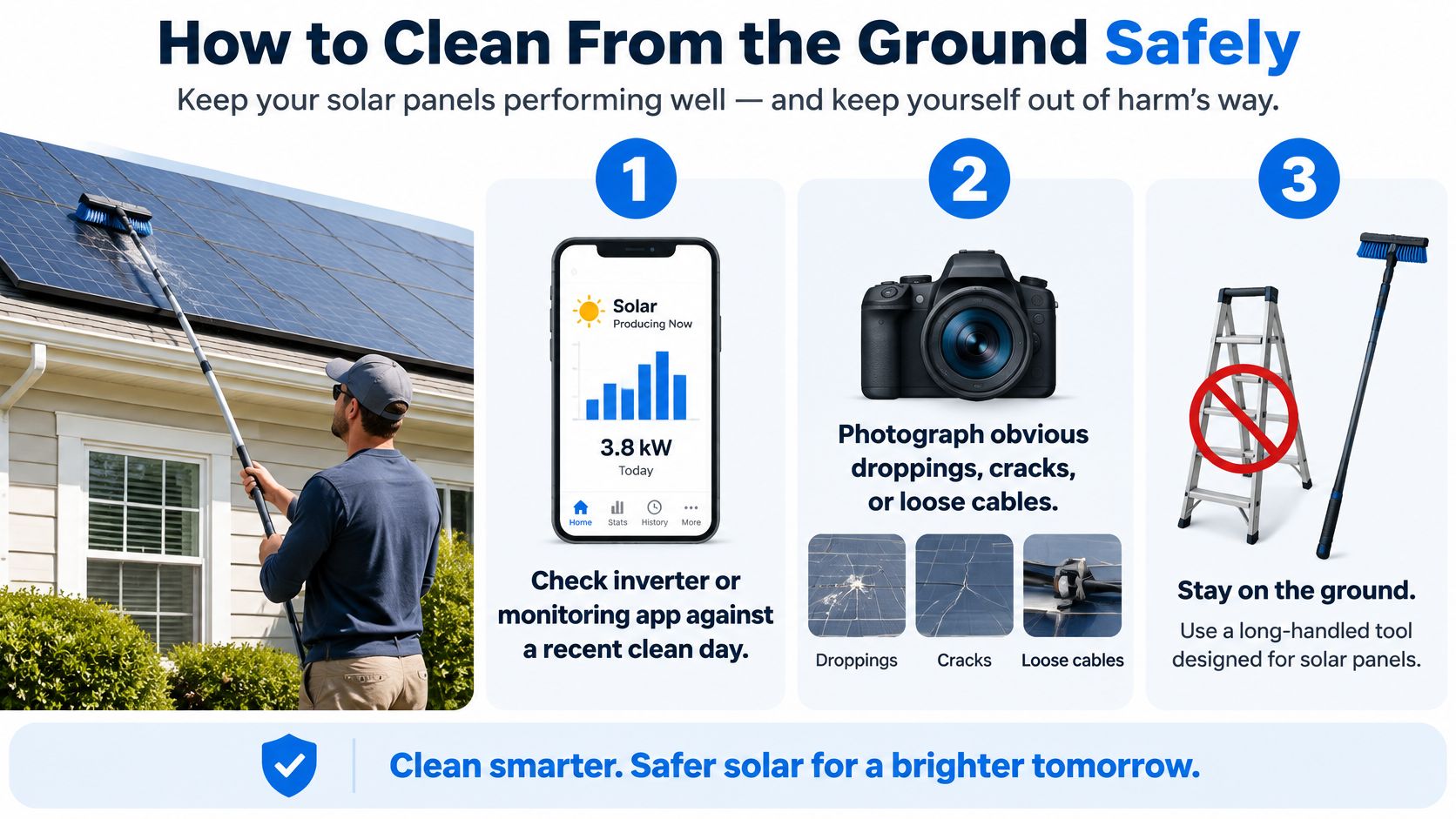
- Check and document. Review the monitoring app against comparable clean conditions. Photograph buildup and any visible damage from the ground; cracks or damaged cables mean stop and arrange qualified assessment.
- Choose cool glass. Work early or late, provided the modules aren’t hot. Turn off nearby sprinklers so overspray doesn’t add fresh spots.
- Follow the electrical procedure. Consult the system’s cleaning instructions before starting. Don’t operate disconnects unless the manufacturer requires it and you can do so safely; modules remain electrically active in daylight even after isolation.
- Lift loose dust gently. Use a clean soft nylon head with light downward strokes, where permitted. Stay on stable ground and keep the pole well away from overhead power lines.
- Treat soluble film. Use low-flow purified water and gentle brush contact. Our explanation of how a water-fed pole system works shows how water reaches the brush without a separate high-pressure spray.
- Keep contact surfaces clean. Rinse the brush and any finishing blade before each pass. Don’t carry trapped grit onto the next section.
- Let the panels dry and verify. Check for remaining deposits and compare production under suitable conditions. Stop if water pools abnormally at a frame edge, and never direct water toward damaged electrical equipment.
The ground-level approach keeps inspection and cleaning within a controlled working area.
Decide on DIY or a Local Clean
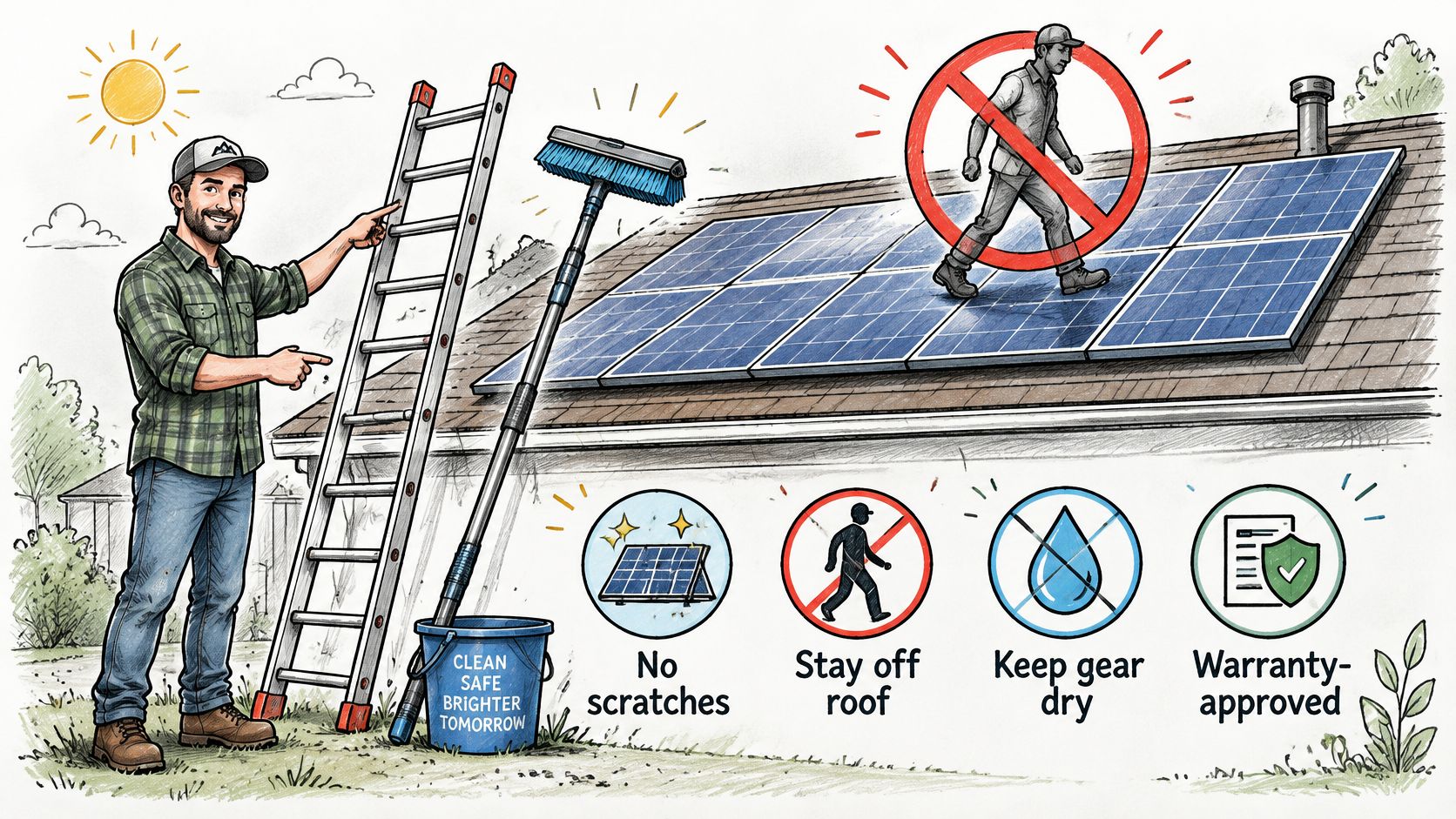
If cleaning requires walking on the modules, leaning from a ladder at the eaves, or stretching beyond control of the pole, it isn’t a sensible DIY job. Safe cleaning means protecting the person, the coating, the electrical system, and the manufacturer’s requirements. Clear glass isn’t a successful result if someone falls or damages the array.
Use the tool’s reach to avoid roof access, not to justify an unstable working position.
Choose based on access and deposit
DIY is reasonable when you can stand securely on the ground, control the brush across the whole target area, and follow the module manufacturer’s permitted method. Cool, undamaged glass with loose dust or light soluble film is a more manageable task than a raised array with attached deposits. You should also be able to keep runoff away from exposed electrical equipment.
Hire help when the roof is steep, the array is beyond controlled pole reach, or droppings and mineral deposits resist gentle treatment. Cracked glass, damaged wiring, and electrical alerts need a qualified solar professional, not a more determined cleaner. Don’t let the cost of a brush tempt you into a job that requires different training or access equipment.
The potential production gain doesn’t override those hazards. A rooftop photovoltaic field study published in 2025, examining a 2 kW system, reported performance improvements ranging from 11.06% to 49.53%, with larger gains under heavier initial soiling. That spread supports assessing the starting condition instead of expecting a standard improvement from every cleaning.
The video provides an additional visual reference for solar-panel maintenance.
Make the service decision property-specific
For Ventura County homeowners, our solar cleaning includes bird-dropping and grime removal, purified water, and soft tools, followed by a check that panels are clear and unobstructed. We don’t use abrasives or pressure washing. Cleaning can remove surface obstructions, but it can’t repair an inverter fault or reverse equipment degradation.
Our free on-site quote accounts for the number of panels and roof accessibility. That lets you compare the actual cleaning cost with the condition of your array instead of relying on a generic per-roof assumption. You can book online or call (805) 341-4121, and we come to your property.
Keep your production screenshots and safe ground-level photographs available for the visit. They help distinguish a cosmetic concern from a persistent performance change and give you a useful reference after cleaning.
Aloha Window Bros offers solar panel cleaning with purified water and soft, nonabrasive tools, including bird-dropping removal and a clear-panel check. Visit Aloha Window Bros to arrange a free on-site quote and choose a cleaning approach that fits your panels, deposits, and roof access.