

To clean storefront windows, rinse off loose grit first, wash from the top down with a mild, non-abrasive solution or purified water, squeegee with a clean blade, and dry the edges, all while keeping the entrance open and the sidewalk safe. How often you repeat that depends on the site: traffic, salt, dust and sprinkler overspray set the interval, not a generic calendar.
A shop can have a polished sign, well-dressed displays and a welcoming entrance, yet still look neglected when the glass is hazy or covered in handprints. Storefront cleaning also has to happen without blocking customers, soaking the pavement, or putting someone on an unstable ladder beside moving foot traffic.
The right approach combines clean water, controlled technique, awareness of the site, and a schedule that fits the business. Coastal salt, inland dust, sprinkler overspray, mullions, frames and door hardware all change how you work. The process below is written for ground-level commercial glass, with clear limits for situations that need trained professionals.
Table of Contents
- Preparing Your Storefront Window Cleaning Toolkit
- The Step-by-Step Technique for Streak-Free Glass
- Handling Specific Challenges Like Salt and Hard Water
- Prioritizing Safety and Reducing Risks on the Job
- Managing Business Operations and Maintenance Schedules
- When to Call in the Professionals
- Frequently Asked Questions
Preparing Your Storefront Window Cleaning Toolkit
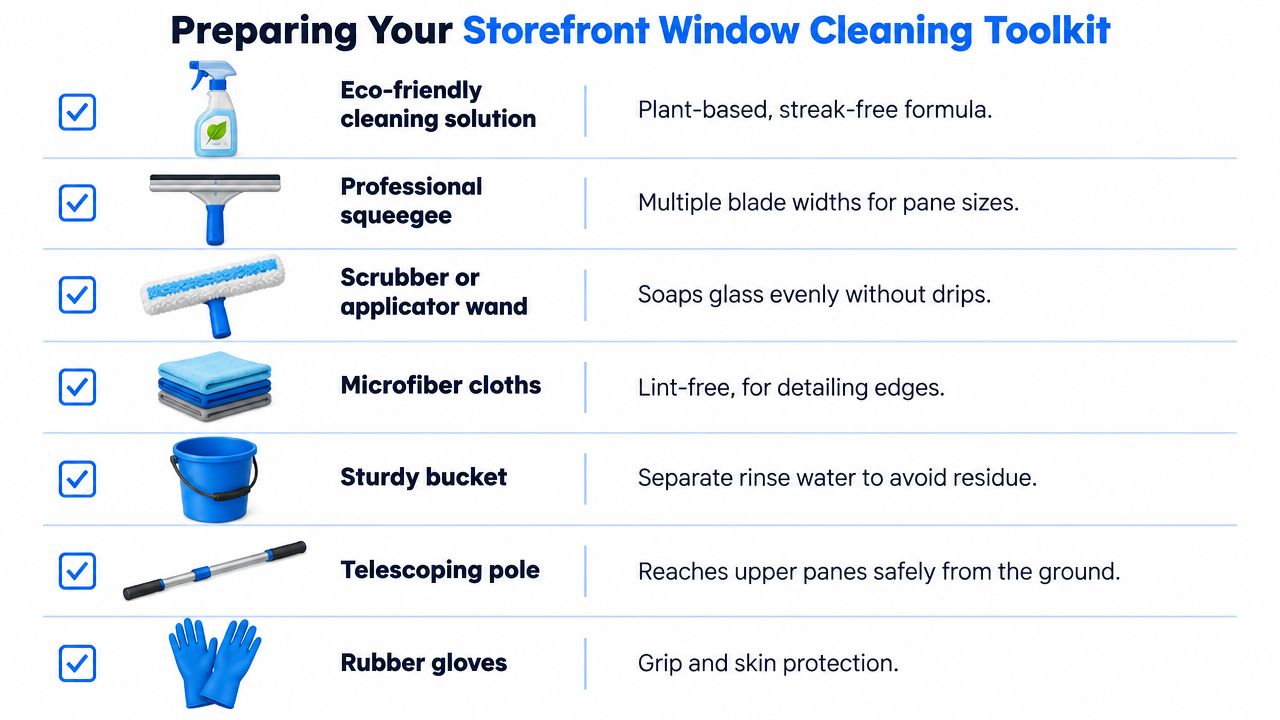
Good results start before the first scrub. Bring equipment that separates loose dirt from final detailing, keeps dirty water away from clean glass, and lets you work safely around customers and displays.
Build the kit around water quality
A bucket, applicator or scrubber, professional squeegee, lint-free microfiber cloths, gloves and a telescoping pole cover most routine storefront work. When you need detergent to loosen fingerprints, oily marks or traffic film, use a mild, non-abrasive glass cleaning solution. That is what the glass industry’s own cleaning standard calls for, and the same standard says glass cleaning solutions should not include acids, especially muriatic (hydrochloric) and hydrofluoric (NGA/IWCA Glass Technical Paper FB01-00). Keep the mixture restrained. Excess soap leaves residue and makes the final rinse harder.
For exterior glass, purified water is often the most reliable finishing tool, because it carries none of the dissolved minerals that tap water leaves behind as it dries. Unger, which makes pure-water window cleaning equipment, says water above 10 parts per million (ppm) of total dissolved solids (TDS) may not produce streak-free, spot-free results, and recommends keeping it at roughly 5 to 10 ppm (Unger pure-water cleaning guidance). Drinking water is held to a much looser bar: the US EPA’s secondary drinking water guideline for TDS is 500 milligrams per liter (roughly 500 ppm), a non-enforceable level tied to aesthetic problems that include hardness, deposits and staining (EPA secondary drinking water standards). Water can be perfectly fine to drink and still spot a window.
A handheld TDS meter gives you a practical check before the route begins. If the reading is too high, don’t assume a clean-looking rinse will dry cleanly. Switch to properly purified water, or use a conventional wash-and-squeegee method with clean solution and fresh detailing cloths. Our guide to purified water window cleaning explains how the filtration works.
Match tools to the storefront
Use a soft brush for loose dust and a dedicated glass scrubber for washing. Keep separate microfiber cloths for glass, frames, sills and door hardware. A cloth that has picked up grit from an aluminum sill can drag that grit across the next pane.
Choose squeegee blade widths that suit the pane rather than forcing one large tool into narrow mullion bays. Inspect blades for nicks, wash the rubber, and replace damaged edges. For screens, remove them when practical and clean them with equipment meant to lift dust without bending the frame, or leave them to a screen cleaning service.
A water-fed pole can reach upper panes from the ground, but it isn’t a substitute for judgment. Learn the equipment and its limits with our guide to how a water-fed pole system works. Before opening the bucket, identify power lines, fragile signage, awnings, sprinklers, uneven paving, and places where runoff could enter the business.
The Step-by-Step Technique for Streak-Free Glass
Start by protecting the work area. Move or cover items near the entrance, place cones where pedestrians can see them, and tell the manager which doorway or pane you’ll handle first. Cleaning in manageable sections keeps the entrance open instead of turning the whole frontage into a wet obstacle.
Before the first full pane, clean one small area and check it in daylight for scratches or an exposed coating. The NGA/IWCA standard strongly recommends that test and gives a simple way to find a coating: touch a pencil point to the glass, and if the reflection meets the real pencil point, the coating is exposed on that side.

Wash from the top down
The glass standard says exterior cleaning should begin at the top and continue downward, so residue and solution never run onto glass you have already finished.
-
Remove loose grit. Rinse or brush away dust, sand and dry particles before rubbing the pane. Grit trapped under a cloth, brush or blade can scratch glass, which is why the standard says not to begin cleaning without rinsing off excessive dirt and debris.
-
Wet the upper edge first. With a water-fed pole, scrub the top edge and corners before working across the main field. Keep the brush square to the pane and use overlapping passes. Don’t jab the brush into mullions, locks, seals or handles.
-
Work downward in controlled sections. Keep contact even and let the brush loosen contamination rather than relying on force. If you’re using a scrubber and squeegee, apply a modest amount of solution and avoid spraying hot glass, where it can dry before you finish.
-
Squeegee with a clean blade. Begin at the top and use smooth, overlapping pulls. Wipe the blade after each pass or whenever it collects grit. Dirty rubber transfers residue instead of removing it.
-
Detail the perimeter. Moisture pools at corners, gaskets and mullion joints. Use a clean microfiber cloth to dry the edges, then inspect from different angles. A pane can look clear head-on while holding a wet line along the frame.
Practical rule: If the glass dries before you complete the pass, reduce the working area, add controlled moisture, or choose a cooler part of the day.
For conventional work, clean blades, clean water and edge detailing matter more than a heavy dose of soap. Our guide to the best streak-free window cleaner traces most streaks to cleaner residue, a dirty cloth, glass drying too early, or minerals in the rinse water.
Handling Specific Challenges Like Salt and Hard Water
Coastal salt and inland dust don’t behave like ordinary fingerprints. Salt aerosol can leave a dull film on the pane and settle into frame joints, while windborne dust forms a gritty layer that should be rinsed away before scrubbing. In both cases, dry wiping is the wrong first move because it can spread contamination and drag grit across the glass.
Use a gentle rinse or purified water to float loose material away. Wash in smaller sections when salt has dried into a visible film, and pay attention to the lower corners and frame channels where residue collects. A second rinse is often more useful than more detergent.
Diagnose mineral deposits before choosing a remedy
Hard water is high in dissolved minerals, largely calcium and magnesium, and the USGS describes the spots and film it leaves on glassware as hard-water residue (USGS Water Science School). On a storefront, sprinkler overspray is a common culprit, especially when a nozzle reaches the frontage repeatedly. The marks can look like ordinary dirt, but soap and a quick squeegee pass won’t remove established mineral buildup.
Use this decision guide:
- Check for a coating first: Run the pencil test. The NGA/IWCA standard says razor blades should never be used on coated glass surfaces.
- Light film: Soak with clean water and a mild, non-abrasive solution, agitate gently, squeegee, then rinse with purified water and dry the perimeter.
- Stubborn spotting: Give the soak more dwell time rather than more pressure. Keep any stronger product off frames and seals, because the standard warns that glazing materials don’t stop cleaning agents from entering the glazing pocket, where they can damage the glass edge or affect an insulating glass seal.
- Bonded crust: Treat it as non-routine work. The standard says razor blades and metal scrapers should not be part of routine cleaning, notes that heat-treated glass is used in most architectural glass products today, and calls razor blades the last possible option on it.
- Clouding that remains: Wet the pane. If the haze looks the same wet and dry after careful cleaning, it may be etching, which is damage to the glass itself rather than a deposit on it. Stronger chemicals or harder abrasion won’t fix it.
Our guide to removing hard water spots from windows walks through each stage in detail. The important distinction is between preventive maintenance and restoration. Purified water helps prevent new mineral residue, but it won’t reverse etching that has already changed the glass surface.
Timing matters too. Avoid cleaning in high wind, during active dust movement, or while nearby sprinklers are running. The glass standard specifically says to check that wind isn’t blowing solution and residue onto glass you’ve already cleaned, and to avoid cleaning tinted or coated glass in direct sunlight, where the surface may be too hot. Then shorten the service interval if salt, dust or irrigation brings the film back quickly.
Prioritizing Safety and Reducing Risks on the Job
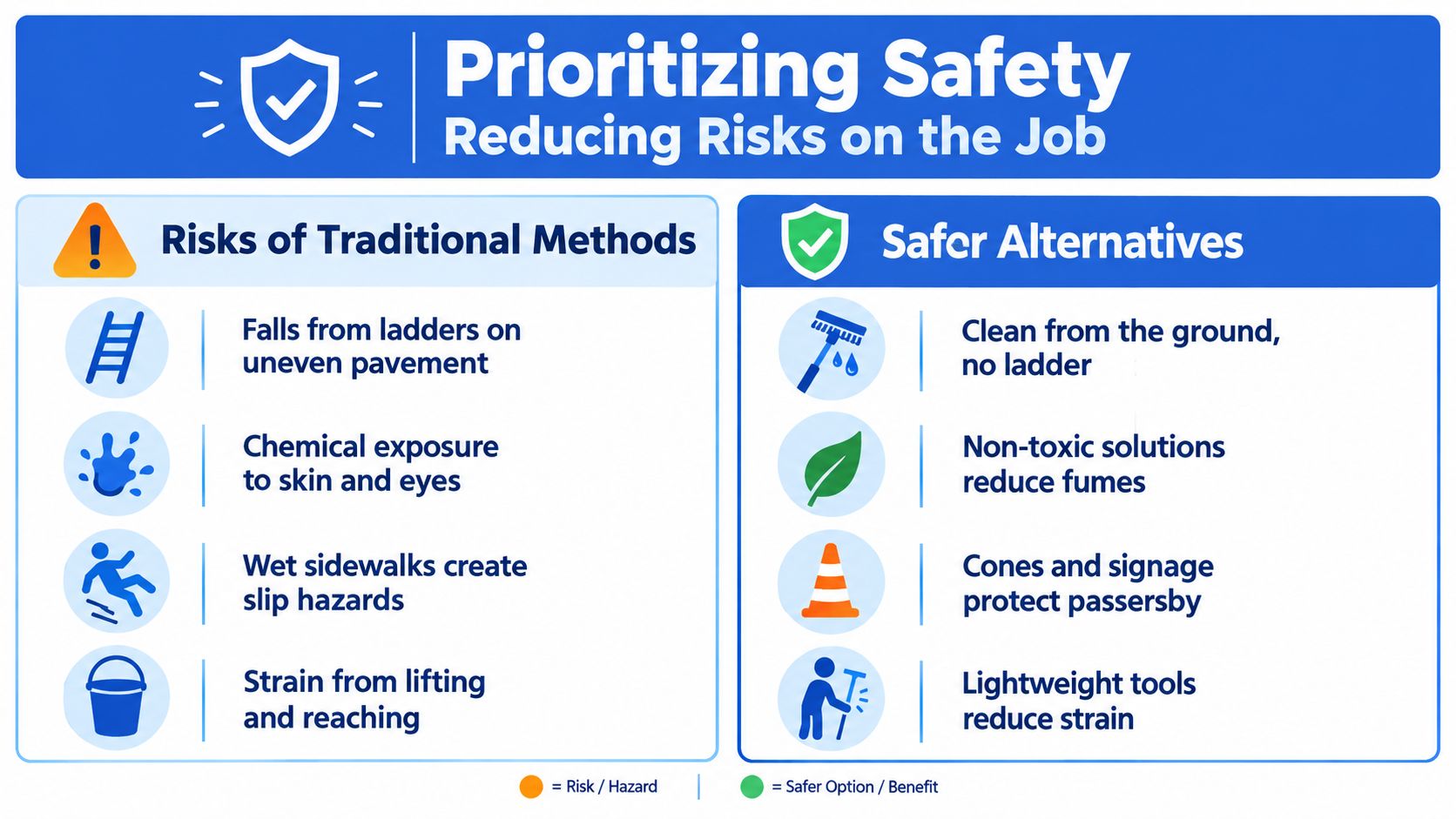
A busy storefront adds hazards that a private home may not have. Pedestrians step around equipment, doors open unexpectedly, delivery vehicles pass close to the curb, and wet paving becomes slippery. A worker focused only on the pane can miss the people and surfaces around it.
Make ground-level work the default
Keep routine work on the ground wherever you can. A pole used from the sidewalk, or cleaning upper panes from inside the shop, reaches most storefront glass without anyone climbing, and it takes the ladder out of the busiest part of the job. A pole isn’t risk-free: one that is too long for the operator, unstable in wind or hard to control creates its own hazards, and long poles must stay clear of overhead power lines.
When a ladder is the only way to reach a pane, OSHA’s general-industry ladder rule sets the baseline for employees (29 CFR 1910.23):
- Ladders are used only on stable, level surfaces unless they are secured or stabilized, and ladders on slippery surfaces must be secured and stabilized.
- A ladder in a doorway, passageway or driveway, where traffic could knock it, must be secured or guarded by a temporary barricade such as a row of traffic cones or caution tape.
- The worker faces the ladder, keeps at least one hand on it while climbing, and carries nothing that could cause a loss of balance.
- The top step and cap of a stepladder are not used as steps.
If the work moves onto a roof or balcony with an unprotected edge 4 feet or more above a lower level, OSHA’s fall protection rule requires the employer to protect workers from falling (29 CFR 1910.28). At that point the job has usually outgrown a shop’s own staff.
Protect the crew and the public
Set cones and visible signs before wetting the pavement. OSHA requires employers to keep walking-working surfaces free of hazards such as leaks and spills (29 CFR 1910.22), and on a storefront the same puddle is a hazard for customers. Route hoses away from doorways and trip paths, assign one person to watch pedestrian movement on a busy frontage, and pause work when customers or deliveries need the space.
Use these physical checks on every route:
- Keep a front-on stance: Face the glass and move your feet instead of twisting under load.
- Lower the strain: Keep elbows below shoulder height, alternate arms, and take breaks before fatigue changes your technique.
- Control the pole: Keep the brush from striking mullions, hardware, signs or awnings.
- Respect the weather: Don’t use long poles in high wind or near overhead power lines.
Chemical safety matters too. Wear gloves, follow the product label, keep runoff out of door thresholds, and never mix cleaning chemicals. If staff handle a commercial descaler or another hazardous chemical, OSHA’s hazard communication standard requires the employer to provide labels, safety data sheets and training on the hazardous chemicals in their work area (29 CFR 1910.1200). For many exterior panes, purified water and gentle agitation reduce the need for stronger products.
Managing Business Operations and Maintenance Schedules
A storefront cleaning plan should fit the business, not interrupt it. Ask the manager about opening routines, delivery windows, peak foot traffic, customer queues and which entrance must stay accessible. Then clean in short sections, leaving a dry path and moving signs as each area is finished.
There is no universal interval. The NGA/IWCA standard says glass should be cleaned as dirt and residue appear, with frequency tailored to site conditions and local environmental factors. As our guide to storefront glass types, framing and coastal wear puts it, weekly or biweekly cleaning may suit high-traffic locations, while lower-traffic properties can often use monthly or quarterly service. Coastal salt, dusty wind, sprinkler overspray, nearby construction and heavy hand contact all shorten the interval.
Turn observations into a maintenance calendar
Record the condition of the glass at each visit. Note salt film, dust loading, hard-water spots, fingerprints on doors, and whether frames or sills are collecting residue. This record helps you choose between a light maintenance clean and a more detailed visit without guessing.
| Storefront condition | Practical response |
|---|---|
| Light dust and occasional fingerprints | Schedule routine glass and door cleaning |
| Heavy customer contact | Add more frequent entry and handle detailing |
| Coastal salt film | Rinse thoroughly and shorten the inspection interval |
| Sprinkler spotting | Redirect irrigation and plan mineral treatment when needed |
| Dusty frontage or nearby construction | Increase visual checks and rinse loose grit before scrubbing |
Keep the property owner or manager informed about permissions, water access, drainage, insurance requirements and any restrictions on ladders or equipment. The practical objective is consistency: clean before grime bonds to the surface, protect the entrance while work is underway, and leave a record that tells the next crew what changed.
When to Call in the Professionals
A ground-level shop with accessible panes is a reasonable setting for trained staff to maintain. Multi-story glass, restricted access, overhead lines, severe mineral deposits, coated or fragile architectural glass, and panes above busy pedestrian areas are different problems. They need equipment selection, risk controls and restoration judgment that a basic bucket-and-squeegee setup can’t provide.

A professional crew can also combine glass, screens, frames, tracks and sills into one planned visit. Before you hire, our guide to choosing a commercial window cleaning company covers the questions and documents to ask a vendor for, and our commercial window cleaning prices guide explains what drives the cost. The only reliable figure for your own frontage comes from a free on-site quote.
Frequently Asked Questions
How often should storefront windows be cleaned?
There is no single interval that suits every shop. The NGA/IWCA glass cleaning standard says glass should be cleaned as dirt and residue appear, with frequency tailored to site conditions and local environmental factors. Busy entrances that collect fingerprints and door-edge grime often need weekly or biweekly attention, while quieter frontages can often run monthly or quarterly. Coastal salt, dust, sprinkler overspray and nearby construction all shorten the interval.
What should I use to clean storefront glass?
Use clean water and a mild, non-abrasive glass cleaning solution applied with a scrubber or soft brush, then remove it with a professional squeegee and dry the edges with lint-free microfiber. The glass industry cleaning standard says solutions should not include acids, especially muriatic and hydrofluoric. For exterior panes, purified water works well because it leaves no minerals behind, and Unger recommends keeping it at 10 ppm total dissolved solids or less.
Can I clean storefront windows myself?
Yes, for ground-level glass you can reach safely from the sidewalk or from inside the shop. Rinse off grit first, wash from the top down, squeegee with a clean blade and dry the edges. Set cones before wetting the pavement. If a ladder has to stand in a doorway or walkway, OSHA requires it to be secured or guarded by a barricade such as traffic cones. Multi-story glass, overhead power lines and roof or balcony edges are jobs for a trained crew.
How do you remove hard water spots from storefront glass?
First touch a pencil point to the glass. If its reflection meets the real tip, a coating is exposed on that side, and razor blades should never be used on it. Soak the spots with clean water and a mild, non-abrasive solution, give it dwell time rather than pressure, squeegee, and rinse with purified water so new minerals are not left behind. If the haze looks the same wet and dry after careful cleaning, the glass may be etched and needs a restoration assessment.
What is the best time of day to clean storefront windows?
Pick a time when the glass is out of direct sun, the wind is calm and foot traffic is light, such as before opening or after closing. The NGA/IWCA glass cleaning standard advises against cleaning tinted or coated glass in direct sunlight because the surface may be too hot, and says to check that wind is not blowing solution onto glass you have already cleaned. Also avoid times when nearby sprinklers are running.
Aloha Window Bros cleans residential and commercial glass across Ventura County and Santa Barbara County, including interior and exterior glass, screens, frames and sills, with eco-friendly, biodegradable solutions and water-fed poles for hard-to-reach panes. Request a free on-site quote from Aloha Window Bros, or see what our window washing service includes, and set a maintenance schedule that keeps your storefront clear without putting staff or customers at risk.