

You’re in the driveway with a phone full of elevation photos, a pane count that doesn’t match the last quote, and a homeowner who hears “windows” and assumes screens, tracks, skylights, and the solar array are included. That mismatch is where the argument starts after the crew leaves.
A window cleaning estimate template is the written scope boundary, not a courtesy total. Each line names a surface, the access method that reaches it, and the price for that work. If it isn’t on the page, it isn’t in the job. I would rather hand a property manager a longer form they can compare than a one-line bid that looks cheap until someone asks who was supposed to pull the screens.
Fill the same blocks in the same order on a house, an HOA, or a storefront, so a signature means the same thing every time.
Table of Contents
- Template Fields Every Estimate Needs
- On-Site Versus Virtual Estimates Compared
- Line Items for Labor, Materials and Lifts
- Access Methods and Risk Notes That Set Price
- Pricing Solar Panels Without Promising Output
- When an Estimate Becomes a Binding Contract
- Writing Exclusions and Change Orders
- Check Your Estimate Against Local Ranges and Book
Template Fields Every Estimate Needs
Copy this structure into a fillable form before the next walkthrough. Eight blocks, filled top to bottom, turn a conversation into a document someone else can price against.
| Block | Field | What to Enter |
|---|---|---|
| 1. Parties | Customer name and billing contact | Who signs and receives the invoice |
| 1. Parties | Service address | Where the work happens, including gate or building access |
| 2. Dates | Estimate date, validity period, proposed service date | Sets how long the price holds |
| 3. Scope | Glass, screens, frames, tracks, sills, skylights, solar panels | A count per surface, not one total |
| 4. Access and risk | Working height, ladder or lift need, electrical lines, pedestrian exposure | Explains how the price was built |
| 5. Line items | Quantity, unit, unit price, extended amount | Labor, materials, lifts and add-ons |
| 6. Totals | Subtotal, taxes or fees, total price | One total the customer can compare |
| 7. Terms | Payment terms, exclusions, change-order rule | Limits the scope in writing |
| 8. Acceptance | Signature, date, accepted or declined status | Records approval before work begins |
Why the blocks exist in that order
The U.S. Federal Trade Commission advises consumers to obtain written estimates that describe the work, materials, completion date, and price, and recommends comparing multiple estimates rather than automatically selecting the lowest bid.
Parties come first because the person who pays is often not the person who opens the gate. Keep the billing contact separate from the service address, and note the gate code or building entry on the address line. Dates come next: estimate date, how long the price holds, the proposed service date, and a plain completion window. Pane counts, multi-story access, hard-water spotting, screen removal, and coastal grime cannot be priced from “clean the windows.”
Scope is a count per surface. Interior glass and exterior glass are separate lines. So are screens, frames, tracks, sills, skylights, and solar panels. Access and risk explains the labor behind those counts. Line items carry quantity, unit, unit price, and extended amount. Totals are subtotal, taxes or fees, and one total price.
A blank exclusions line is where most disputes start, because the customer assumes everything visible was included.
Terms name payment, exclusions, and the rule that added work needs a written change. Acceptance is signature, date, and an accepted or declined status. That block is the handoff from inspection to scheduling, and the start of the agreement once they sign.
The same habit works outside glass. You can build a reusable design proposal template in LiveDocument, then mirror it here: scope first, price second, signature last. Save the table as a fillable form and test it on one real property before you send it to any client.
On-Site Versus Virtual Estimates Compared
| Factor | On-Site Estimate | Virtual Estimate |
|---|---|---|
| Pane and screen count | Counted during walkthrough | Estimated from photos and customer count |
| Access and hazards | Inspected directly | Described by customer, flagged as unknown |
| Skylights and roof work | Confirmed on site | Excluded or contingent until confirmed |
| Price certainty | Higher, based on measured scope | Lower, a range until confirmed |
| Best for | Multi-story, commercial, HOA, solar | Single-story, simple layout, repeat customer |
What an on-site walkthrough actually verifies
On site, the count is yours, not the customer’s memory. The crew inspects the windows and protects landscaping before any solution goes on the glass, then cleans with eco-friendly solutions and professional tools, and walks through every window with the customer before leaving. That last pass is where a missed slider or a torn screen gets named while both of you are still standing there.
Use on-site for multi-story homes, storefronts, HOA properties, skylights, solar arrays, and any job where access is a question. A photo cannot show a soft planter, a sidewalk full of pedestrians, or a balcony door that doesn’t open.
Where a virtual estimate is enough
A virtual estimate works for a single-story home with a simple layout, and for a repeat customer whose last signed scope is still accurate. Minimum data: a photo set of each elevation, approximate working height, screen count, skylight count, and a note on coastal salt or dust. Every unknown is an exclusion or a contingency, not a silent assumption.
An HTML form template for quote requests from FormBackend is a practical way to collect those photos and counts before anyone drives out. Treat the virtual number as a range.
A virtual price becomes firm only after the first on-site visit confirms the count.
Line Items for Labor, Materials and Lifts
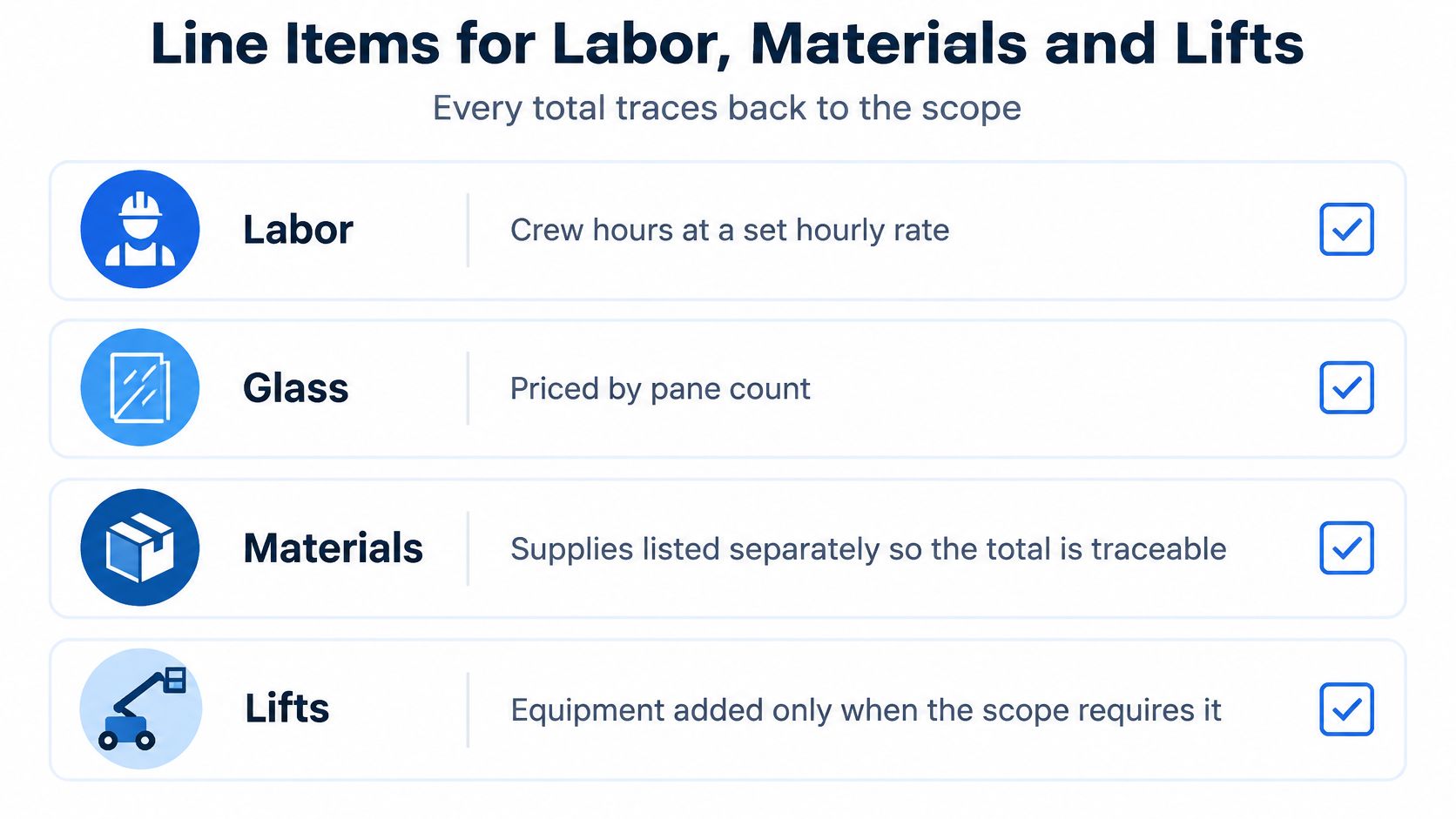
Every extended amount should trace to a count you wrote down. A lump sum cannot. A property manager can audit hours, panes, and a lift rental. They cannot audit “windows, $400.”
| Line Item | Pricing Basis | What to Record |
|---|---|---|
| Labor | Crew hours at a set hourly rate | Crew size and estimated hours per surface |
| Glass | Pane count, interior and exterior counted separately | Count of each side, not just the house total |
| Screens | Per screen, adjusted for buildup | Number of screens and level of dirt |
| Frames, tracks and sills | Included in the four-in-one clean or quoted per surface | Whether included or excluded |
| Skylights | Per unit | Count and access method |
| Access allowance | Ladder time, pole time or lift rental | Access category from the access section |
| Mobilization or trip charge | Flat charge per visit | Disclosed before scheduling |
| Materials | Purified water, eco-friendly solution, consumables | Small allowance shown as its own line |
| Add-on services | Gutter or solar work quoted separately | Separate line, never merged into glass |
How the lines add up
Labor is crew size times hours at your set hourly rate, split by surface so a slow track detail doesn’t hide inside the glass. Glass is pane count, interior and exterior counted apart. A double-hung with both sides cleaned is two units of work, not one window. Screens are per screen, with a bump when pollen or salt film means a wash, not a rinse. Frames, tracks, and sills are either inside the four-in-one clean or their own per-surface lines. Write which. Skylights are per unit, and the access method sits on that line.
Access allowance is ladder time, water-fed pole time, or lift rental, copied from the access block so the dollars match the method. Mobilization is a flat charge per visit, shown before anyone is on the calendar. Materials stay a small separate allowance for purified water, eco-friendly solution, and consumables. Gutters and solar never fold into the glass line.
Say a single-story house has 24 panes, 4 screens, and 2 skylights. Glass is 24 interior plus 24 exterior if both sides are in scope. Screens are 4, with a buildup note on each. Skylights are 2, each tagged ladder or pole. Labor hours sit beside those counts. Mobilization and the materials allowance are their own lines. Add the extended amounts and you have a subtotal you can defend. Drop the screens and the total drops by that line alone.
AmaJova’s guide to pricing services is a useful check on whether your hourly rate covers the stop, not just the minutes on the glass. Never merge an add-on into the glass line. The customer should be able to approve or remove each one on its own.
Access Methods and Risk Notes That Set Price
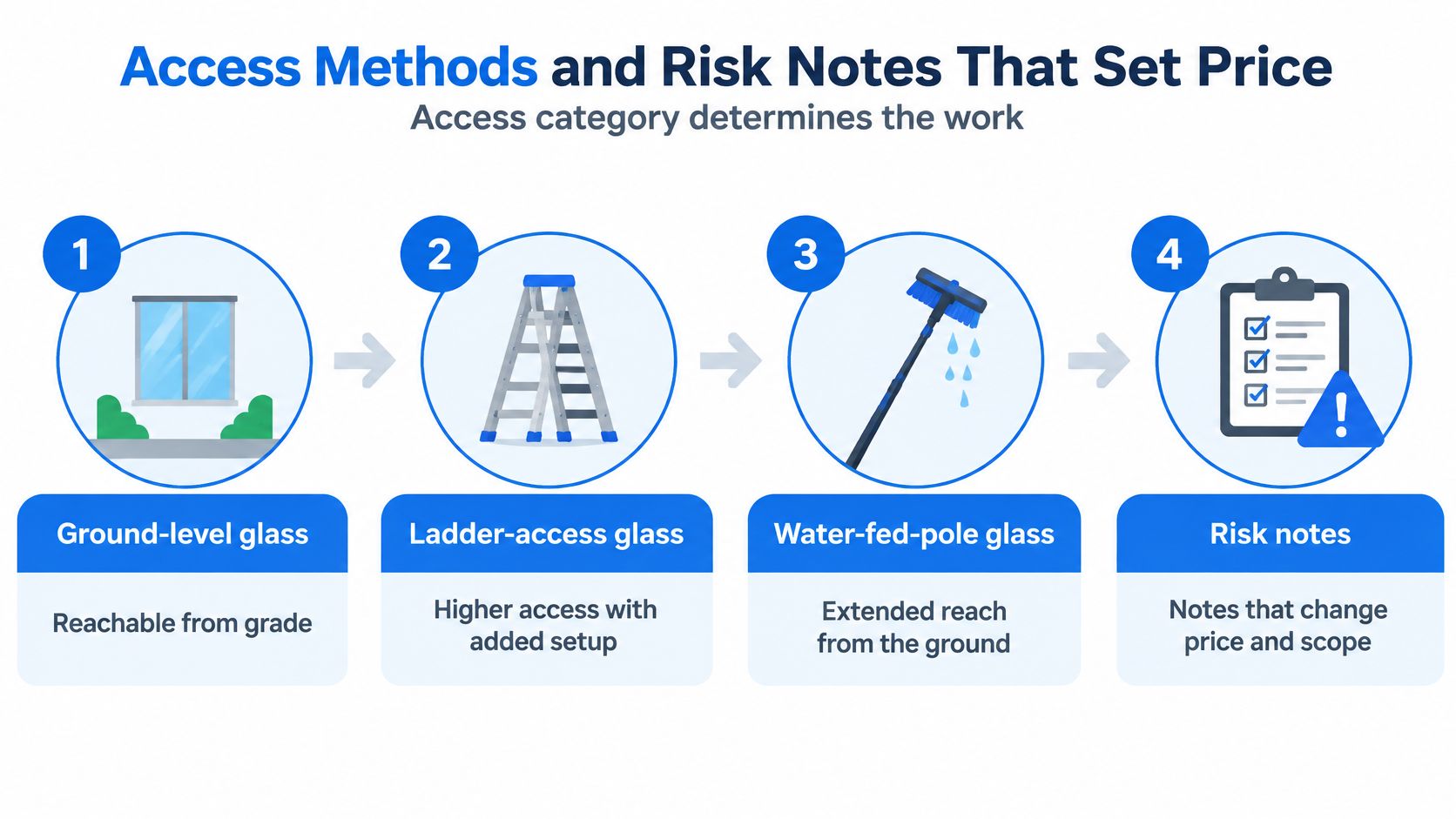
Price follows how you reach the glass. Sort every elevation into one of four categories, and give each its own labor, mobilization, and safety allowance.
| Category | Reach | What the allowance covers |
|---|---|---|
| Ground-level glass | From grade | Base labor only |
| Ladder-access glass | Setups off the ground | Extra setup time and a second person when the ladder requires it |
| Water-fed-pole glass | From the ground with extended reach | Pole time, purified-water setup, slower production |
| Lift-access glass | Powered equipment | Rental, operator time, exclusion zone |
What to write on each elevation
For every side of the building, record approximate working height, glazing type, skylights, roof or balcony access, and whether a ladder, a water-fed pole, or a lift is feasible. Then the hazards: overhead electrical lines, ground that won’t hold a ladder, pedestrian exposure, coastal wind, landscaping in the drop zone, and a public sidewalk.
OSHA aerial-lift guidance requires operators to be trained and authorized, controls inspected before daily use, manufacturer load limits respected, and workers to remain on the platform floor rather than using ladders or other devices to extend reach. OSHA also identifies ANSI/IWCA I-14.1 as the window-cleaning safety standard for access equipment and related practices. Your template needs fields for equipment method, pre-job hazard controls, the exclusion zone, and property protection.
Glass you cannot reach safely is an excluded-work line, not a pane you skip without noting it. On multi-story façades, the method choice is also a production choice. A pole day and a lift day are different jobs, which is why high-window cleaning has to be scoped before anyone quotes a single rate per pane.
Write the customer’s obligations in the same block: parking, access codes, roof permission, electrical-line information, and building records. If the property manager has to provide them, the estimate says so before the crew is booked.
Pricing Solar Panels Without Promising Output
Price the array as its own module: base mobilization, plus a per-module or per-array rate, then modifiers. Solar pricing turns on two variables, panel count and roof accessibility, so keep both out of the window total where they would blur the per-pane math.
Record panel quantity and array layout apart from the cleaning method. Also record roof pitch, walkable paths, obstructions, hose or purified-water reach, visible bird waste or mineral deposits, and whether the work is dry, water-based, or needs an approved detergent. Each of those entries ties a line item to an access decision, which is what makes the estimate defensible when the customer questions the number later.
Modifiers that change the rate
- Steep roofs: pitch is too sharp for a normal walk path, so labor and fall protection go up.
- Multiple roof sections: each array is its own setup, not one continuous wash.
- Restricted hose access: purified water cannot reach without extra hose or a tank move.
- Heavy deposits: bird waste or mineral crust is more than light dust.
- Lift requirements: the array is not reachable from a walkable roof.
The cleaning method belongs in writing too. Follow the panel manufacturer’s instructions: plain demineralized water, a manufacturer-recommended mild detergent when water alone is not enough, and no high-pressure water, brushes, solvents, abrasives, or harsh detergents that can damage components or surfaces. List the prohibited methods as excluded work, not as optional upgrades.
The output sentence
The scope covers removing bird droppings, grime, and surface soiling. It stops short of any performance promise. Put this sentence on the estimate: cleaning removes surface soiling and does not guarantee a specific energy-production increase, because weather, shading, equipment condition, and how the soiling is spread all affect output. That single line is the boundary that keeps a signed estimate from reading like a production warranty.
Keep the solar charge on its own line even when panels are scheduled on the same visit as the window wash. The crew is already on site, so mobilization is shared rather than billed like a separate trip. For how those module counts usually land in a local quote, see solar panel cleaning cost.
When an Estimate Becomes a Binding Contract
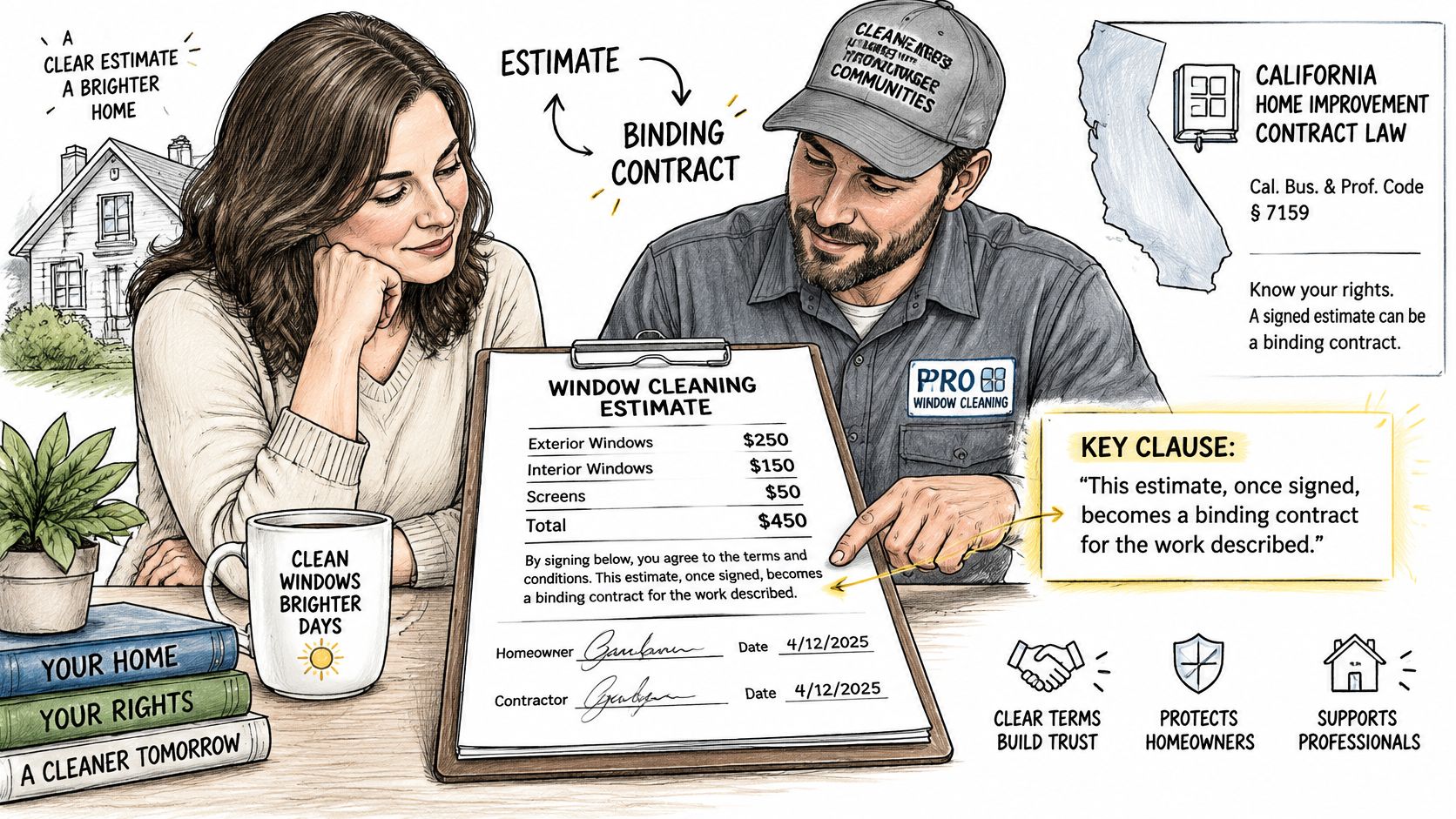
California sets a clear benchmark, and most generic window forms ignore it. The Contractors State License Board states that written contracts are required for home-improvement projects exceeding $500 in combined labor and materials.
A routine window-cleaning visit may not fall in that same legal category. Treat the rules as a design standard for the template, not as a conclusion that every house wash is a home-improvement contract. Confirm the line with the licensing board before you rely on one reading.
What the signed document should carry
State guidance says the document should identify the work, price, payment schedule, start and completion timing, contractor identity, business address, and license number. Changes must be written and understandable. Contracts include approximate start and completion dates, and a signed, dated copy goes to the customer before work begins.
For a covered home-improvement job, the down payment is limited to the lesser of $1,000 or 10% of the contract price. Your form should also separate service location from billing contact, itemize labor and optional services, and say whether the price is fixed or subject to site conditions.
Label the paper as an estimate or a fixed quote, state the validity period, and mark the signature line as the moment it becomes the agreement. Customer approval is documented before anyone sets a ladder. That sequence scales from a single house to an HOA and a property-management portfolio without turning every visit into a construction packet.
Writing Exclusions and Change Orders
A customer points at a skylight halfway through the job and says, “while you’re up there.” Added work is what turns a clean quote sideways. Screens, sills, or a solar row show up after the inspection, and the answer should be one procedure every time.
- Describe the added work by surface and location, never by a vague “extra windows.”
- Price it with the same line items as the original estimate, so the math stays familiar.
- State the effect on timing and on the access method, including any new lift or roof permission.
- Get written authorization before that work starts.
- Update the total and the scope record so the file matches what was signed.
Written change orders should be signed before the added work begins, and any service or trip charge belongs on the written estimate, on its own line, rather than in a verbal aside. If you price time and materials, the document should state the estimated contract amount, the labor rate, the material estimate, the billing increments, and that the estimate cannot be exceeded without the buyer’s written authorization. Every changed line ties back to a specific surface and a specific access method, which is what keeps the signed paper and the actual job describing the same work.
Name the exclusions in plain language
- Unsafe reach: glass the crew cannot get to without a safe setup.
- Hard-water etching: mineral damage that calls for restoration work, beyond what a wash can fix.
- Failed glass: cracked or loose panes.
- Torn screens: noted on the estimate and replaced only when a separate line authorizes it.
- Roof work without permission: no array and no skylight until access is granted.
- Electrical hazards: lines that block a pole or a lift path.
An unforeseen condition is something you find on site, like a screen frame that comes apart in your hands. A scope change is something the customer asks for. Treat them as two different events. The first may pause the work until it is documented. The second needs a new price before anyone starts.
Three mistakes cause most of the callbacks: a scope that only says “clean windows,” add-ons agreed in the driveway and never written, and no baseline photos before the first tool touches the glass. Write the boundary in customer language, and the signed estimate does the arguing for you.
Check Your Estimate Against Local Ranges and Book
After the lines are filled, check the total against what a complete clean usually runs in this area. The complete four-in-one clean covers windows, screens, frames, and sills.
| Area | Typical Range | What It Covers |
|---|---|---|
| Camarillo and Ventura | $175 to $425 | Complete four-in-one clean on typical homes |
| Oxnard | $175 to $450 | Complete four-in-one clean |
| Ojai | $200 to $475 | Complete four-in-one clean |
| Santa Barbara | $200 to $475 | Full clean, commonly quoted range |
| Most homes across the service area | $150 to $475 | Complete four-in-one clean |
Three checks before you send it
Range. Does the total sit inside the local band for a complete clean, or did add-ons and access push it out on purpose? More local context sits in residential window cleaning prices.
Separate lines. Screens, solar, gutters, and a lift each appear on their own row. If the customer removes one, the new total is obvious.
Scope versus access. Every elevation’s method matches the allowance you charged. Excluded glass is listed, not implied.
If the total sits above the band, look first for a missing access allowance or a mobilization charge you forgot to show, not for an inflated labor rate. If it sits below, check whether screens or frames were excluded while the customer still thinks they bought the full clean. Screen pricing follows the number of screens and how much buildup is on them, and most of those jobs belong beside the window wash rather than as a second trip.
Send the estimate with the validity dates and the payment terms still attached. Book a free on-site quote so the count is confirmed before work is scheduled. At the end of the job, the crew walks every window with the customer, which is how the finished work gets checked against the signed scope instead of against someone’s memory of the phone call.
Aloha Window Bros writes estimates this way for homes, storefronts, and HOAs across Ventura County and Santa Barbara County, with free on-site or virtual quotes and a documented scope before any work starts. If you want the pane count, the access method, and the price on one page you can sign, visit Aloha Window Bros and book a quote.