

A restaurant manager in Ventura notices it first from inside the dining room. The glass still lets in daylight, but the view looks hazy, the entry doors carry fingerprints, and salt film has settled along the lower panes. Across the county, a Santa Barbara retailer may face a different problem, with dry-season dust, pollen, and Sundowner wind residue making a clean storefront look tired before the day’s first customer arrives.
That’s why what is commercial window cleaning has a more technical answer than “someone washes the windows.” It’s a planned property-maintenance service that combines glass cleaning, frame and screen care, access planning, scheduling, and fall-risk controls. The right scope depends on the building, the glass, the exposure, and how safely a crew can reach each pane.
Table of Contents
- What Commercial Window Cleaning Actually Means for Your Property
- Commercial Window Cleaning Services and What They Include
- Manual Crews Versus Automated Systems in Commercial Window Cleaning
- How Commercial Window Cleaning Frequency Varies by Business Type
- Safety and Insurance Essentials for Commercial Window Cleaning
- Pricing Models, Quoting, and Contract Options for Commercial Properties
- Choosing a Commercial Window Cleaning Program for Ventura and Santa Barbara Properties
What Commercial Window Cleaning Actually Means for Your Property
A busy Ventura restaurant can look clean from the dining room while salt spray dulls the lower panes, fingerprints cover the entry doors, and mineral marks remain outside. A Santa Barbara storefront faces a different burden during dry weather, when Sundowner dust, pollen, and windblown residue settle on glass. These conditions explain why commercial cleaning is classified property work, not a larger version of a household chore.
A residential cleaner can often work around a few rooms and a flexible appointment. A commercial crew may clean a long storefront before opening, protect planted areas from runoff, work around diners and pedestrians, and reach upper panes without interrupting tenants. The difference is coordination and access.

The building changes the job
Commercial properties often combine ground-floor doors, fixed glass, operable windows, skylights, decorative panes, and upper elevations. A technician may clean a storefront by hand with a washer and squeegee, then use a purified-water pole for exterior glass above it. Recessed panes, awnings, narrow setbacks, and landscaping can change the access plan again.
The crew must also match the schedule to the business. A restaurant may require early-morning or evening work. A retailer may need the storefront finished before foot traffic begins. An office manager may want recurring service that limits disruption to employees and visitors.
Glass condition determines the technique and the time involved. Light dust is straightforward; sprinkler minerals, adhesive residue, bird deposits, and salt aerosol require different treatment. On properties near the coast, salt film can return quickly even after a careful wash. In Santa Barbara, Sundowner dust may settle on glass and frames before the next scheduled visit.
The window-washing market reflects this specialization. IBISWorld estimated 35,344 U.S. window-washing businesses and $2.9 billion in industry revenue in 2024, as reported in the IBISWorld window-washing industry overview.
Practical rule: A commercial quote should explain how the crew will reach every included pane, protect the site, and handle its specific glass conditions, not just count the windows.
Commercial Window Cleaning Services and What They Include
A property manager may request “window cleaning” and receive very different scopes. One crew may wash only the panes. Another may clean glass, screens, frames, tracks, and sills during a coordinated visit. Clarify those boundaries before comparing bids, because the visible glass is only one part of the maintenance job.
Glass comes first, but it is not the whole visit
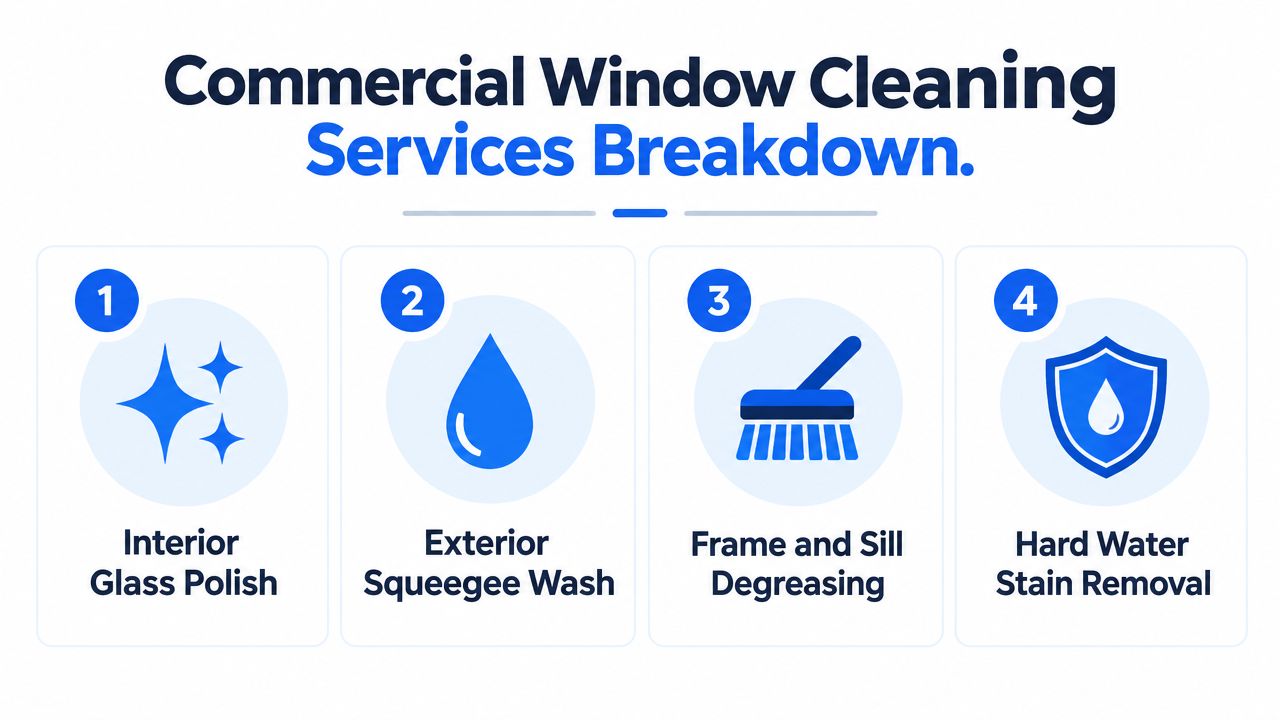
Interior service generally removes dust and fingerprints, washes the pane, details the edges, and checks the finish from several angles. Exterior work addresses airborne grime, pollen, bird deposits, irrigation residue, and coastal salt. A storefront beside the road may need a different treatment from an office interior, even when both have similar-sized panes.
Ventura properties can collect salt spray that returns soon after cleaning. Santa Barbara buildings may receive Sundowner dust on glass and frames. These conditions affect the method, inspection time, and realistic service interval. They also explain why commercial work is classified work rather than a simple chore.
Ground-level glass often suits a washer-and-squeegee method. The technician can inspect the surface closely and respond to deposits while working, and our guide on how to clean storefront windows walks through that sequence for street-level retail glass. High exterior panes may be better suited to a water-fed pole. The system sends purified water through a brush, and the pane dries without the dissolved minerals found in ordinary tap water. That reduces spotting when water evaporates under direct sunlight. Kärcher describes traditional squeegee work and purified-water systems in its commercial window-cleaning resource.
The surrounding parts determine the finish
Screens can hold road dust, pollen, and hillside debris even when the glass looks clean. A proper process removes each screen, washes it with suitable pressure, lets it dry, and returns it to the correct opening.
Frames, tracks, and sills collect grit, dead insects, moisture, and organic debris. Cleaning only the pane leaves that material along the edges and can push grit into moving parts. Track detailing may also expose blocked drainage openings that need to stay clear.
A practical service scope may include:
- Interior glass: Clean tenant-facing or customer-facing panes and detail their edges.
- Exterior glass: Remove environmental residue with a squeegee or purified-water pole.
- Screens and frames: Wash screens, then wipe frames, tracks, and sills.
- Specialty surfaces: Add skylights, hard-to-reach panes, solar panels, or stain treatment when the property requires them.
Skylights and high architectural glass require a separate access plan. A crew may use a purified-water pole from a safe position, a lift, or another approved method. Solar panels need compatible tools and careful handling where dust, salt, and bird residue affect their surfaces.
A quote marked “all windows” should state whether screens, tracks, skylights, hard-water deposits, and solar panels are included or excluded.
Manual Crews Versus Automated Systems in Commercial Window Cleaning
Automation sounds attractive when a building has extensive, repetitive glass. Drones, robotic systems, and other automated equipment can reduce the amount of direct exposure for workers on suitable façades, but they don’t remove the need for planning, inspection, or skilled judgment.
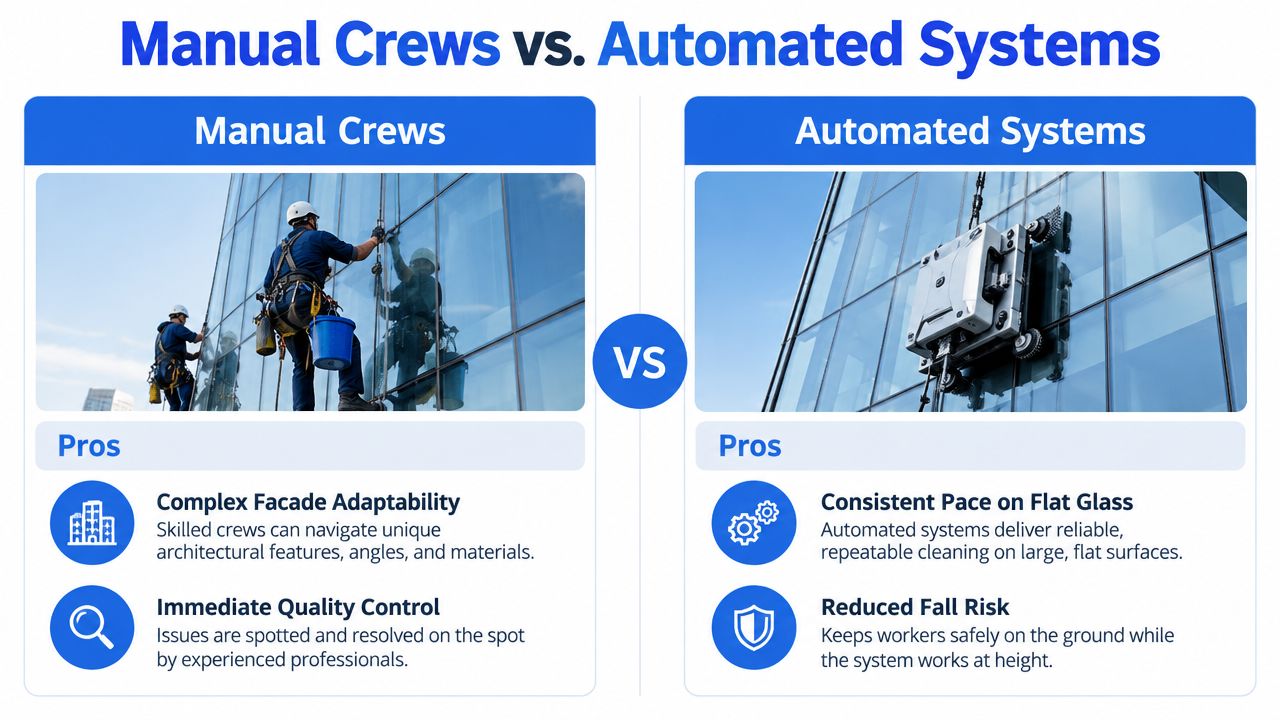
A manual crew remains flexible. Technicians can adjust pressure, recognize a failing seal, work around mullions, remove a stubborn deposit, and clean irregular frames. They can also switch methods during one visit, using a squeegee at the entrance and a water-fed pole on upper exterior panes. That adaptability matters on mid-rise properties with setbacks, awnings, landscaping, and mixed façade materials.
Automated systems are more compelling when the surface is broad, consistent, and accessible to the machine. A flat glass elevation with repeated panels may offer a predictable route and pace. A façade with deep reveals, decorative trim, heavy mineral buildup, or fragile finishes may require manual intervention before or after automated cleaning.
Evaluate the whole operating model
Recent market coverage links automated adoption to labor shortages and wage inflation in developed economies. One industry report projects the global building window-cleaning systems market will rise from US$2.4 billion in 2024 to US$4.8 billion by 2030, citing labor shortages and the rising cost of trained workers as key drivers in its automatic window-cleaning systems market report.
That projection doesn’t mean a robot is automatically economical for your property. The decision should include:
- Surface compatibility: Can the system handle the façade’s glass, joints, frames, and coatings?
- Setup and supervision: Who positions, monitors, retrieves, and inspects the equipment?
- Maintenance: What happens when brushes, batteries, sensors, or control systems need service?
- Quality control: Who removes mineral deposits and checks edges, tracks, and frames?
- Risk transfer: Does the provider’s insurance specifically address the equipment and operation?
A mid-rise building may get better value from a hybrid plan, with manual technicians handling entrances, details, and difficult elevations while automation supports repetitive flat glass. A multi-site owner has more opportunity to standardize equipment and routes, but should still test the method on representative façades before changing the entire program.
The decision isn’t “people or robots.” It’s whether each building has enough repeatable, compatible work to justify automation without creating a second maintenance problem.
How Commercial Window Cleaning Frequency Varies by Business Type
A uniform quarterly schedule is easy to administer, but it often misses the property’s real exposure. A restaurant entrance, a medical lobby, and an industrial warehouse collect different soils and serve different visibility needs. The right interval starts with how quickly the glass becomes unacceptable, not with a calendar habit.
Recent commercial-cleaning coverage identifies weekly to biweekly exterior service for some retail storefronts, monthly to quarterly service for offices, more frequent attention at healthcare entry points, and less frequent but more debris-focused work at industrial sites. Those ranges are starting points, not promises. Business type, exposure, and local conditions set the real interval.
| Site Type | Baseline Interval | Coastal Adjustment | Industrial Adjustment |
|---|---|---|---|
| Retail storefront or restaurant | Weekly to biweekly exterior attention where visibility drives sales | Shorten the interval when salt haze returns quickly | Add frame, door, and lower-pane debris checks |
| Office building | Monthly to quarterly, based on entrances and tenant expectations | Monitor salt film on exposed elevations | Focus on dust, loading areas, and traffic-side glass |
| Healthcare facility | More frequent entry-point cleaning, with broader exterior service planned separately | Give entrances and patient-facing glass priority | Address construction dust and operational residue promptly |
| Industrial site | Less frequent appearance cleaning, with debris and visibility as priorities | Check exposed frames for salt residue | Prioritize grit, process dust, and safety-critical visibility |
Local exposure changes the baseline
A property near the Ventura or Santa Barbara coast may accumulate salt aerosol even when the glass doesn’t look dramatically dirty from the parking lot. Salt can haze the pane and settle along frames, so the maintenance question includes material exposure, not just curb appeal.
Inland sites around Thousand Oaks, Westlake Village, Simi Valley, and the foothills can face dry-season dust, pollen, and windborne grit. Sundowner events in the Santa Barbara area can push dust onto glass and screens quickly. After the first rain, that residue may turn into a more visible film.
A maintenance contract helps the property manager respond to those patterns. The provider can inspect results, adjust the route, and separate high-visibility entrances from less exposed elevations instead of forcing every part of the property into one identical cycle.
Safety and Insurance Essentials for Commercial Window Cleaning
A two-story storefront may need only controlled ground access, while a taller façade can involve roof edges, suspended equipment, public walkways, and fall exposure. Both jobs involve glass, but they are classified work rather than simple chores. Salt spray in Ventura can affect frames and anchors, while Sundowner dust around Santa Barbara can reduce visibility and leave crews working on contaminated surfaces.
In the United States, OSHA’s general industry rule requires fall protection wherever a worker is exposed to a fall of 4 feet or more (29 CFR 1910.28(b)(1)), and anchorages for personal fall arrest must support at least 5,000 pounds per attached worker (29 CFR 1910.140). Building owners must also certify rope descent anchorages before rope work begins (1910.27(b)(1)).
Access starts with the roof and the ground
Before approving work on a high or complex elevation, identify roof edges, anchor points, parapets, setbacks, lift locations, pedestrian routes, and nearby landscaping. An anchor may be physically present yet still require inspection, documentation, and approval before a contractor can use it.
The crew needs controls for dropped objects, wet walkways, public separation, changing weather, and emergency response. A clear quote should state the access method for each elevation, such as poles, ladders, lifts, or specialty access. If a section cannot be reached safely, that limitation belongs in the scope before scheduling.
Shortcuts create exposure for everyone on site.
Insurance protects the property manager too
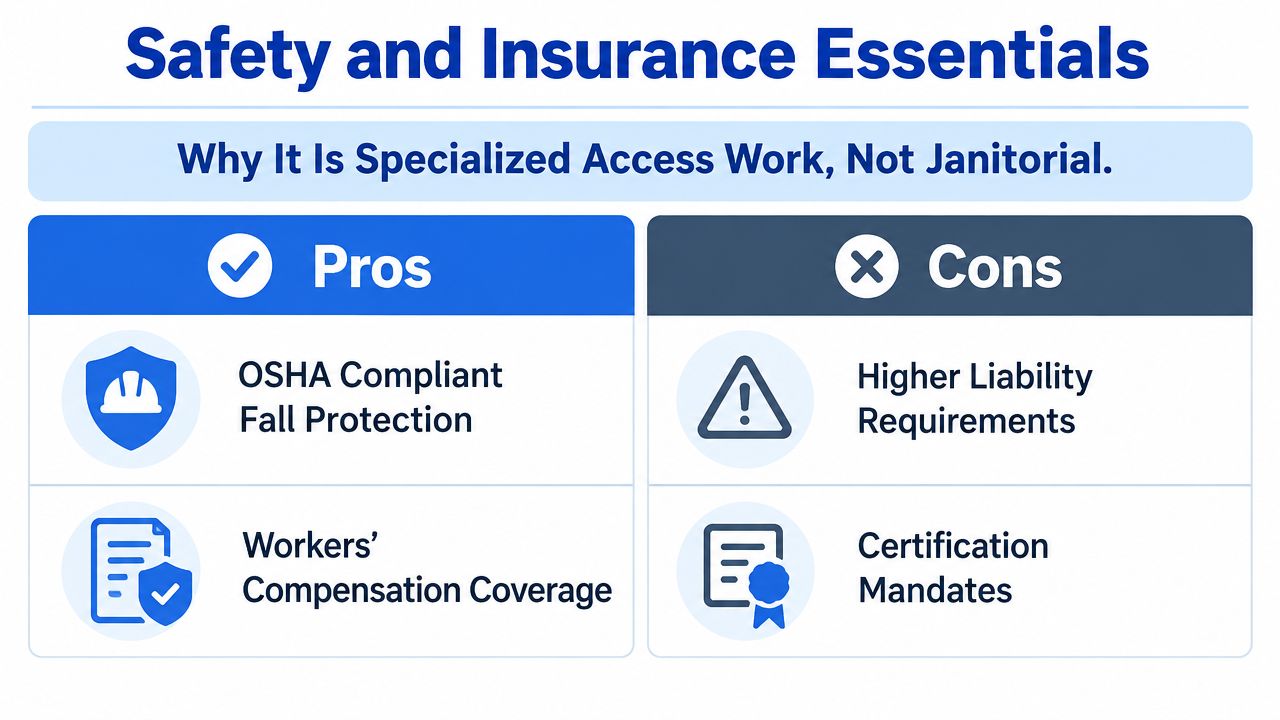
Request current proof of liability and workers’ compensation coverage, then check that the policies match the proposed work. Ask whether lifts, water-fed poles, suspended access, or automated equipment require different documentation or limits. Training records and a site-specific safety plan should also be available before work begins.
Specialized access work carries different safety and insurance considerations from ordinary janitorial service. The comparison chart below helps clarify why the contractor’s method, equipment, and coverage should match the building’s access conditions.
Before approval: Require the scope, access method, insurance documents, training records, and site-specific safety controls in writing.
Pricing Models, Quoting, and Contract Options for Commercial Properties
Commercial pricing rarely comes from pane count alone. A provider may consider glass area, height, access difficulty, frame condition, screens, tracks, stain removal, traffic control, water requirements, and the time window available for work. A site walk-through turns those unknowns into a scope that different bidders can price on comparable terms.
A one-time clean can make sense before a sale, opening, inspection, or special event. It can also be the wrong long-term strategy if the building quickly returns to a dusty, salt-coated condition. Reactive work often asks a crew to remove more buildup at once, while a recurring plan keeps the condition more predictable.
Compare the scope, not just the total
A fair bid should identify:
- Included elevations: Note interior, exterior, doors, skylights, and hard-to-reach panes.
- Detail work: Confirm screens, frames, tracks, sills, and mineral deposits.
- Access assumptions: State whether poles, ladders, lifts, or specialty access are required.
- Schedule terms: Define service windows, weather rescheduling, and route frequency.
- Rework policy: Ask how missed areas or quality concerns are handled.
- Insurance documentation: Verify coverage before workers arrive on site.
A recurring maintenance contract can stabilize appearance and simplify budgeting, but only if the provider can adjust the scope when exposure changes. For a coastal storefront, the contract might prioritize entry doors and street-facing glass. For an inland office, it might add screen and sill attention after dusty seasons.
The lowest proposal isn’t necessarily the lowest ownership cost. A transparent assessment can prevent change orders, missed elevations, unsafe access assumptions, and the repeated labor of correcting neglected frames or screens.
Choosing a Commercial Window Cleaning Program for Ventura and Santa Barbara Properties
Start with four questions: What must look clean, how fast does it soil, how will each pane be reached, and who needs to approve the work? A small State Street storefront may need a frequent ground-level route. A coastal office may need closer monitoring of exposed frames. A multi-story property may need a provider that can document access limits before quoting.
Use the building’s exposure to shape the program:
- Coastal properties: Watch for salt haze, residue along frames, and faster deterioration of exposed surfaces.
- Inland and foothill properties: Track dust, pollen, and Sundowner or Santa Ana wind events that load screens and exterior glass.
- Customer-facing sites: Prioritize entrances, doors, low panes, and the elevations customers see first.
- Industrial properties: Define whether the main objective is appearance, natural light, process-dust removal, or visibility.
- Multi-story buildings: Confirm the access method for every elevation, including any areas a provider can’t safely service.
A property manager should request a written scope, proof of insurance, training and access credentials where relevant, a schedule tied to actual exposure, and clear terms for weather, rework, and exclusions. Ask whether the quote includes screens, frames, tracks, sills, skylights, solar panels, and hard-water stain treatment. If those items aren’t listed, assume they require clarification.
A local provider such as Aloha Window Bros offers commercial window, screen, frame, and sill cleaning, uses purified-water systems for suitable high glass, and provides free on-site quotes for properties in Ventura and Santa Barbara counties. That makes an on-site assessment the sensible first step, especially when salt, dust, landscaping, or mixed heights complicate the scope.
The best program is specific enough that the crew, manager, and owner share the same expectations. It connects frequency to exposure, methods to access, and price to documented work, rather than treating every building as a row of identical panes.
Ask a qualified provider to walk your Ventura or Santa Barbara property, identify the glass, screens, frames, access conditions, and local exposure concerns, then build a recurring or one-time scope around the site. Visit Aloha Window Bros to request a commercial quote and discuss a window-cleaning program that fits your building.