

Professional solar panel cleaning is performance maintenance, not just an appearance upgrade: soiling is “considered responsible for an average of 4% to 7% global energy loss” in photovoltaic systems, according to the IEA Photovoltaic Power Systems Programme. Whether a cleaning visit pays off at your home depends on local conditions, panel access, and the type of residue on the glass.
You might be looking up at a dusty array in Ventura, wondering whether to book a cleaning or wait for rain. Your monitoring app still shows electricity production, so nothing seems obviously wrong. The useful question isn’t whether the panels look spotless, but whether removing those deposits would recover enough generation to justify the service.
Table of Contents
- Why Solar Panel Cleaning Matters More Than You Think
- Understanding How Dirt and Debris Affect Panel Output
- Professional Cleaning vs DIY: What the Evidence Shows
- What a Professional Solar Cleaning Visit Involves
- How Much Solar Panel Cleaning Costs and How Often
- What to Look for When Hiring a Solar Cleaning Service
- Making the Right Call for Your Home’s Solar Panels
Why Solar Panel Cleaning Matters More Than You Think
Consider a homeowner in Camarillo who notices a dull film across the panels after a dry stretch. From the driveway, it looks like ordinary dust. Because the system is still producing electricity, leaving it alone seems reasonable.
That’s an understandable decision, but continued production doesn’t prove the panels are performing as well as they could. Soiling is the accumulation of dust, pollen, pollution particles, and other deposits that reduce the sunlight reaching a photovoltaic surface. The IEA PVPS soiling report estimated that soiling cost at least 3% to 4% of global annual PV energy production in 2018 (IEA PVPS T13-21:2022), and the programme’s 2025 Insights report puts the average at 4% to 7%.
The distinction between appearance and performance is the starting point.
A working system can still need attention
Think of a window screen that gradually collects dust. Light still enters the room, but the screen isn’t as transparent as it was. Solar panels can similarly remain operational while surface deposits limit their potential generation.
However, a global average isn’t a forecast for your roof. The same IEA report says mitigation “must be tailored to local conditions and system/site characteristics,” because dry, dusty, and polluted sites soil much faster than others. A homeowner shouldn’t apply a worldwide loss estimate directly to an individual electricity bill.
Practical rule: Treat visible dirt as a reason to investigate, not automatic proof that a cleaning visit will pay for itself.
For a coastal Southern California property, useful questions include:
- Exposure: Does the array receive salt spray, windborne dust, or persistent bird residue?
- Persistence: Are deposits still present after rainfall?
- Access: Can someone inspect the panels without climbing onto the roof?
- Performance: Does the monitoring history suggest a change worth investigating?
Maintenance starts with a decision, not a calendar
A useful cleaning recommendation should explain why your particular array needs attention. It shouldn’t begin with an automatic recurring appointment.
For a closer look at scheduling, this guide to how often solar panels should be cleaned provides a starting point for discussing your property’s conditions. The aim is to maintain useful generation without purchasing unnecessary visits.
The homeowner in Camarillo doesn’t need to decide from the driveway alone. A safe inspection, a review of production history, and an access assessment provide a more sensible basis for choosing professional service.
Understanding How Dirt and Debris Affect Panel Output
A film of grime on a window can dim a room even when the sun is bright. On a solar panel, deposits interfere with incoming light before the cells can use it.
The effect isn’t always uniform. A light dust layer may cover much of the glass, while bird droppings or other adhered material may obscure smaller areas more heavily. The IEA PVPS report on soiling losses documents non-uniform soiling as its own case, including buildup along the sides and bottom edge of the module frame and blotches covering several cells, which shade some cells more than others.
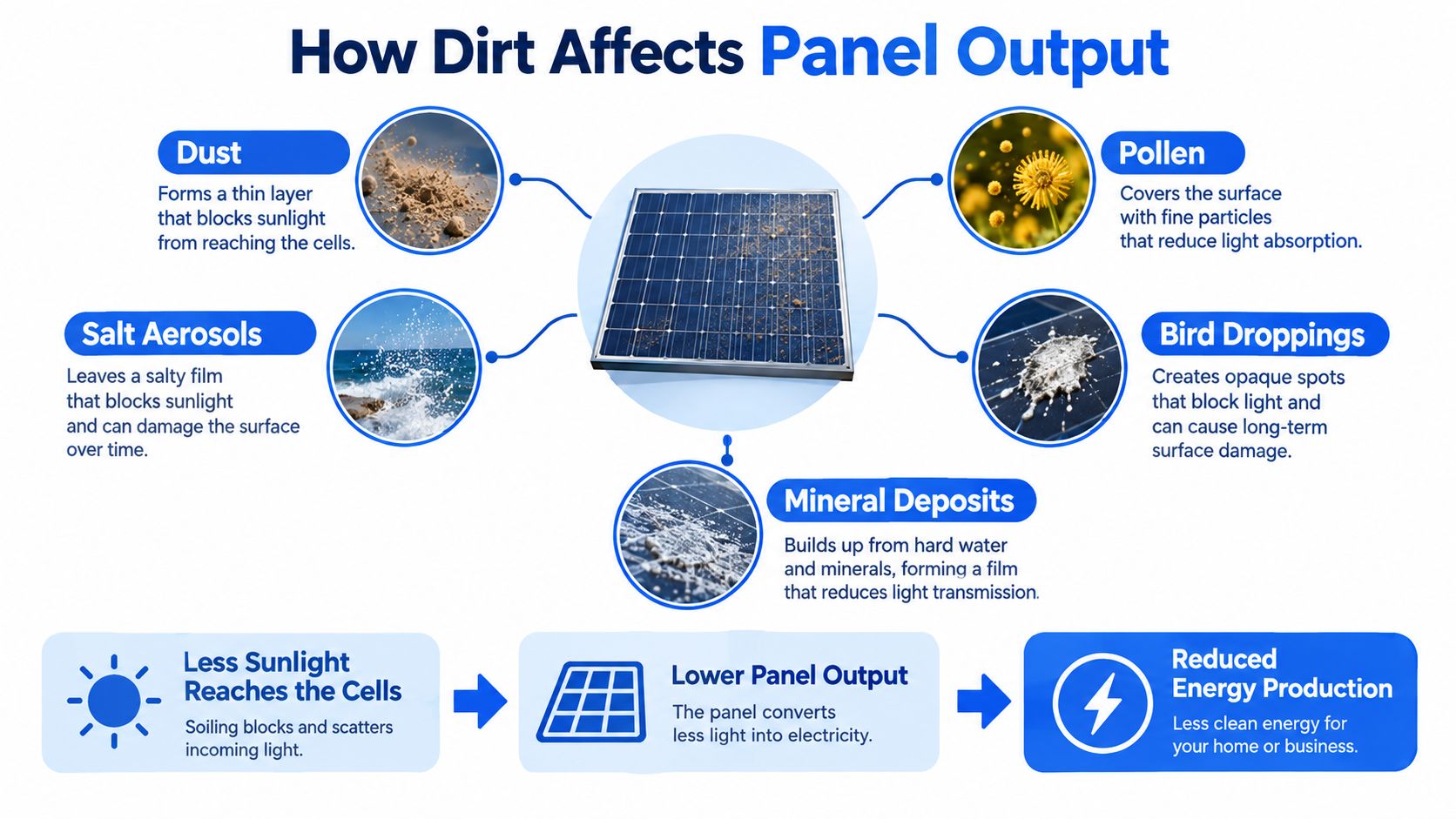
Different deposits create different problems
The surface may look generally dirty, but the material matters when choosing a cleaning method.
- Loose dust: A dry coating calls for a different approach from firmly adhered residue.
- Pollen: Seasonal deposits can persist beyond the period when pollen is most noticeable.
- Salt aerosols: Coastal exposure deserves attention when assessing the film on the glass.
- Bird droppings: Concentrated deposits require careful treatment rather than forceful scraping.
- Mineral spotting: Irrigation overspray or unsuitable rinse water can leave deposits after drying.
These categories help explain why a single cleaning method won’t suit every roof. A provider should identify what’s present before deciding how to remove it.
Rainfall isn’t a reliable performance test
Rain may remove some material, but a wet panel isn’t necessarily a clean panel. The clearest evidence comes from comparing measured performance rather than assuming that a storm completed the job.
In a National Renewable Energy Laboratory study of utility-scale solar plants in North Carolina, performance fell by as much as 15% during peak pollen season, mostly from cypress, juniper, pine, and oak pollen, even with frequent rain. Mechanical wet-brush cleaning then measured performance increases of 5% to 11%.
Those findings concern utility-scale sites in a different region. They demonstrate that pollen can persist and cleaning can recover output, but they don’t establish a guaranteed improvement for a home in Oxnard or Goleta.
Use the monitoring app carefully
A glance at the glass can miss meaningful losses, while a dusty appearance can exaggerate the urgency. Production records offer another piece of evidence.
Compare output against a weather-adjusted historical baseline, rather than contrasting an overcast day before cleaning with a sunny day afterward. Module-level monitoring, where available, can provide more detail about uneven performance.
The goal is to separate a plausible soiling problem from an assumption. If the evidence doesn’t point toward surface contamination, cleaning shouldn’t be presented as a universal solution.
Professional Cleaning vs DIY: What the Evidence Shows
A homeowner stands at the end of the driveway, garden hose in hand, looking up at a second-story array streaked with salt film and bird droppings. The water can reach the glass. Reaching it safely, and removing what is stuck to it, is where the decision gets harder.
The gap between DIY cleaning and professional service comes down to how the person manages access, selects tools, handles adhered residue, and avoids introducing new contamination. A ground-level visual check is a reasonable homeowner task. Climbing onto a roof to scrub deposits that resist a gentle rinse is a different job entirely.
A hose rinse and controlled cleaning aren’t equivalent
NREL’s work on pollen and mold soiling in the Southeast U.S. found modules whose I-V curves were 13% to 14% below nameplate, held back by mold that rain had not removed. In its words, “rubbing with DI water and soft cloth restores clean surface while pressurized garden hose did not” (NREL poster, Muller et al.).
That result supports controlled mechanical action for adhered contamination. It does not support harder scrubbing, and it does not show that cleaning always restores full output. Brushing works here the way a soft mitt works on a car: it lifts grime that water alone leaves behind, while an abrasive pad would damage the finish.
| Decision factor | Homeowner consideration | What to ask a professional |
|---|---|---|
| Roof-mounted panels | Do not improvise access to reach the glass | How will you reach the array safely? |
| Adhered residue | Avoid escalating to scraping | Which nonabrasive method will you use? |
| Water quality | Consider what remains after drying | Will you use purified or low-mineral water? |
| Equipment | Household tools may not suit module surfaces | Are your tools compatible with my panels? |
| Verification | A cleaner appearance isn’t a complete result | What condition record will you provide? |
Gentle technique matters more than force
A practical protocol is to work on cool panels, use nonabrasive tools, account for water quality, and avoid walking on modules. The IEA PVPS degradation and failure annex lists “inappropriate cleaning techniques (mechanical removal techniques, inappropriate cleaning agents)” as a cause of glass abrasion and corrosion that can damage or remove a module’s coatings.
Water quality deserves attention on its own. Hard water behaves on a panel the way it does on a shower door: the water evaporates and the minerals stay behind, leaving fresh residue where dirt used to be.
Check the module manufacturer’s care instructions before any cleaning. Ask a provider how its method aligns with those instructions rather than accepting an unsupported promise that a particular tool is safe for every panel.
Paying for professional cleaning should buy a suitable method and safer access, not just more vigorous washing.
When professional help makes sense
Professional service is easier to justify when difficult access and stubborn residue occur together. A roof-mounted array collecting persistent deposits presents a different decision from a readily accessible installation with light contamination.
Electrical and fall hazards also belong in the comparison. Do not climb onto a roof merely to confirm that it needs cleaning, and do not handle wiring as part of a DIY wash.
The strongest solar panel cleaning pros explain what they will do differently and why. A job title alone does not establish good practice, so evaluate the proposed method rather than assuming any paid service will produce better results.
What a Professional Solar Cleaning Visit Involves
A professional visit should begin with the property, not a brush. Before work starts, the provider needs to understand access, panel condition, surrounding surfaces, and the deposits being treated.
The initial inspection should establish what can be cleaned safely and what falls outside the service. Our solar panel cleaning service guide walks through a full visit, from the site walk-through to warranty questions.
Assessment and preparation
Ask the crew to describe its access plan before equipment is set up. Depending on the layout, a purified water-fed pole may provide an appropriate way to reach the array without walking on modules.
A clear service plan should address:
- Condition checks: Record existing residue and any visible concerns before cleaning.
- Property protection: Explain how hoses, tools, and runoff will be managed.
- Service boundaries: Distinguish surface cleaning from electrical diagnosis or repair.
- Water use: Choose an approach suited to the deposits rather than assuming prolonged rinsing is necessary.
The IEA PVPS Insights report says cleaning technologies “should be selected based on site-specific factors such as water availability, system layout, and budget.” Both water-based and waterless approaches may have a role, but neither should be treated as universally appropriate.
Cleaning and equipment selection
Where suitable, a provider may use purified-water rinsing followed by controlled soft-brush agitation and a final rinse. The technician should adapt the treatment to the residue while protecting the module surface.
Keep the equipment discussion specific. Tools built for window glass or screens are not automatically safe on solar modules. A company offering several exterior-cleaning services should clearly distinguish its solar-cleaning method from its other processes.
Inspection and documentation
At completion, ask for dated before-and-after photographs showing comparable areas. Confirm whether any residue remains and whether the crew encountered a condition requiring separate attention.
A final walk-through should also establish what was completed, rather than relying on a distant impression of shinier glass. If production monitoring is available, agree on how you’ll review normalized output afterward.
A thorough cleaning record documents both the work and its limits. It shouldn’t imply that a surface-cleaning visit certifies the electrical health of the entire solar system.
How Much Solar Panel Cleaning Costs and How Often
A useful solar-cleaning price is a quote for your array, not a borrowed range from a different service. Window-cleaning packages, another region’s rates, and unusually accessible installations don’t establish what your roof will cost.
What Sets a Solar Cleaning Quote
Aloha Window Bros does not publish a flat solar price, because the job changes with every roof. A quote should account for:
| Factor | Why it moves the price |
|---|---|
| Panel count and layout | More modules and split arrays take more time |
| Roof height and pitch | Ground-reach pole work is faster than a steep two-story roof |
| Residue type | Loose dust rinses off; bird droppings and cemented film need brush work |
| Water | Purified water costs more to produce than tap water but leaves no mineral spots |
| Documentation | Before-and-after photos and a condition note take time to do properly |
Those details make competing proposals more useful than comparing headline prices alone. For a local starting point, review the guide to solar panel cleaning cost and then request an estimate for the actual installation.
Let conditions determine the next visit
A recurring appointment can be convenient, but convenience doesn’t establish economic value. The IEA PVPS Insights report says cleaning schedules “must be optimized to balance the revenues from the recovered energy and the operational costs.” The IEA soiling report adds that in high humidity or below the dew point, water dissolves part of the dust and cements it to the glass. That matters on the coast, where the morning marine layer keeps humidity high.
That makes the timing decision more nuanced than waiting until panels look heavily coated. Yet it still doesn’t justify frequent cleaning at every property.
Use changes in conditions as inspection prompts:
- Coastal exposure: Look for persistent deposits rather than assuming proximity to the ocean defines the interval.
- Seasonal events: Reassess after pollen accumulation or prolonged dry, windy weather.
- Nearby activity: Check after construction dust or ash exposure.
- A previous cleaning: Use the documented result to inform the next decision.
Estimate the financial benefit conservatively
A practical calculation is:
Expected recovered electricity × the value of that electricity = estimated energy benefit.
Compare that benefit over the period before substantial re-soiling with the cleaning quote. Use a cautious recovery estimate supported by your system’s condition or previous measured results, not the highest recovery reported elsewhere.
A cleaning visit can be technically effective without recovering enough electricity to cover its price.
You may still value appearance or avoiding difficult DIY work. Keep those reasons separate from energy savings so you know what you’re purchasing.
What to Look for When Hiring a Solar Cleaning Service
A trustworthy quote should make the job easier to understand. If a provider can’t explain its access method, water choice, or treatment of stubborn deposits, a polished sales pitch isn’t enough.
Compare providers through the questions they can answer about your property. Local familiarity is useful when it produces specific observations, not just a claim that every coastal home needs the same service.
Ask about protection and competence
Start with matters that affect your home and the proposed work.
- Insurance coverage: Request current evidence of coverage appropriate to the service.
- Solar-specific experience: Ask how the company’s module-cleaning process differs from window or screen washing.
- Access planning: Have the provider explain where technicians and equipment will be positioned.
- Manufacturer compatibility: Ask how the proposed method follows your panels’ care requirements.
- Residue assessment: Request an explanation of what the crew thinks is on the glass and how it plans to remove it.
A good answer should be understandable without technical language. You should be able to explain afterward why the provider selected that method for your array.
Compare the promises in writing
A satisfaction guarantee and an energy-performance guarantee aren’t interchangeable. Ask what happens if visible residue remains, what qualifies for rework, and whether the guarantee applies to cleaning quality rather than a promised production increase.
Be cautious about guaranteed percentage gains without system-specific evidence. The research discussed earlier establishes that recovery is possible, not that every rooftop will achieve the same result.
| Question | What a useful answer establishes |
|---|---|
| What’s included? | The surfaces treated and the service boundaries |
| What happens if deposits remain? | Reinspection or rework terms |
| Will you document the job? | A condition record you can retain |
| What requires another specialist? | A distinction between cleaning and repair |
Use local knowledge without buying unnecessary frequency
A provider working around Ventura, Montecito, or Goleta should be willing to discuss your particular exposure and access challenges. Ask what would justify a return visit and what would justify waiting.
For property managers and HOAs, also request clear arrangements for access and communicating completion. A defined scope helps everyone understand what the visit covers.
The most useful recommendation might be to clean now, monitor first, or address another concern before washing. Professional judgment includes recognizing when cleaning isn’t the next necessary step.
Making the Right Call for Your Home’s Solar Panels
The right decision combines evidence, access, and value. None of those factors should stand alone: a dirty appearance doesn’t establish financial benefit, and an attractive quote doesn’t make an unsuitable cleaning method acceptable.
For a Ventura or Santa Barbara homeowner, the next step is usually modest. Gather what you can safely observe, review the monitoring history, and ask a provider to explain its recommendation for your property.
Choose a next step you can verify
- Monitor first: If contamination appears light and there’s no clear performance concern, gather more information before booking.
- Request an assessment: If residue persists or the panels are difficult to inspect, obtain a scoped quote.
- Seek separate diagnosis: If the concern involves system operation rather than surface condition, don’t assume washing will resolve it.
If you’re still weighing the expense, this discussion of whether solar panel cleaning is worth it can help frame the decision around your priorities.
Appearance-focused cleaning and performance-focused cleaning are different purchases. Both can be legitimate, but only the latter should be evaluated as an investment in recovered generation.
Choose service when the proposed method, likely benefit, and access plan make sense together. When the evidence is weak, ask for clarification rather than accepting a universal schedule. That approach gives you a maintenance plan you can refine using your own property’s results.
Aloha Window Bros offers solar panel cleaning with purified-water equipment and soft, nonabrasive brushes in Ventura County and Santa Barbara County. Book a free on-site quote with Aloha Window Bros and mention your array size, roof access, and any persistent residue. We walk the property with you before we leave, and if anything doesn’t look right, we redo it on the spot.