
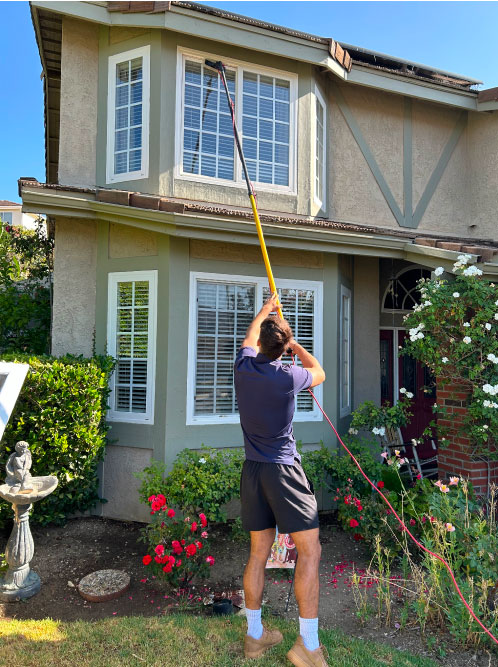
Window and door screens in Thousand Oaks accumulate more pollen than screens in almost any other Ventura County city, because the Conejo Valley is named for — and surrounded by — the same coast live oaks that release heavy yellow pollen between March and June. Aloha Window Bros provides professional screen cleaning across Thousand Oaks using purified water systems that strip out pollen, dust, spider webs, and wildfire ash without bending frames or tearing mesh. Most Thousand Oaks homes should have screens professionally cleaned at least twice a year — and homes near oak groves or with allergy-sensitive residents often benefit from a third cleaning during peak pollen season.
Why Thousand Oaks Screens Get Dirtier Than Other Ventura County Cities
“Thousand Oaks” is not a marketing name. The Conejo Valley genuinely contains tens of thousands of mature coast live oaks (Quercus agrifolia), and those oaks shed pollen, leaves, and tannin-rich debris onto every horizontal and vertical surface in the city — including window screens.
“Coast live oak (Quercus agrifolia) pollen counts in the Conejo Valley routinely exceed 1,500 grains per cubic meter during peak season, placing the area in the top 5% of California cities for tree pollen exposure. Window and door screens function as passive air filters and capture a disproportionate share of that particulate before it ever reaches indoor air.”
The major contributors to screen soiling in Thousand Oaks:
- Coast live oak pollen — March through June, with peak counts in April and May
- Conejo Valley dust — fine soil particulate kicked up by wind through the valley
- Wildfire ash — Thousand Oaks sat downwind of the 2018 Woolsey Fire and the 2025 Lake Fire, and ash continues to settle on screens for weeks after major events
- Spider webs and insects — undisturbed screens collect web debris year-round, especially on north-facing windows
- Vehicle exhaust — homes along the 101 corridor accumulate carbon residue faster than homes deeper in the neighborhoods
- Bougainvillea, jacaranda, and pepper tree debris — Thousand Oaks landscape staples that drop fine plant matter onto screens
The combination of oak pollen and Conejo Valley dust forms a yellow-brown film that bonds to screen mesh. Rinsing screens with a hose typically just pushes that film deeper into the weave instead of removing it.
For the full window-cleaning picture in the same neighborhoods, the Thousand Oaks window cleaning guide and the Thousand Oaks service area page cover everything from Conejo Valley estates to Newbury Park-adjacent homes.
How Dirty Screens Affect Indoor Air Quality in Thousand Oaks
Most homeowners think of screens as a way to keep insects out. They are actually one of the most underrated indoor air quality systems in a home — and one of the most neglected.
“A clean window screen functions as a coarse pre-filter for outdoor air entering through open windows. Once that screen becomes saturated with pollen and dust, it stops filtering and starts acting as a reservoir that releases captured particulate back into indoor air every time wind passes through.”
Specifically, dirty Thousand Oaks screens cause:
- Increased indoor allergen exposure — oak pollen is a known allergen for the majority of seasonal allergy sufferers; saturated screens essentially deliver that pollen indoors
- Reduced HVAC efficiency — when screens shed particulate inside the home, the HVAC filter has to remove it instead
- Visible film on interior glass — dirty screens deposit a brown film on the inside of windows during wind events
- Reduced airflow when windows open — clogged screens reduce ventilation by 15–30%, which matters in Thousand Oaks summers when many homes use natural ventilation instead of running AC
The American College of Allergy, Asthma & Immunology classifies oak as a “moderate to high” allergen across California and recommends reducing pollen contact at every entry point — including screens.
How Much Screen Cleaning Costs in Thousand Oaks
Pricing depends on screen count, screen size, and condition. Standard window screens and patio sliders are typically priced per screen; whole-home cleanings get a volume discount.
| Home Size | Approximate Screen Count | Estimated Cost |
|---|---|---|
| Small (1,200–1,800 sq ft) | 8–12 screens | $80–$140 |
| Medium (1,800–2,800 sq ft) | 12–20 screens | $140–$220 |
| Large (2,800–4,000 sq ft) | 20–30 screens | $220–$320 |
| Estate (4,000+ sq ft) | 30+ screens | $320+ |
| Patio sliders / French door screens | each | +$15–$25 |
| Heavily soiled or pollen-saturated screens | per visit | +20–30% |
Most Thousand Oaks homeowners pair screen cleaning with window washing — it costs significantly less to do both at the same visit because the crew is already on-site.
Thousand Oaks Neighborhoods With the Highest Pollen Loads
Some Thousand Oaks neighborhoods accumulate pollen and debris much faster than others — usually because of proximity to mature oaks or to the 101 corridor.
| Neighborhood | Primary Soiling Sources | Recommended Cleaning Frequency |
|---|---|---|
| Conejo Oaks / Lynn Ranch | Heavy oak pollen, leaves, tannin | 3 times a year |
| North Ranch | Oak pollen, landscape debris, larger windows | 3 times a year |
| Lake Sherwood-adjacent | Oak pollen, lake humidity, wildlife | 3 times a year |
| Westlake-adjacent / Westlake Village proximity | Oak pollen, lake humidity | 2–3 times a year |
| Old Town Thousand Oaks | Road dust, oak pollen | Twice a year |
| Conejo Hills | Oak pollen, hillside dust | Twice a year |
| Ladyface Mountain area | Oak pollen, canyon dust, ash | 3 times a year |
| Sunset Hills | Oak pollen, ag dust from valley | Twice a year |
| Hillcrest / Wildwood | Oak pollen, wildland debris | 3 times a year |
Homes within 100 feet of mature coast live oaks should expect to see visible pollen on screens within 2 to 3 weeks during March–June.
Professional vs. DIY Screen Cleaning in Thousand Oaks
Most Thousand Oaks homeowners eventually try one of two DIY methods — spraying screens in place with a hose, or removing screens and brushing them with a stiff brush. Both have problems.
| Factor | Professional Cleaning | DIY (Hose or Brush) |
|---|---|---|
| Pollen removal | 95–100% — purified water lifts pollen from mesh | 40–60% — pushes pollen deeper into weave |
| Water type | Deionized / reverse-osmosis (no minerals) | Conejo Valley tap (10–15 grains hardness) |
| Frame damage risk | None — screens removed and laid flat | High — bent corners, torn mesh |
| Effort | None to homeowner | 2–4 hours for a typical home |
| Spider web removal | Full | Partial |
| Reinstallation | Crew reinstalls each screen | Homeowner |
| Hard water spots on glass | None | Tap water sprayed at screens hits adjacent windows |
| Effectiveness | Restores original mesh color and airflow | Often makes screens dingier |
Thousand Oaks water is only moderately hard: California American Water, which serves Thousand Oaks and Newbury Park, reports about 140 mg/L, roughly 8.2 grains per gallon, in its 2025 water quality report. That is still enough to leave spots. Spraying tap water at screens puts mineral deposits on the window glass next to them, which is why DIY screen cleaning often leaves windows looking worse than before.
What’s Included in an Aloha Window Bros Screen Cleaning
Every Thousand Oaks screen cleaning follows the same systematic process:
- Screen removal — every screen carefully taken out without bending corners or tearing mesh
- Frame inspection — quick check of each frame for damage or worn corners (worth noting before cleaning so it’s not blamed on the service)
- Initial dry brush-down — soft brush removes loose pollen, dust, and web debris
- Purified water bath — screens laid flat and rinsed with deionized water to lift bonded pollen and tannin
- Light agitation — soft brush on heavily soiled sections (typically lower halves and corners)
- Final rinse — complete purified water rinse so screens dry spot-free
- Air dry — screens dried flat to prevent water pooling at corners
- Reinstallation — each screen returned to its original window with a final fit check
This process restores screen color from yellow-brown to the original gray or charcoal mesh tone — usually visible from across the room.
When to Schedule Screen Cleaning in Thousand Oaks
Timing makes a big difference in how much pollen and dust a cleaning actually removes.
- Late spring (May–June) — after the main oak pollen drop. This is the highest-impact cleaning of the year and the one we recommend if a home can only do one.
- Early fall (September–October) — remove accumulated dry-season dust and any wildfire ash before winter rains turn that residue into mud on the mesh
- Early spring (February–March) — clean screens before pollen season starts so the mesh starts the season fresh
- After any wildfire smoke event — the California Air Resources Board documented elevated PM2.5 across the Conejo Valley after the Woolsey, Hill, and Lake fires; ash settles on screens within hours and stays for weeks
- Before listing a home for sale — clean screens are one of the cheapest curb-appeal upgrades in a real estate listing
- Anytime someone in the home has worsening seasonal allergies — pollen-saturated screens are a documented contributor
“In coastal-Mediterranean climates like Ventura County, rain removes only 30% to 45% of pollen and tannin from window screens because both are partially water-resistant and bond to the mesh on a microscopic level. Without periodic professional cleaning, screens accumulate residue continuously across the entire 6-month dry season.”
Service Areas Around Thousand Oaks
Aloha Window Bros provides screen cleaning across the Conejo Valley and Ventura County, including:
- Thousand Oaks (all neighborhoods — North Ranch, Conejo Oaks, Lynn Ranch, Sunset Hills, Hillcrest, Wildwood)
- Westlake Village
- Newbury Park
- Agoura Hills
- Camarillo
- Simi Valley
- Oxnard
- Ventura
- Santa Barbara
- Ojai
In addition to screen cleaning, Aloha Window Bros offers professional window washing and solar panel cleaning for Thousand Oaks homes — bundling services into one visit lowers the per-screen price and means the crew only sets up on your property once.
Frequently Asked Questions
How often should window screens be cleaned in Thousand Oaks?
Most Thousand Oaks homes should have screens professionally cleaned at least twice a year — once in late spring after oak pollen drops, and once in early fall after the dry season. Homes near mature coast live oaks, in neighborhoods like Conejo Oaks, North Ranch, or Lynn Ranch, often benefit from a third cleaning during peak pollen season. Homes with allergy-sensitive residents should consider quarterly service.
Can dirty screens really make seasonal allergies worse?
Yes. Window and door screens act as passive air filters for outdoor air entering the home through open windows. When screens become saturated with oak pollen and Conejo Valley dust, they stop filtering and start releasing captured pollen back into indoor air every time wind passes through. Professional cleaning restores the screen’s filtering capacity and reduces indoor allergen exposure, which is one reason allergy sufferers often notice improvement within days.
How much does screen cleaning cost in Thousand Oaks?
Most Thousand Oaks homeowners pay between $80 and $320 for a full home screen cleaning, depending on screen count and size. A typical 12–20 screen home runs $140 to $220. Patio sliders and French door screens are usually $15 to $25 each on top of the base price. Aloha Window Bros provides free quotes with no obligation before any work begins.
Will cleaning damage my screens?
No. Professional cleaning with purified water and soft brushes does not damage standard fiberglass or aluminum mesh, and screens are removed and laid flat to prevent frame bending. DIY methods — spraying screens in place with a hose, or scrubbing them with a stiff brush — carry a much higher risk of bent corners, torn mesh, and pulled spline. Aloha Window Bros inspects each frame before cleaning so any pre-existing damage is documented.
How do I schedule screen cleaning in Thousand Oaks?
Aloha Window Bros offers free quotes for screen cleaning throughout Thousand Oaks and the Conejo Valley. Schedule a free estimate online or call (805) 341-4121 to book a convenient time.
Get Your Free Quote Today
Aloha Window Bros has cleaned screens for hundreds of Conejo Valley homeowners. The same purified water system that keeps Thousand Oaks windows streak-free also restores screen color, airflow, and indoor air quality without damaging mesh or frames. Schedule your free quote online or call (805) 341-4121 for a no-obligation on-site assessment.