

A typical Santa Barbara full window clean runs $200 to $475 (see our Santa Barbara window cleaning page for what a visit covers), and oceanfront or highly exposed homes may need service every 4 to 8 weeks during active onshore-wind season. If your glass looked clear last week but turned hazy after the morning marine layer, the culprit usually isn’t ordinary dust alone.
A homeowner in the Mesa or San Roque can wipe a pane on Sunday and still see a dull film by the next weekend. Salt aerosol settles on glass, mineral-rich rinse water leaves its own residue, and older wood assemblies need more care than a modern vinyl frame. Santa Barbara windows demand a maintenance plan that respects both the coast and the city’s architectural history.
Table of Contents
- Why Santa Barbara Windows Demand More Attention
- What Coastal Conditions Do to Glass and Frames
- What’s Included in a Professional Santa Barbara Window Cleaning
- DIY Methods Versus Professional Coastal Cleaning
- How Pricing Works for Santa Barbara Homes
- Service Areas and How to Book a Visit
- Keeping Glass Clear Between Visits
Why Santa Barbara Windows Demand More Attention
The morning marine layer has burned off. You step onto the patio, look toward the Channel, and notice that the living-room glass still looks cloudy even though you cleaned it recently. The haze is strongest along the lower edges and around the small divisions in an older sash. A quick pass with household glass cleaner may improve the view briefly, but it doesn’t remove everything sitting on the frame, track, and weep holes.
That pattern is common because Santa Barbara combines marine moisture, salt residue, strong sunlight, and mineral spotting. Homes near the bluffs receive more airborne brine, while hillside properties collect windblown grit in tracks and screen mesh. Older Spanish Colonial Revival and Craftsman homes add another complication, with true divided lights, narrow muntins, recessed openings, and traditional wood components that create more seams and surfaces to maintain.
Generic window-cleaning advice usually treats glass as a uniform, isolated surface. Coastal work isn’t that simple. A technician has to distinguish salt haze from hard-water scale, protect painted or unfinished wood, and avoid pushing residue into channels where it can corrode hardware or block drainage.
Practical rule: If the glass looks hazy again soon after cleaning, inspect the frame, screen, track, and irrigation pattern rather than repeatedly polishing the pane.
Santa Barbara’s preservation guidance makes the architectural side especially important. Many historic structures still retain original wood windows that have lasted more than 100 years, and the city’s design guidance identifies those windows as defining architectural elements, not disposable openings. Spanish Colonial Revival buildings often use recessed wood windows, paired casements, divided lights, and wood or iron grilles, details that influence how restoration and cleaning should be approached. Santa Barbara’s Historic Resource Design Guidelines explains why preserving period character and craftsmanship matters.
The result is a local maintenance problem with two sides. You need chemistry suited to coastal air, but you also need a gentle process that keeps historic proportions, wood finishes, and traditional sightlines intact.
What Coastal Conditions Do to Glass and Frames
Four conditions usually leave the clearest fingerprints on Santa Barbara windows. Learning their signatures helps you decide whether a simple rinse is enough or whether the glass needs mineral-spot treatment and frame detailing.
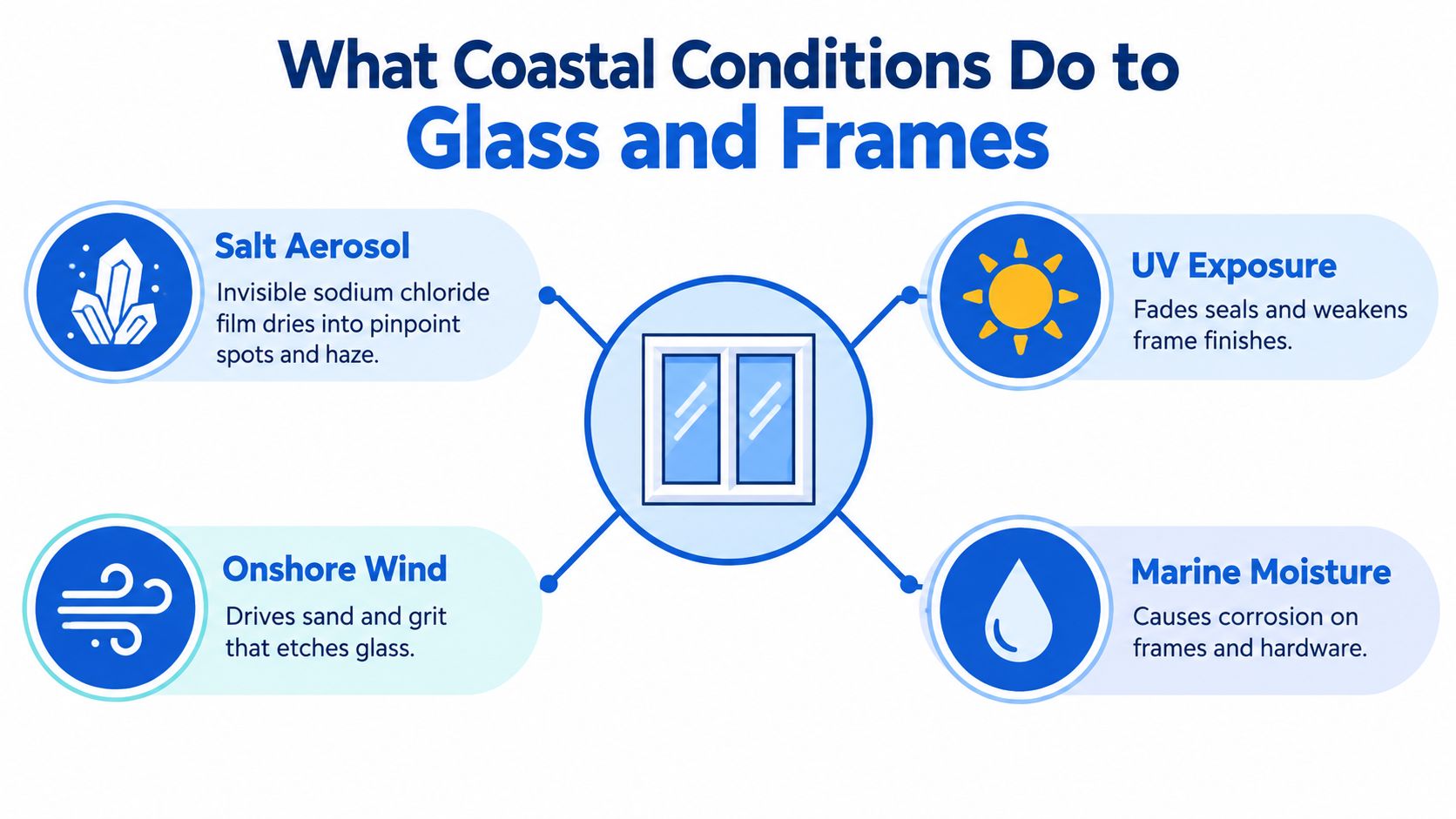
Salt aerosol and marine moisture
Salt arrives as a fine marine aerosol and settles on glass, frames, slider channels, and drainage openings. Once the water evaporates, the residue appears as pinpoint spotting, a gray-white veil, or sticky grime around the lower frame. Technical coastal-cleaning guidance recommends wet-cleaning the frame and track at the same frequency as the pane, starting with a clean-water rinse and allowing roughly 30 to 60 seconds of dwell time before squeegeeing. This coastal window-cleaning guide also identifies 4 to 8 weeks as a possible service rhythm for high-care oceanfront properties during active onshore-wind periods.
Aluminum frames and exposed hardware show corrosion risk first, while wood frames show swelling, softened coatings, or grime trapped in joints. Salt isn’t always dramatic at the beginning. A light film can be easy to miss until sunlight hits the pane at an angle.
Hard-water minerals
Mineral residue creates white halos, sprinkler arcs, and chalky bands along the bottom edge. California water hardness commonly falls within the 60 to 450 mg/L CaCO₃ range, a moderate-to-hard band that can contribute to spotting when rinse water dries on glass. California Cleaning Authority’s guidance on drought-conscious cleaning explains why exterior methods and rinse-water choices deserve attention during conservation periods.
A vinegar-and-distilled-water mixture can help with mineral haze when used appropriately. Journeyman HQ’s hard-water and salt-air guidance recommends a 50/50 distilled white vinegar and distilled water solution, a short dwell period, thorough rinsing, and drying. The rinse matters because dissolved minerals can redeposit as streaks.
UV exposure
Strong sunlight dries coatings, fades finishes, and stresses old putty and untreated wood. On historic sashes, the visible signs may be cracking paint, brittle glazing compound, or dry muntins rather than dirty glass. Don’t attack those areas with an aggressive pad or blade before checking whether the finish is already failing.
Dust and windborne grit
Wind pushes fine dust into tracks and screen mesh. A gritty slider can scratch glass when the sash moves, especially if someone drags it without vacuuming first. The visual clue is a rough-feeling channel, dust packed into corners, or fine lines that follow the direction of travel.
For property managers or service teams, documenting these conditions helps crews return with the right tools.
What’s Included in a Professional Santa Barbara Window Cleaning
A proper visit follows the condition of the property, not just the visible pane. Exterior work generally starts with the highest and hardest-to-reach glass, then moves toward detailed hand cleaning and inspection.
Exterior washing and elevated glass
For second- and third-story panes, a deionized water-fed pole pushes purified water through a soft brush. The brush agitates the surface while the water carries away residue, reducing the need for ladders near landscaping, balconies, and stucco walls. Ground-level glass may receive a traditional mop-and-squeegee pass with a neutral surfactant, particularly where edges, corners, or old deposits need controlled hand work.
A technician should inspect the frame before washing. Salt crust inside aluminum weep holes can block drainage, while calcium often collects near skylight flashing. Skylights can receive the same pole-and-brush treatment, with careful attention to the seal and flashing line.
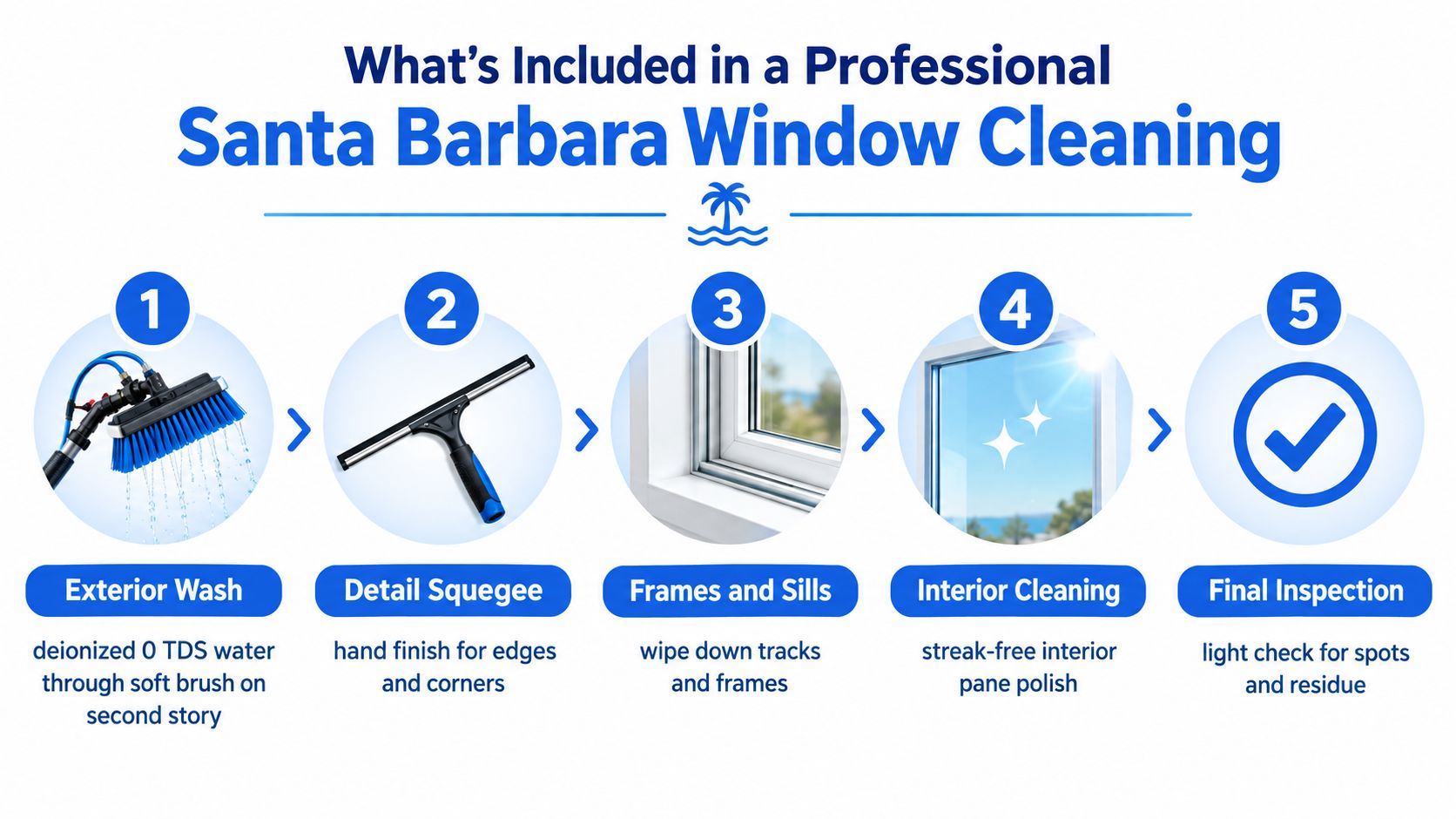
Screens, tracks, and interior panes
Screens should be removed, rinsed, scrubbed with a soft brush, dried, and reinstalled. A screen can hold salt, pollen, and dust against clean glass, so skipping it undermines the result.
Frames and tracks get vacuumed before a detail cloth removes remaining grit. Inside, the crew protects flooring with drop cloths, removes screens, hand-wipes the glass, finishes with a squeegee, and uses a lint-free cloth on edges. Historic wood requires a lighter touch than a heavily soiled modern aluminum frame.
A purified-water method is useful when the local water supply leaves residue. For a deeper explanation of that approach, see this guide to purified-water window cleaning.
If solar panels are present, the same purified water and a non-abrasive pad can remove surface dust without detergent. Detergent isn’t appropriate for every panel coating, so the technician should confirm the panel manufacturer’s care requirements before scrubbing.
For a visual walkthrough of equipment and sequencing, watch the embedded demonstration below.
DIY Methods Versus Professional Coastal Cleaning
A bucket, blue glass cleaner, microfiber cloth, and step ladder can handle a reachable bathroom window. That setup becomes less convincing on exterior panes where dissolved minerals dry quickly, screens are packed with salt, or the glass sits above a two-story stucco wall.
The DIY trade-off isn’t price. It involves finish quality, time, and exposure to risk. A homeowner may spend a morning cleaning accessible panes and still leave tracks, screens, and mineral deposits untouched. Ladder placement adds another concern around sloped ground, hillside decks, balconies, and delicate landscaping.
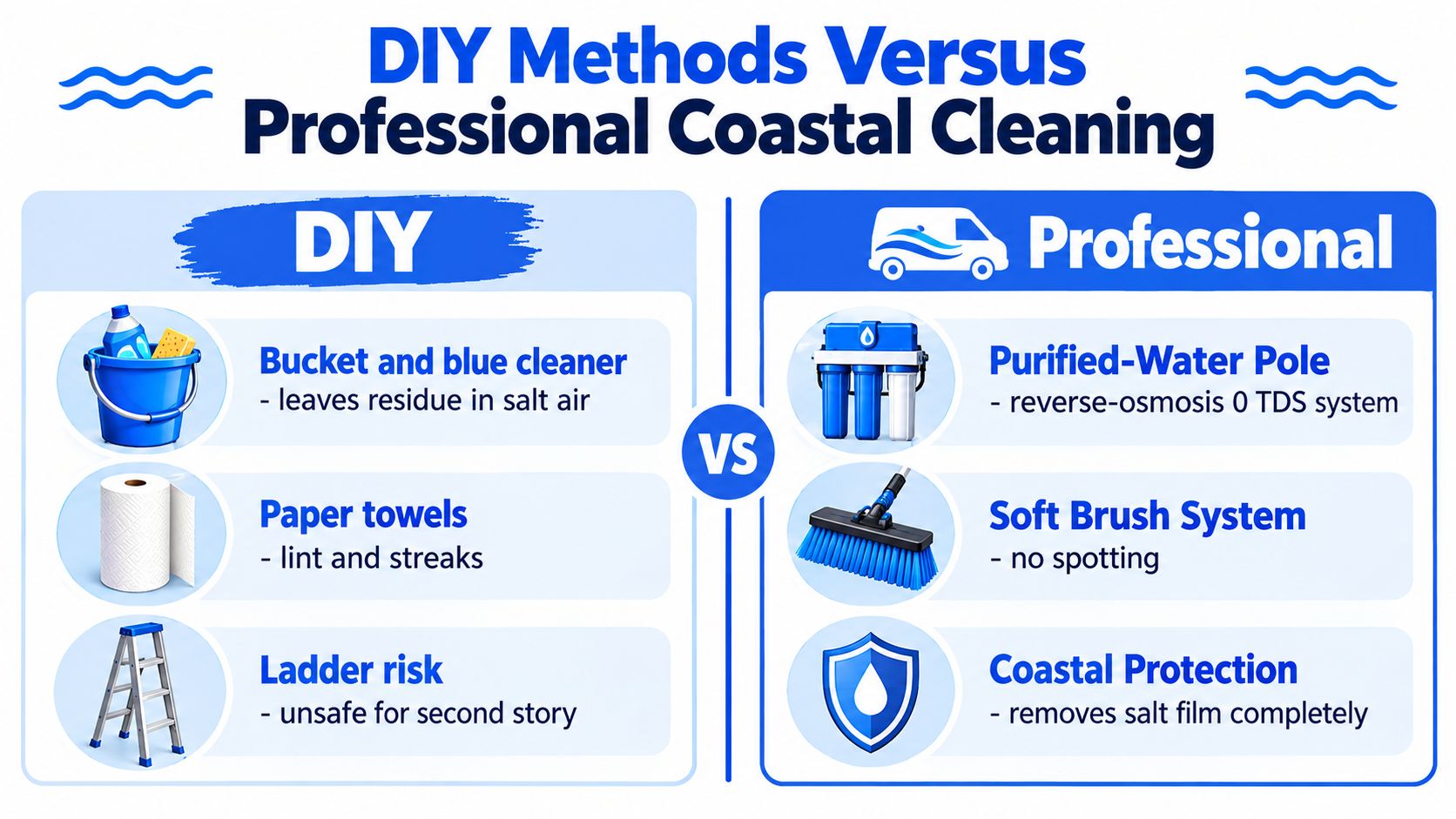
Where each method makes sense
| Task | DIY approach | Professional approach |
|---|---|---|
| Reachable interior glass | Microfiber and hand squeegee work well | Faster detail finish with proper edge control |
| Exterior upper panes | Ladder work creates access and safety concerns | Carbon-fiber water-fed pole reaches from the ground |
| Salt film | Hose rinsing may leave minerals behind | Purified water removes residue without a detergent film |
| Screens and tracks | Often postponed or skipped | Screens are removed, washed, dried, and tracks are vacuumed |
| Mineral spotting | Household acid may help light haze | Deposit severity can be assessed before blade or chemical work |
A professional reverse-osmosis and deionization setup produces low-residue water, while a soft brush loosens coastal film without repeatedly dragging grit across the pane. Stainless blades may be appropriate for certain mineral deposits, but they require a trained hand, a clean surface, and awareness of coatings and historic glass.
A sensible boundary: Do the reachable interior touch-ups yourself. Leave upper exterior glass, fragile wood assemblies, stubborn mineral spotting, and ladder-dependent work to an insured crew.
How Pricing Works for Santa Barbara Homes
The typical $200 to $475 full-clean range gives Santa Barbara homeowners a practical starting point, but it isn’t a universal menu price. The final quote depends on how many panes need attention, where they sit, how much screen and track work is included, and whether salt or mineral deposits need additional treatment.
A single-story home with accessible glass usually takes a different crew plan from a two-story hillside property with casement banks, balconies, skylights, or solar panels. Screen quantity can also change the labor significantly because each screen needs removal, washing, drying, and careful replacement.
Main cost variables
- Pane count: More glass means more washing, detailing, and final inspection.
- Story height: Upper panes may require water-fed poles, specialty access, or additional setup.
- Accessibility: Hillside decks, narrow side yards, gates, and landscaping affect working time.
- Screen count: Salt and airborne debris make screen cleaning more than a quick dust-off.
- Deposit severity: Hard-water spotting may require separate assessment and treatment.
- Additional glass: Skylights, French doors, divided lights, and solar panels add distinct work areas.
| Home Profile | Approximate Range | Primary Cost Driver |
|---|---|---|
| Typical Santa Barbara full clean | $200 to $475 | Pane count, access, screens, and detail level |
| Small, accessible single-story home | Qualitative estimate needed | Fewer panes and simpler access can reduce labor |
| Multi-story or hillside home | Qualitative estimate needed | Height, decks, recessed glass, and equipment setup |
| Historic home with divided lights | Qualitative estimate needed | Muntin detail, delicate materials, and careful hand work |
A recurring schedule may reduce the per-visit price by roughly 15 to 25% compared with a one-off booking. For a broader explanation of residential quote variables, review residential window-cleaning prices.
Photos help, but they rarely show track buildup, second-story exposure, or the condition of old wood. A free on-site or virtual estimate is the reliable way to separate routine cleaning from restoration-style detail work.
Service Areas and How to Book a Visit
Window crews serving the Santa Barbara and Ventura region commonly build routes around both coastal neighborhoods and inland appointments. In Santa Barbara proper, that includes The Mesa, Upper East, San Roque, and Hope Ranch, with nearby service along the corridor through Carpinteria, Summerland, Montecito, Goleta, and Isla Vista.
By appointment, service can extend to Solvang, Buellton, and the Santa Ynez Valley. East of Santa Barbara County, homeowners may also find coverage in Ventura, Ojai, and Camarillo, depending on the crew’s route and the property’s access requirements.
A straightforward booking process
- Request the estimate. Use an online form or phone call and provide the address, preferred service, approximate story count, and any concerns about salt haze or hard-water spotting.
- Choose the assessment style. A free on-site walk-through is preferable for multi-story, historic, hillside, or heavily screened homes. A virtual estimate can work when you can send clear photos of representative windows, tracks, screens, and access points.
- Confirm the visit. Ask for the arrival window, expected crew size, included tasks, and insurance documentation if your property manager or HOA requires it.
A useful confirmation should also identify whether interior access is needed, whether screens are included, and whether skylights or panels are separate line items. Those details prevent the common misunderstanding where a homeowner expects a full frame and screen service but booked pane cleaning only.
Recurring customers often prefer the same weekday each cycle. That rhythm makes it easier to coordinate pets, gates, cleaners, tenants, and irrigation shutoffs, especially when coastal exposure requires a shorter maintenance interval.
Keeping Glass Clear Between Visits
Use the 4 to 8 week coastal cadence as the baseline for exposed properties, then protect the finish with one simple habit: rinse exterior glass with fresh water after a fog or strong wind event. The rinse lifts salt aerosol before it dries into a bonded film. It isn’t a replacement for professional detailing, but it can slow the return of haze.
For fingerprints and pet nose prints, use a clean microfiber cloth and a spray bottle filled with deionized or otherwise low-residue water. Avoid paper towels, pressure washers aimed at seals, and vinegar on coated glass unless the coating manufacturer permits it. Vinegar can be useful for compatible mineral deposits, but coated surfaces need a more cautious product decision.
A practical maintenance rhythm
- Weekly: Check the glass from an angle and rinse obvious exterior salt after fog or wind. Look for blocked weep holes and new water marks.
- Mid-cycle: Remove fingerprints with a microfiber cloth and low-residue spray. Don’t scrub a gritty pane dry.
- After irrigation: Use a squeegee where sprinkler overspray reaches glass, then redirect the irrigation head away from the window.
- At the professional visit: Request screen removal, track vacuuming, frame wiping, and a check for recurring mineral sources.
- For established stains: Use a specialist when ordinary cleaning no longer changes the white spotting. Praz Pure Water’s hard-water stain removal resource offers a useful reference for evaluating deposit treatment.
Screen care deserves its own attention in a coastal home because salt and airborne pollen settle into mesh and reduce the quality of ventilation. This Santa Barbara screen-cleaning guide can help you decide whether a rinse is enough or the screens need removal and scrubbing.
If streaks appear soon after a completed service, photograph the affected pane with a timestamp and contact the cleaner promptly. A clear image, window location, and description of the condition make a satisfaction-guarantee review much easier, and a follow-up visit can often fit into the next available route.
Aloha Window Bros provides interior and exterior window cleaning, screen cleaning, frames and sills, skylights, and solar-panel care for Santa Barbara and Ventura County properties, with free on-site and virtual estimates. Visit our Santa Barbara window cleaning page to request a quote and describe your home’s salt exposure, historic windows, access challenges, or hard-water spotting.