

Water spots are dissolved minerals, mainly calcium and magnesium, left as a thin residue when a droplet of water evaporates on glass. Hardness, the measure of those minerals reported as calcium carbonate, runs from soft at 0 to 60 mg/L through moderately hard at 61 to 120 and hard at 121 to 180, up to very hard above 180 mg/L, and every step up that scale leaves more solid material behind each time a droplet dries.
You probably know the scene. You pull out of the driveway on a July morning and the low sun hits the passenger window, and there it is: a fan of pale half-rings across the glass, following the exact arc of the sprinkler head by the mailbox. You hit it with a damp rag at the gas station. The rag moves the rings around. It doesn’t remove them.
That moment is where most window care goes wrong, and not because the rag was dirty. It’s because the mark on the glass isn’t grime sitting in a film of soap. It’s mineral material that formed in place, and the way you deal with it depends entirely on what it’s made of and how long it’s been there. Treating every white mark as hard water is as unreliable as treating every stain on a shirt the same way.
The practical skill here is diagnosis. Once you can read the pattern, the rest follows: match the mark to its cause, check what your local water carries, then choose the gentlest method that will work. This walkthrough covers what causes water spots, why some homeowners fight them constantly while their neighbors never see one, and how to tell a deposit you can lift from damage you can’t.
Table of Contents
- Minerals Left Behind as Water Dries on Glass
- Matching the Mark to Its Likely Cause
- How Minerals and Local Water Set Spot Risk
- Removable Deposits Versus Etched Glass
- How to Prevent Spots from Coming Back
- Choosing Between a Home Fix and Professional Cleaning
Minerals Left Behind as Water Dries on Glass
Picture a puddle on a concrete sidewalk after a summer storm. The water disappears and a pale salt line stays behind, tracing the outline of where the puddle used to be. Glass behaves the same way. Water is the carrier that leaves, the dissolved minerals are the cargo that stays, and a rinse with perfectly pure water would leave nothing at all.
So a water spot is a deposit, not dirt. That single distinction explains a frustration plenty of homeowners run into. As the USGS explanation of water hardness puts it, ordinary detergent lifts surface oils and dirt but doesn’t dissolve the carbonate scale a dried droplet leaves bonded to the pane. You can scrub a mineral ring for ten minutes and redistribute it into a thinner ring.
Three factors decide how bad the spotting gets on any given window:
- How much mineral the water carries. Hard water delivers more solids per droplet than soft water, so the same spray pattern builds a thicker residue.
- How many droplets land on the same pane. One wetting event leaves almost nothing visible. Season after season of the same sprinkler arc leaves overlapping rings that read as haze.
- How fast each droplet dries. Sun, wind and warm glass drive evaporation, and faster evaporation concentrates the minerals into a tighter, denser spot.
Watch the difference in one house. A west-facing pane that catches sprinkler spray every morning in July and then bakes in afternoon sun can build a visible film in a matter of weeks. A pane on the shaded side that only sees occasional rain may look clear a year later, even though the same person cleans both with the same method.
That’s the frame for everything that follows. A spot is a mineral deposit formed by evaporation, which means it’s readable. You can identify the cause, choose the right response, and then interrupt the wet-and-dry cycle that keeps depositing new material.
Matching the Mark to Its Likely Cause
The mark itself is the first clue. Shape, location and behavior under a gentle test narrow the cause faster than any product label, and each cause calls for a different response.
| Visible pattern | Most likely cause | Quick test |
|---|---|---|
| Semicircles or arcs on lower or sprinkler-facing panes | Sprinkler overspray | Compare with a pane sprinklers never reach |
| Uniform milky haze on coastal glass | Salt aerosol bonded with grime | Haze returns quickly after a plain rinse |
| Isolated white crusts with clear edges | Mineral-rich droplets | Crust softens after a damp cloth and a short wait |
| Sheen or fine scratch trail after wiping | Dust or grit dragged across glass | Check the pane at a low light angle for scratch lines |
| Spot resists safe cleaning and feels rough | Mineral etching | Fingernail catches on the spot and the surface feels rough |
Read that table from the bottom row upward. Everything above the last row is a deposit sitting on the glass; the last row is damage in the glass. A removable surface deposit and mineral etching are different problems: repeated evaporation and exposure can roughen the surface itself, and no cleaning product reverses that.
Why one neighborhood spots and another doesn’t
Not every white mark is hard water, and hardness itself varies widely from one supply to the next. West Linn, Oregon reports hardness of about 24 ppm in West Linn’s 2025 water quality report. Other municipal supplies run far higher, which is why the same spray pattern leaves heavier residue in one town than another. Along the South Coast, sprinkler overspray can deposit more than four times the mineral load on identical glass compared with the imported supply serving Thousand Oaks and Newbury Park.
Hardness reflects dissolved calcium and magnesium, while other visible residues come from salt aerosol, dust, bird droppings or soap films. Along the coast those sources stack: salt aerosol bonds a haze onto glass within about two miles of the water, irrigation adds mineral rings, and drought dust and first-rain runoff mark the same pane. No single cleaning recipe holds everywhere from Ojai to Hope Ranch. Hardness is a cosmetic water-quality issue, so the goal is an accurate read on the deposit, not alarm about what is in your water.
Two rules that prevent expensive mistakes
Compare before you treat. Find one pane the sprinklers never reach and hold it next to the suspect window. If the sheltered glass is clear and the arc-covered glass isn’t, overspray is the driver. Turn the sprinkler heads away from the glass first, then remove the existing deposit; no product fixes the problem while the head keeps spraying.
Never dry-wipe field dust. Dust on glass is mineral grit, and a dry cloth grinds it across the pane the way fine sandpaper would. Rinse it off with water first, every time, before anything touches the surface.
How Minerals and Local Water Set Spot Risk
A spot forms in five predictable stages, and each stage offers an opportunity to intervene.
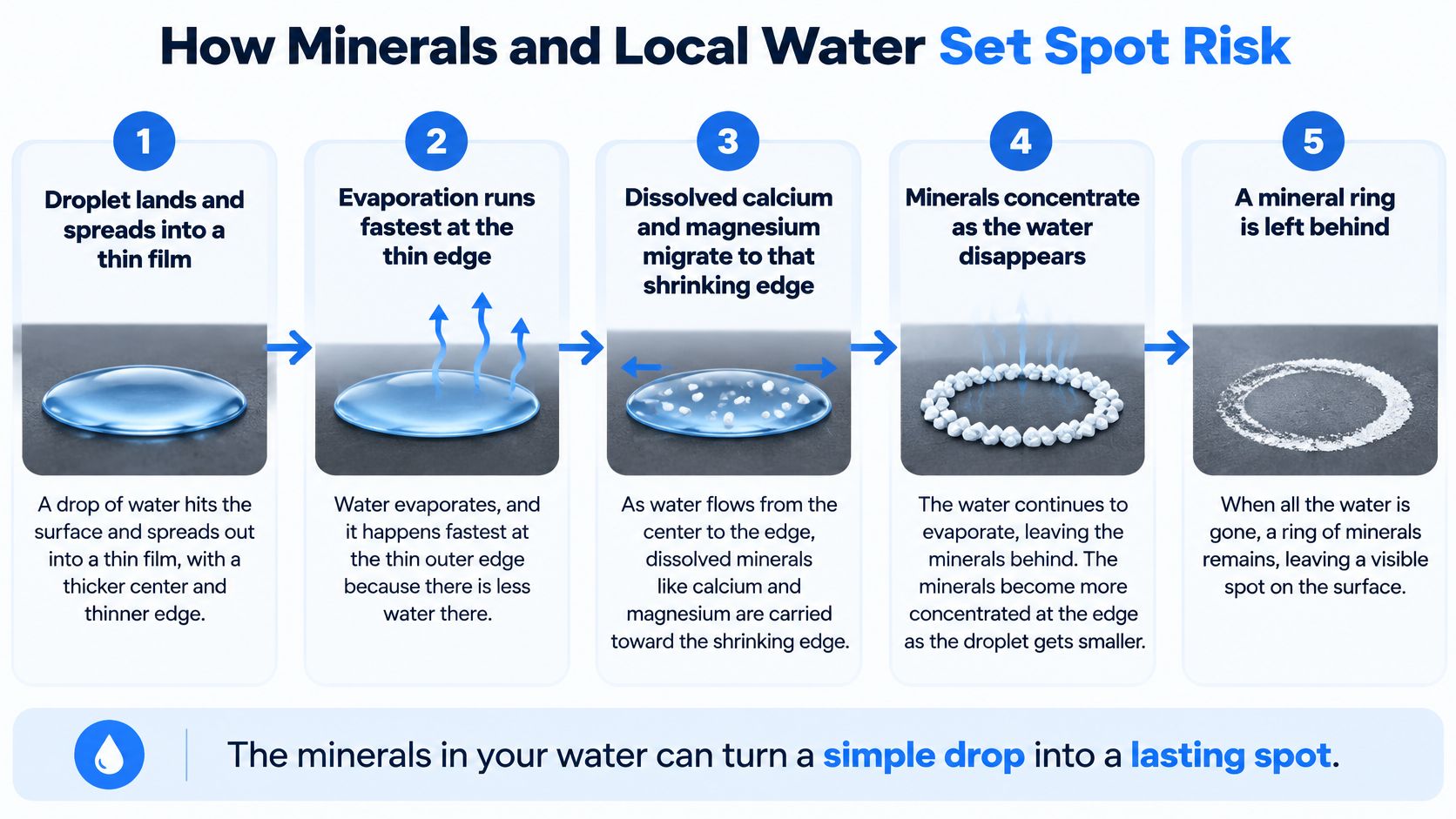
- A droplet lands and spreads into a thin film. The water flattens against the glass, exposing far more surface area than a bead would.
- Evaporation runs fastest at the thin edge. The rim dries first because it has the least water and the most contact with moving air.
- Dissolved calcium and magnesium migrate to that shrinking edge. As the droplet retreats, it carries its dissolved load toward the boundary.
- The residue dries as a white or ring-shaped line. Whatever was in the water is now sitting on the glass in a concentrated circle.
- Repeated wetting stacks overlapping rings into haze. Each cycle adds material, and later droplets partially redissolve and redistribute what’s already there.
What your hardness number predicts
Hardness is reported in milligrams per liter as calcium carbonate, a common currency that lets you compare one water supply with another at a glance.
| Hardness class | Hardness (mg/L as CaCO3) | Typical spotting on exposed glass |
|---|---|---|
| Soft | 0-60 | Few spots; regular rinsing usually keeps glass clear |
| Moderately hard | 61-120 | Spots appear on sprinkler-facing and lower panes |
| Hard | 121-180 | Visible rings and haze build between cleanings |
| Very hard | Above 180 | Frequent crusting; deposits harder to lift and etching risk rises |
Those classes come from the USGS groundwater quality overview, which also names what groundwater commonly carries: calcium, magnesium, sodium, chloride, bicarbonate and sulfate. None of those evaporate. All of them stay on the glass when the water leaves.
Where the minerals come from
Geology sets the baseline, and the spread is enormous. The same USGS data describe calcium concentrations below 10 mg/L in some granite- or silica-based waters, 30 to 100 mg/L in waters contacting limestone or dolomite, and several hundred mg/L in some gypsum-influenced waters. Rock type under your neighborhood partly decides how hard your windows are to keep clear.
Tap water studies land in the same territory. A 2024 nutrition study published in Frontiers in Nutrition measured average tap water calcium at 45.85 mg/L and magnesium at 6.61 mg/L, both of which remain on the pane after the droplet dries.
Local supply differences are just as dramatic within one region. South Coast sprinkler overspray can deposit more than four times the mineral load on identical glass compared with the imported supply serving Thousand Oaks and Newbury Park. Montecito, Goleta and Carpinteria carry the hardest water we work in anywhere, and if you’re on a private well, hard water stains from Ojai well water follow a different pattern again, because well chemistry tracks the aquifer rather than a treatment plant.
Where to find your number: your utility mails an annual water quality report, and hardness is listed in it. Read your own, not your neighbor’s, because a supply can change when a district blends sources or switches wells.
Removable Deposits Versus Etched Glass
Here’s the test that decides everything downstream: does the mark sit on the glass, or has it started to alter the glass?
A fresh mineral deposit is superficial. It rests on the surface and lifts when the chemistry matches the mineral. Etching is different. It’s chemical roughening from prolonged mineral contact under heat and repeated wetting, and the USGS notes on dissolved solids draw the same line, describing fresh residue as usually removable while long mineral contact under heat and repeated wetting can contribute to surface damage that’s harder to reverse. Coastal salt aerosol adds another layer to that story, and not every visible spot is salt alone.
The chemistry behind persistence is worth knowing. Carbonate hardness comes from calcium or magnesium combined with bicarbonate and carbonate species, and as a droplet evaporates, carbon dioxide exchange and concentration shifts push carbonate minerals to precipitate onto the glass, as a USGS report on hardness and scale describes. Once that happens, ordinary wiping spreads the deposit rather than dissolving it.
The removal ladder, gentlest rung first
- Wash with water and a microfiber cloth. Rinse loose grit away before anything touches the pane, then wash with a mild solution and a clean cloth.
- Soften white crusts with diluted white vinegar. Mix roughly one part vinegar to one part water, test a hidden corner first, and give it a minute of dwell time rather than scrubbing harder.
- Step up to a purpose-made mineral remover for rings that survive vinegar. These are formulated to dissolve carbonate deposits without attacking the glass.
- Finish with a rinse of distilled or purified water, which leaves no minerals behind as it dries. We use purified water to lift mineral spots precisely because it dries without streaks or new residue.
- Consider polishing or abrasive restoration only after inspection. Abrasives remove glass, so they’re the last option, never the first.
One warning before any of that: coated, low-E and tinted glass can be damaged by acids and abrasives. Check the glass type, usually etched in a corner of the unit or listed on the window label, before you apply anything.
The stop signal: if a spot survives every safe rung of the ladder and your fingernail catches on it, the glass is likely etched. Stop cleaning and get a professional assessment before any abrasive work.
For homeowners dealing with sealed units, the same care applies to both panes, and the sequence for cleaning double-pane windows matters as much as the product.
How to Prevent Spots from Coming Back
Cleaning removes what’s already there. Prevention changes the conditions that made it. Drying speed and mineral concentration decide how much residue each cycle leaves, so droplet size, direct sun, wind, glass orientation, surface temperature and irrigation distance all carry as much weight as the water itself, as the City of Phoenix water quality report illustrates in its hardness figures of 172 to 302 ppm for one supply against 77 to 160 ppm for another depending on source.
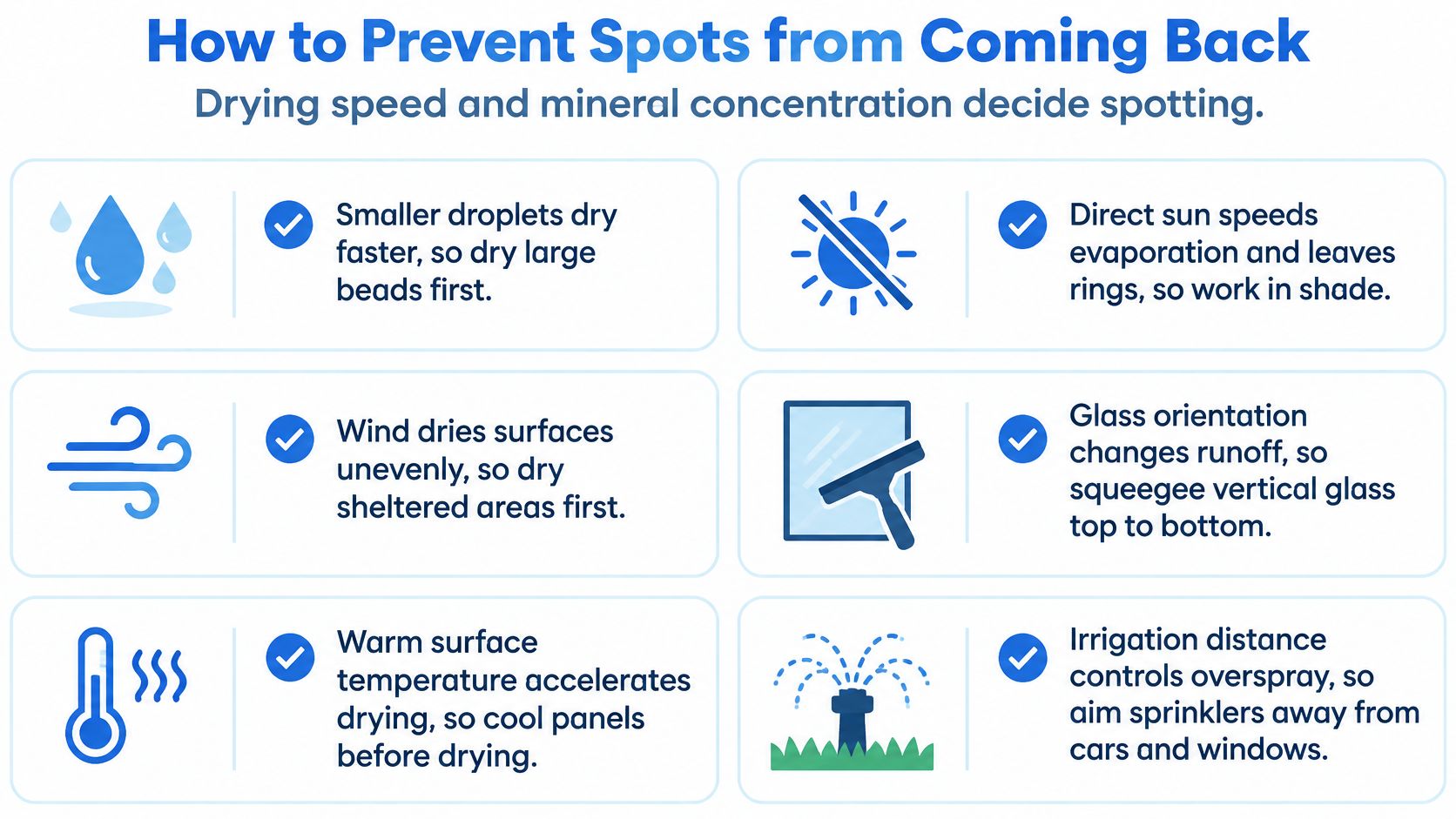
Work through these in order, because the first one does more than the rest combined:
- Redirect sprinkler heads away from glass. Turn off or angle any head that sprays a window, and check after each adjustment by running the zone for a minute.
- Water early or late. A cycle that runs at midday in July leaves spray drying in full sun on warm glass, which is the fastest route to a concentrated ring.
- Rinse frames, sills and lower panes after irrigation. Residue collects in the frame channel and gets splashed back onto the glass at the next wetting.
- Dry glass with microfiber right after hose or rain wetting. Removing droplets before they evaporate is the whole mechanism interrupted.
- Remove overspray deposits before they crust. A light film lifts in minutes. A baked ring takes a mineral remover and patience.
Set an interval, then let inspection adjust it
Intervals are a starting point, not a rule. We recommend window cleaning every 3 to 6 months for most homes, and more often when the property sits near trees, construction or the coast. Santa Barbara windows within about two miles of the water get cleaned every 2 to 3 months, because salt aerosol bonds a haze onto the glass there and rinses off far more readily than it dissolves.
Coastal glass also collects a hygroscopic film that pulls moisture out of the air and traps dust, which is why it re-soils faster than inland glass even when nobody is running sprinklers. Trees drop pollen and sap, construction throws grit, and the first rain after a dry summer washes months of accumulated dust onto panes as a streaky film. Because the rinse water itself can add a fresh deposit, the reasoning behind purified water window cleaning is that the maintenance routine should put nothing on the glass that has to come off later.
The sequence we follow on a sprinkler problem: turn the heads away from the glass first, then remove the existing deposit with purified water. Fixing the deposit without fixing the head means you’ll be back in a month.
The goal is shortening the wet-and-dry cycle, not escalating to stronger chemicals. A gentler product applied to glass that stops getting sprayed beats a harsh one applied every few weeks.
Choosing Between a Home Fix and Professional Cleaning
Use the ladder as a decision tool. If the marks are removable deposits and plain water, vinegar or a mineral remover lifts them, a home fix can be reasonable after one check: confirm the glass is not coated, low-E or tinted, then test a small corner before touching the whole pane. Acids and abrasives can mark those surfaces, so a deposit that wipes clean on ordinary glass still calls for a gentler pass on performance glass. If the spots feel rough under a fingernail, sit on coated or high-performance glass, cover many panes after you have redirected the sprinklers, or keep returning within weeks in very hard water, bring someone in.
Hiring has its own checklist. Ask whether the provider inspects the glass before touching it with anything abrasive. Ask whether they walk the property with you before they leave, which is what we do on every job, along with redoing the work on the spot if the result is not right. Ask how they handle a pane that turns out to be etched rather than spotted.
If the job turns out to be bigger than windows, a local handyman service for homeowners can handle the sprinkler head replacement, sill repair or stucco patching that stops overspray at the source, often the cheapest permanent fix for a chronic spotting problem.
Start with the pattern table. Confirm the cause, take the matching rung, and escalate only after the simpler step has failed.
Aloha Window Bros cleans windows, screens, frames and sills across Ventura County and Santa Barbara County, and every visit starts with the diagnosis described here: what the mark is, what your water carries, and how often that pane gets wet. If sprinkler arcs or coastal haze have been building on your glass for a few seasons, book a free on-site quote and get a straight answer on whether the deposit will lift or the surface has already etched. Visit Aloha Window Bros to schedule a visit.