

More dish soap isn’t the secret to cleaner windows. Neither is replacing every cleaner with vinegar. Both approaches can work on the right pane, but both fail when the soil, surrounding materials, or drying conditions don’t suit the mixture.
The best window cleaning solution for squeegee work is the weakest glass-safe mixture that loosens the dirt, lets the rubber glide, and comes off without film. For most homes, that means a properly diluted, low-residue commercial concentrate. Before committing to a bucketful, let one shaded test pane decide.
Table of Contents
- Best Solution Type for Each Cleaning Job
- What a Squeegee Solution Must Do
- Reading Commercial Labels Before You Buy
- Mix, Dilute and Test One Pane
- DIY Recipes and Where They Break Down
- Matching Your Solution to Coastal and Hard-Water Glass
- Verdict and Next Step
Best Solution Type for Each Cleaning Job
| Solution type | Best for | Residue risk | Main limit |
|---|---|---|---|
| Commercial low-residue concentrate | Routine interior and exterior glass | Low when diluted to label | Needs correct dilution and a surface-compatibility check |
| Mild dish soap mix | Light dust and fingerprints | Medium if overdosed | Film and foam when too strong |
| Vinegar and water | Light mineral haze on compatible glass | Low on glass, unsafe on sensitive stone | Can damage marble, limestone, painted trim, and some hardware |
| Ammonia and water | Greasy or heavy grime on compatible glass | Low when removed completely | Needs ventilation; never mix with bleach or other cleaners |
| Purified water only | Mineral-spot maintenance and tall or hard-to-reach exterior glass | No added chemical residue | A pole system suits tall glass; established scale may need separate treatment |
Match the solution to the soil and the surface, not the strongest claim on the shelf. Dust, cooking grease, coastal salt, and sprinkler deposits aren’t interchangeable cleaning problems. Neither are bare glass, coated glass, painted frames, and stone sills.
A concentrate earns its place through predictable dilution and clean removal. Dish soap earns its place through simplicity and availability. Vinegar and ammonia are narrower tools, not automatic upgrades, while purified water changes the washing and rinsing method rather than replacing detergent.
The practical choice for most homes
I would start with a commercial low-residue concentrate labeled for manual glass cleaning. Choose one that specifies its working dilution and suitability for the glass and surrounding finishes. A concentrated bottle isn’t necessarily better value if you have to wash every pane again to remove film.
Pine Country Window Cleaning’s guide to choosing detergents for streak-free windows offers another useful product-selection perspective. Compare the instructions and intended application, rather than assuming every product sold as glass cleaner behaves well under a squeegee.
For high exterior glass or recurring mineral spotting, our explanation of purified-water window cleaning helps distinguish a water-fed system from ordinary bucket cleaning. Purified water can improve the finish without guaranteeing removal of every established deposit.
Buying rule: Choose the product you can dilute accurately and remove cleanly, not the one that produces the most foam.
Keep a simple home mix if it passes the dry-glass check. Use the mixing procedure below to establish that result before washing the entire house.
What a Squeegee Solution Must Do
A squeegee removes liquid mechanically. The rubber needs steady contact with the pane, not a thick cushion of suds between its edge and the glass. The 1938 United States squeegee patent identifies blade angle and pressure as central operating variables, which explains why detergent alone can’t guarantee a clean finish.
Window-cleaner patent development reaches back to a United States application filed in 1905, so controlled water removal is a mature principle, not a new product feature.
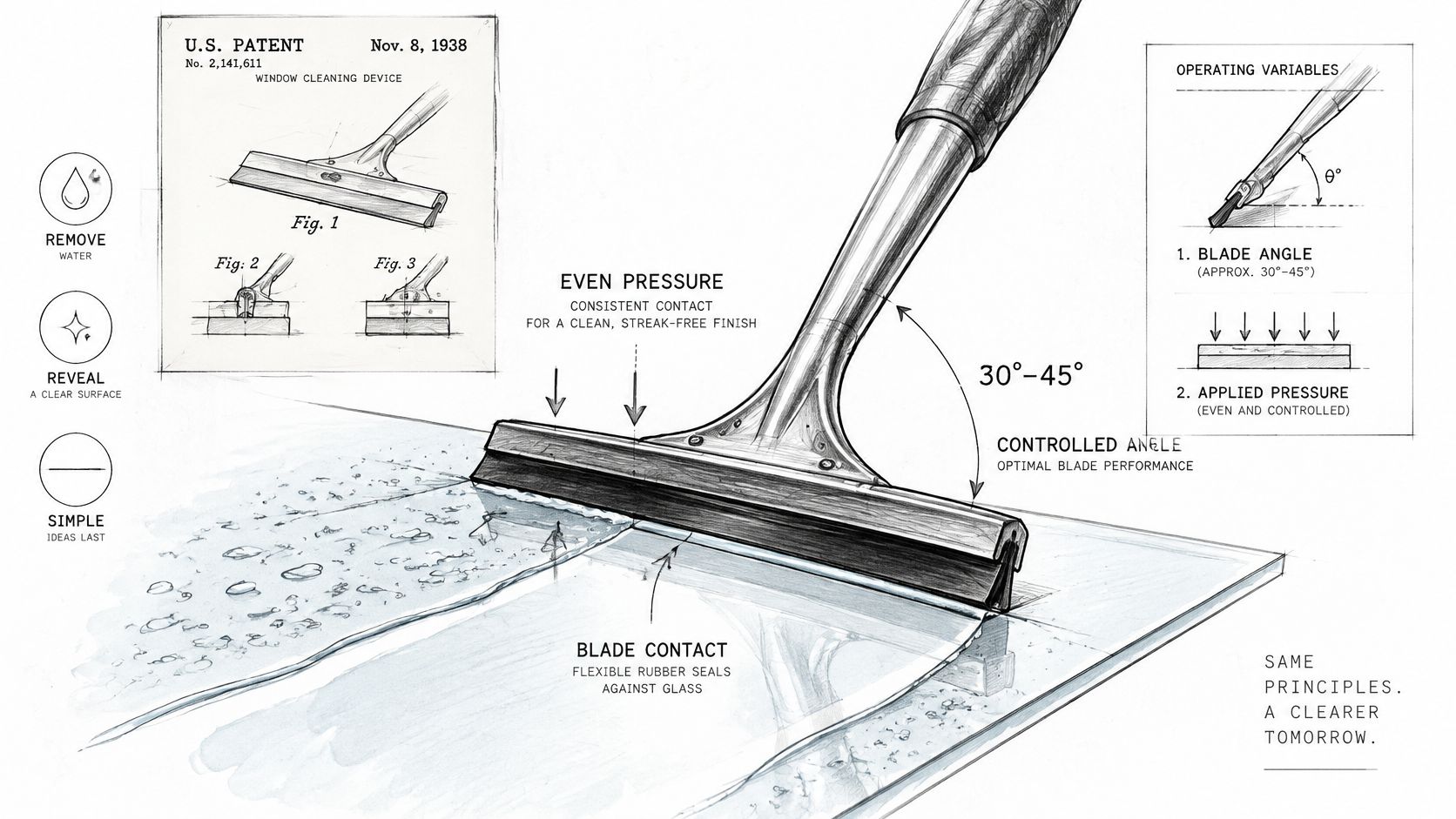
Turn blade mechanics into buying criteria
The liquid has three practical jobs: wet the pane evenly, loosen the contamination, and separate cleanly when the blade passes. An excessively thick or heavily foaming mixture makes consistent removal harder. A pane that’s barely damp presents the opposite problem, the rubber drags rather than glides.
Translate those requirements into a short selection list:
- Low foam: You need a continuous wet surface, not a blanket of bubbles that hides missed dirt.
- Low nonvolatile residue: Avoid unnecessary additives that remain after water removal.
- Good wetting: The wash should spread across the pane instead of leaving dry islands.
- Suitable pH: Neutral to mildly alkaline products are sensible routine candidates, provided the label permits the surrounding materials.
- Clear dilution instructions: A measurable working mixture is more useful than an unspecified splash.
For a complementary explanation of solution choices, South Mountain Window Cleaning’s solution guide is useful alongside a close inspection of your own equipment. Our window-washing squeegee guide addresses the tool side of the same job.
The working combination is straightforward: a lightly surfactant-based, low-foam wash, enough water to maintain glide, overlapping strokes, and clean rubber. Large panes and storefronts make poor removal especially visible. Coastal glass adds salt and dust that need washing away without replacing the original haze with detergent film.
Reading Commercial Labels Before You Buy
Judge a concentrate by its technical information, not its maximum-strength claim. A thin, low-film glass cleaner is a different tool from a heavy alkaline degreaser. More aggressive chemistry can create compatibility problems without improving the final squeegee pass. Crews buying for storefronts and office buildings can use our commercial window cleaning solution guide, which also covers Safety Data Sheets and purified water.
What formulation information actually tells you
Published formulations vary widely in pH and working dilution. A ratio printed for one concentrate says nothing about how to mix another, so the product’s own technical sheet is the only reliable source for those numbers.
The clearest performance example is Nouryon’s Berol LS technical brochure, which reports lower streak intensity for a 2% Berol LS formulation than several compared multi-surface, antibacterial, window, and heavy-duty cleaners. The same document’s suggested window-cleaner starting formulation uses 0.5 to 1.0% Berol LS, 0.2 to 0.5% chelant, and 2.5 to 5.0% isopropanol, with water making up the balance. Treat these as a manufacturer’s formulation test and starting recipe: useful for understanding what goes into a glass cleaner, meaningless as instructions to combine household chemicals in a bucket.
Each component has a job. The surfactant wets and lifts soil. The chelant binds metal ions that could contribute to deposits or haze. Isopropanol speeds drying, although faster drying isn’t always desirable on warm exterior panes where the wash can flash off before the blade arrives.
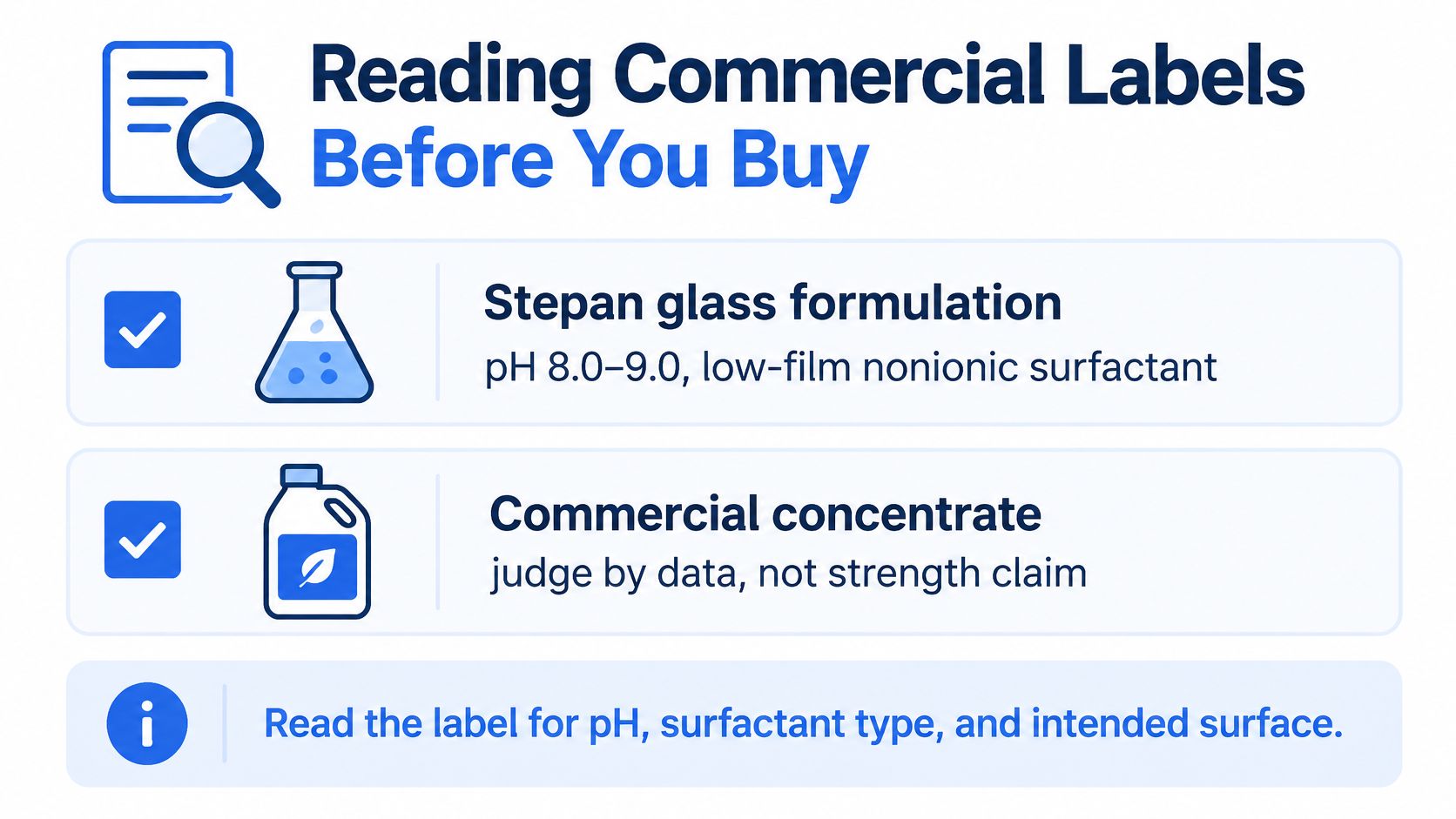
A shelf checklist that rules products in or out
You don’t need to become a formulator. You need enough label information to establish that the product suits the glass, the soil, and a repeatable mix.
- Intended application: Look for manual glass or sponge-and-squeegee use rather than general hard-surface cleaning alone.
- Working dilution: Distinguish ready-to-use spray from concentrate, and confirm the label gives a measurable ratio.
- pH information: Check the technical sheet when the bottle doesn’t state it.
- Residue testing: Give specific streak or film information more weight than fragrance or shine language.
- Foam and surfactant details: Favor a glass-specific low-film system over a detergent selected only for grease cutting.
- Surface restrictions: Read exclusions for films, coatings, seals, frames, and adjacent stone.
- Certification: EPA Safer Choice is a useful additional purchasing filter, not permission to ignore application instructions.
A cleaner that works well when sprayed and buffed isn’t automatically a good bucket solution for a large pane.
If a concentrate provides no usable dilution information, choose a better-documented product. Guessing at strength turns a straightforward cleaning job into repeated washing. And once two candidates survive this checklist, the fair comparison between them is the same pane, the same measured dilution, and the same angled light.
Mix, Dilute and Test One Pane
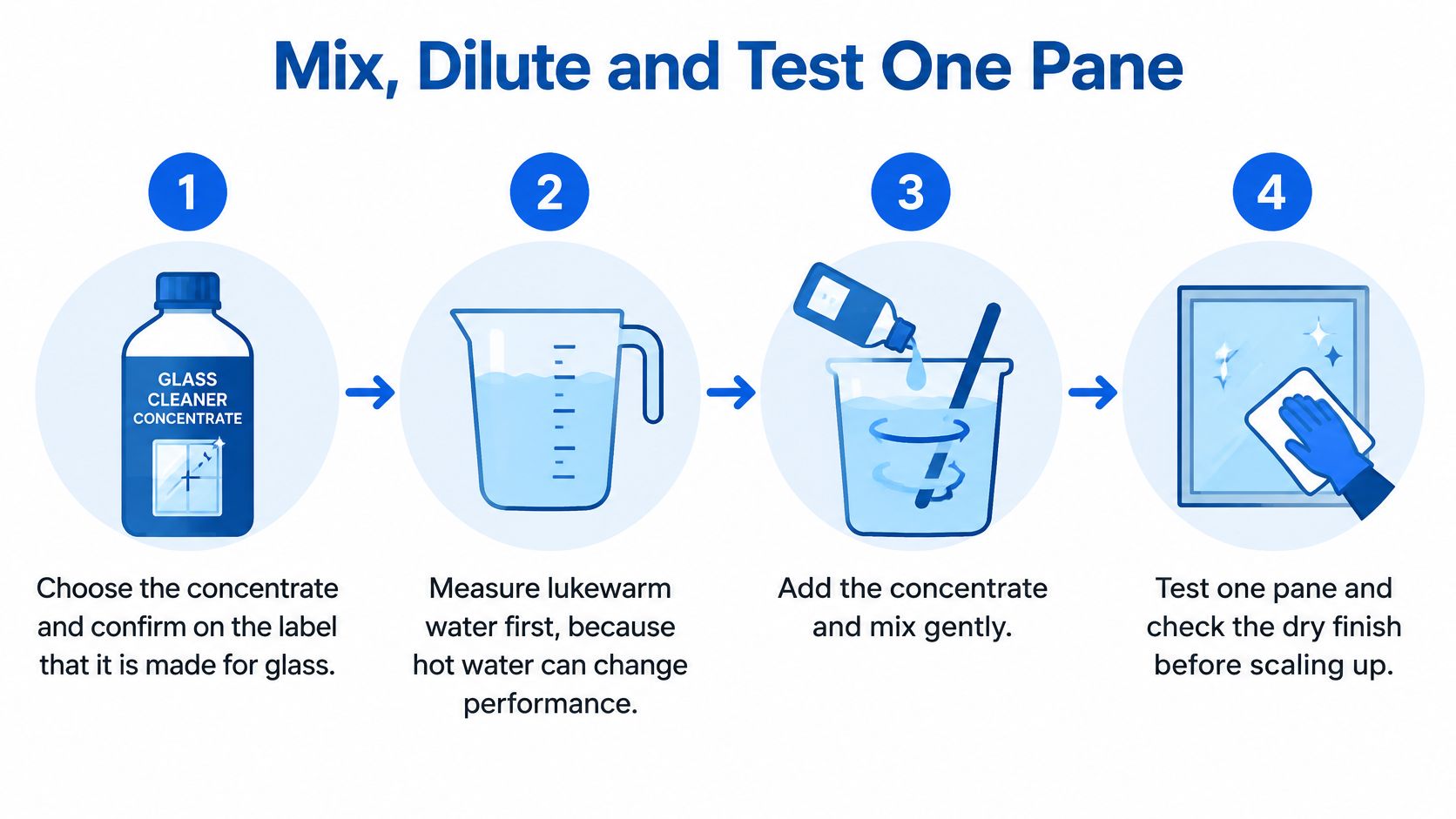
- Confirm glass compatibility. Choose a concentrate intended for your glass and application, because a general-purpose cleaner may have different residue or surface restrictions.
- Measure the water first. Use cool to lukewarm water, because hot water on warm glass shortens the time available for removal.
- Measure the concentrate. Add the label amount, because bottle strength determines the actual working concentration.
- Mix gently. Stir without whipping up suds, because excessive foam makes the wash harder to control.
- Wash a shaded test pane. Scrub the full surface and squeegee from top to bottom with overlapping strokes, wiping the blade between passes.
- Inspect the dry result. Check in angled light after the remaining moisture has disappeared, because wet glass can hide film and fine lines.
Don’t substitute an arbitrary table ratio for missing manufacturer instructions. The formulation guidance below helps explain strength, but it can’t identify the active content of an unlabeled bottle.
Understand active strength before using a dilution ratio
Dow’s hard-surface-cleaner formulation guidance gives a glass-cleaner detergent-surfactant range of approximately 0.02 to 1% in use, with 0.05 to 0.25% preferred for general cleaning and higher levels reserved for greasy soil. The table applies those benchmarks to practical starting decisions, not universal bottle-to-water conversions.
| Soil or condition | Active surfactant in use | Starting dilution | Notes |
|---|---|---|---|
| Light dust or fingerprints | Low end of the published range | Lowest label-approved cleaning strength | Use the lowest level that wets and cleans the pane |
| Routine residential glass | Preferred general-cleaning range | Label dilution for manual glass cleaning | Start toward the lower-strength end |
| Greasy or heavy film | Higher end only when justified | Label’s heavy-soil dilution | Increase only after confirming the remaining soil is grease |
| Coastal salt haze | General-cleaning range after pre-rinse | Routine label dilution | Rinse first, then wash |
| Sprinkler mineral spots | No universal surfactant target | Chelant product’s label rate or purified-water method | Identify deposits before selecting treatment |
Active surfactant percentage isn’t the percentage of cleaner poured into the bucket. A commercial product contains water and may contain solvents, chelants, and other ingredients alongside its surfactant. Without its formulation, you can’t convert an active-surfactant target into a reliable household mixing ratio.
Dow also explains why more detergent can backfire: surfactants improve wetting but do not evaporate with the water. Their chemistry and loading influence smearing. Anionic surfactants generally have good affinity for water, while some other surfactants can remain more strongly associated with the surface.
Read the test pane rather than guessing
A uniformly clear pane is permission to continue. Check the edges as well as the middle, since runoff from a dirty frame can spoil an otherwise clean result. Use a separate dry cloth for detailing rather than repeatedly polishing the whole pane.
If you see broad smears or persistent foam, reduce the detergent concentration within the label’s permitted range and retest with fresh water. Don’t keep adding product to a bucket that already leaves film. Rinse the scrubber too, or it can carry the previous stronger mixture straight back to the glass.
Chatter needs a different diagnosis. First check whether the pane has started drying, the rubber is dirty, or the blade edge is damaged. Diluting a wash won’t repair a nicked blade, and reducing lubrication on nearly dry glass can make dragging worse.
If distinct mineral spots remain after the surrounding glass is clean, stop treating them as ordinary dirt. A compatible chelant-containing formula or purified-water method may help, but established scale can require targeted treatment. Don’t increase detergent strength just because a white ring survives the wash.
The pass condition: The glass stays wet enough for smooth blade travel, and the first cleared strip dries without a greasy trail.
Clean surroundings matter too. Our washing process starts with inspection and landscaping protection, continues with eco-friendly solutions and professional tools, and ends with a walk-through of every window with the customer. That sequence separates preparation, cleaning, and quality control rather than relying on a final wipe to fix everything.
For ongoing maintenance, Aloha Window Bros recommends cleaning most homes every 3 to 6 months, with more frequent service near trees, construction, or the coast. Keeping buildup manageable makes the next wash easier to assess, but the test pane still determines whether a particular mixture is suitable.
DIY Recipes and Where They Break Down
Most DIY window recipes fail at the diagnosis stage, not the mixing stage. The common default is dish soap in water, and it earns its reputation on lightly soiled indoor glass. The mistake is treating that success as proof the same bucket handles mineral scale, coastal film, or a pane baking in afternoon sun. Each household option below works inside a narrow band of conditions. Outside that band, the recipe stops cleaning and starts leaving residue.
Four household options with different limits
Dish soap and water lifts dust, fingerprints, and light greasy marks. Start with a few drops in a bucket and judge the wetting and dry finish rather than trying to build suds. Heavily fragranced or additive-rich products leave more behind on the glass, and dosing past the point where the pane washes clean only buys streaks. If the rubber picks up a soapy film, I read that as the mix running too strong.
Vinegar and water can help with light mineral residue on compatible glass. Its weakness is everything around the glass: acidic runoff can mark marble, limestone, painted finishes, and some metal hardware. Keep it off sensitive surrounds, test compatibility on a single pane, and don’t assume a stubborn deposit calls for a stronger acid.
Ammonia and water cuts greasy grime, but it’s a poor casual choice for enclosed rooms or glass with uncertain material compatibility. Ventilate, follow the product’s safety directions, and never mix ammonia with bleach or other cleaners. A formulated glass product beats improvising ammonia strength at the sink.
Rubbing alcohol and water evaporates quickly. That suits small touch-ups and works against a continuous squeegee pass, since the leading area on hot glass can dry before you finish washing the pane. Keep it away from ignition sources, and don’t add it to another cleaner unless the manufacturer expressly permits that combination.
Natural doesn’t automatically mean safer
The EPA Safer Choice standard distinguishes ingredient functions and evaluates concerns including surfactant aquatic toxicity and biodegradation; certified glass cleaners also carry performance requirements covering cleaning, streaking, and smearing. Plant-derived ingredients alone don’t establish that a cleaner is safer or suitable for your window assembly.
Vinegar illustrates the split: reasonable on compatible glass, wrong for the stone sill directly underneath. Surface compatibility and environmental profile are two separate checks.
- For product comparison: Read each product’s label, ingredient list, and surface restrictions before buying, and look at how suppliers discuss eco friendly glass cleaner options when weighing alternatives to conventional formulas.
- For surface protection: Identify the frame, coating, and sill materials before selecting any homemade treatment.
- For consistent results: Keep recipes simple and separate. Combining cleaners to compensate for an unsuccessful first attempt usually stacks two residue problems on one pane.
Homemade mixtures fit accessible, lightly soiled, shaded glass best. Sun-exposed, coastal, or persistently mineral-spotted windows justify a tested commercial product or purified water, which lifts mineral spots and dries without leaving streaks. Whichever recipe you reach for, let a single washed and dried pane decide before you commit the whole house to one bucket.
Matching Your Solution to Coastal and Hard-Water Glass
The same mixture can succeed indoors and fail outside because the working conditions have changed. Kärcher’s window-cleaning guidance specifically notes that insufficient moisture prevents proper squeegee glide and that cleaner overdosing can cause streaks. Outdoor heat, dirty rubber, and contaminated wash water can defeat an otherwise suitable formula.
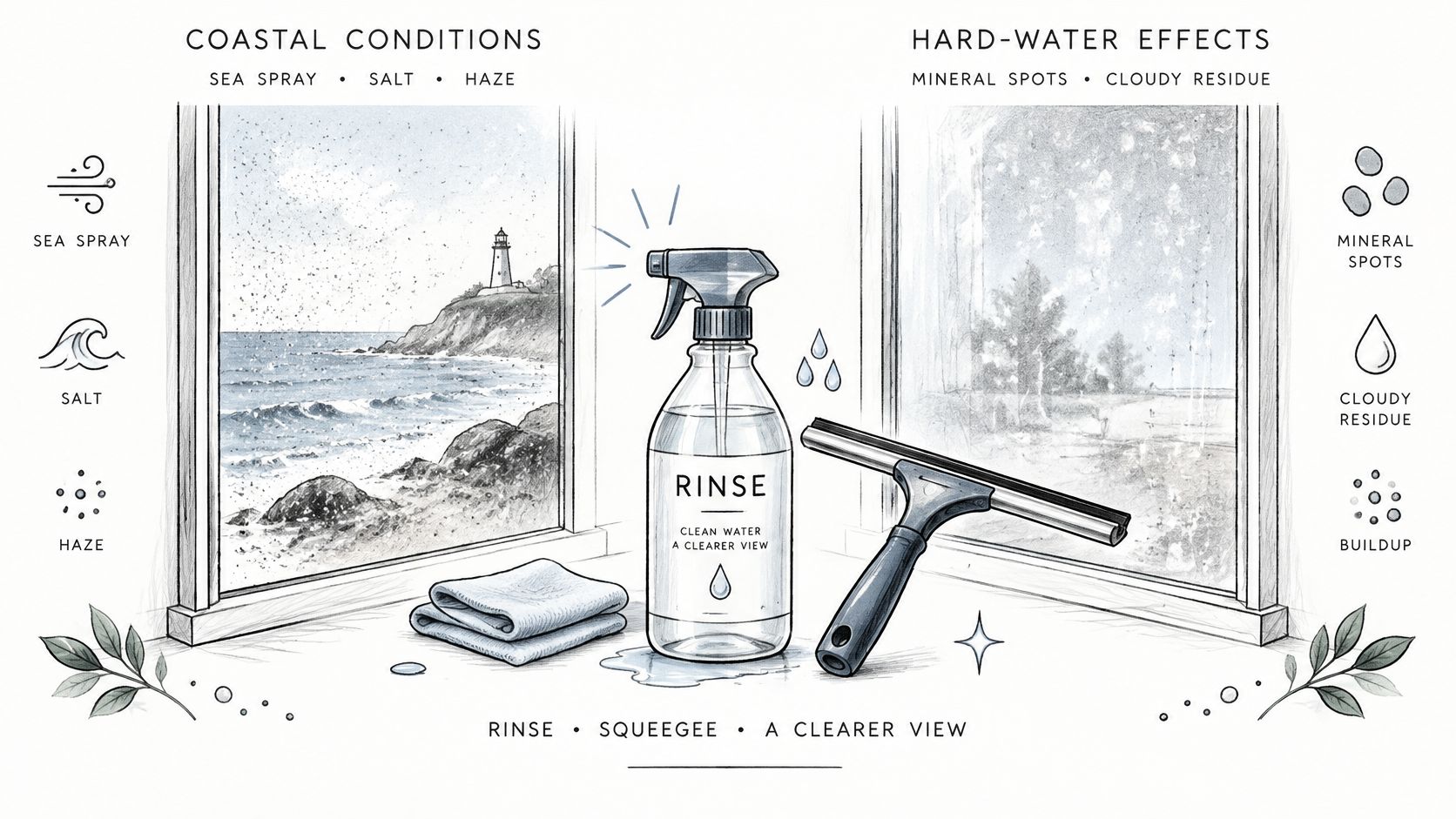
Coastal salt and dry-season dust
Coastal glass carries salt aerosol, often mixed with windborne dust. On Ventura and Santa Barbara coastal properties, washing straight into that buildup loads the scrubber and bucket unnecessarily. Rinse loose contamination away before applying the low-residue wash. The useful change is the pre-rinse, not a stronger soap mixture.
Field dust is mineral grit, not something to polish off with a dry cloth. We never recommend dry-wiping it across the pane, because the cloth grinds that grit over the glass. Wet and flush the surface before washing, then replace contaminated wash water rather than carrying it from window to window. The change is wet removal before wiping.
Homes beside the coast or under trees need cleaning more frequently than sheltered homes. Screens, frames, and sills also hold contamination that can wash back onto freshly cleaned glass. Treat the window assembly as part of the job, not just the transparent middle.
Sprinkler deposits and sensitive surrounds
Sprinkler spots may be mineral scale, not detergent film. Purified water is used to lift mineral spots and dries without leaving streaks, but persistent established deposits need assessment rather than a promise that another rinse will dissolve them. Our guide to removing hard-water spots from windows explains the treatment decision. The change is mineral-specific treatment, not extra surfactant.
Sensitive trim and stone surrounds restrict your options. A cleaner that’s acceptable on bare glass can still harm adjacent finishes through drips or overspray. Avoid acids around marble and limestone, protect surrounding materials, and test a discreet area first. The change is choosing for the whole assembly.
Hot and sun-exposed panes
Warm glass shortens your working time. Clean the shaded elevation first, work early when practical, and wash smaller sections so the solution remains wet until removal. Don’t compensate for rapid drying by making a richer detergent mixture.
A clean blade and fresh wash water become especially important when drying is fast. If you can’t maintain a wet surface through the pass, postpone that elevation rather than repeatedly dragging rubber across drying cleaner. The change is timing and section size, not chemical strength.
Verdict and Next Step
For most homes, choose a commercial low-residue concentrate diluted exactly to its label. It offers a more repeatable starting point than an improvised mixture whose strength changes with every squeeze of the bottle.
For tall exterior glass, recurring mineral spotting, or coastal haze that survives routine washing, consider a purified-water pole system or a compatible chelant-containing formula. Don’t assume either method will reverse established scale or damage to the glass.
Let the dry finish make the decision
Keep using a simple home mixture when the test pane dries clear, the glass is accessible, and the property is sheltered from demanding outdoor conditions. Repeat that check with a fresh batch or a different product. A mixture that worked last time still needs to suit today’s soil and temperature.
Change course when the pane keeps showing film, defined spots, or blade lines after you’ve checked the rubber and corrected the working conditions. Coastal exposure, construction grit, tree debris, and difficult access can make repeated DIY attempts a poor use of time.
- Continue yourself: The finish is clear, access is safe, and the process is manageable.
- Change the method: The contamination needs a different treatment rather than more detergent.
- Book professional cleaning: Repeated washing, tall glass, or uncertain surface compatibility outweighs the saving.
At that point, compare the whole job, including screens, frames, sills, and safe access, rather than the price of a bottle. The right solution is the one that leaves clean glass without creating another cleaning task.
Aloha Window Bros cleans with eco-friendly solutions and professional tools, including purified-water equipment for hard-to-reach windows, and walks through every window with you before leaving. Visit Aloha Window Bros to request a free quote for your Ventura County or Santa Barbara County property and choose a cleaning approach suited to its salt, dust, and mineral buildup.